
What happened
The Big Ear was a large, fixed radio telescope operated by Ohio State University on land near the Perkins Observatory in Delaware, Ohio. It could not be steered; instead it let the rotation of the Earth sweep a strip of sky through its beam, and from 1973 it ran a long, mostly automated search for artificial signals at frequencies near the 1420 MHz emission line of neutral hydrogen, which many SETI researchers considered the natural meeting place for interstellar communication.
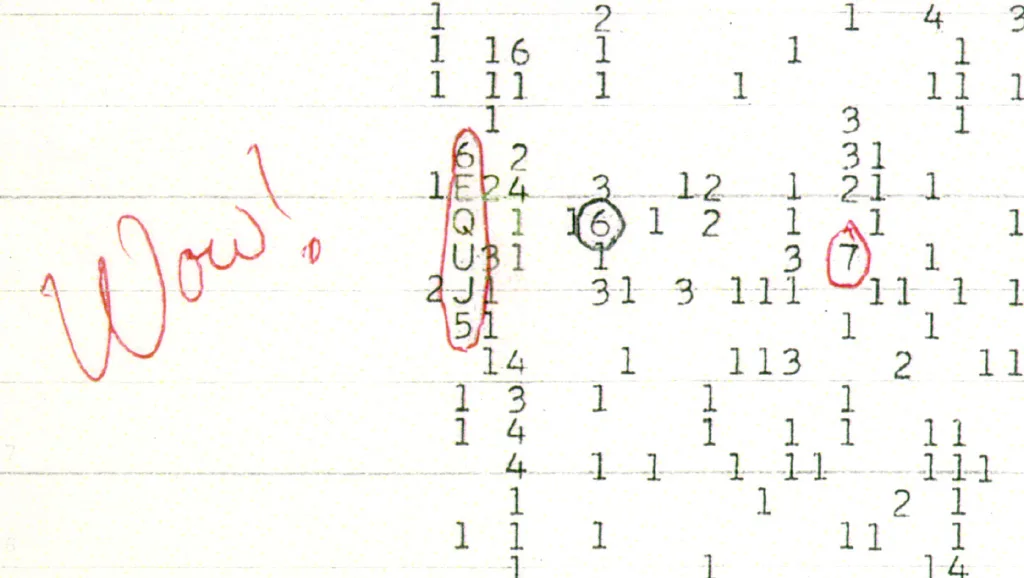
Nobody was at the telescope on the night of August 15, 1977. At about 10:16 p.m. Eastern Standard Time the receiver logged a signal that rose and fell over six consecutive 12-second samples, exactly the pattern a steady point source would produce as the Earth’s rotation carried it across the beam. A few days later Jerry Ehman, a volunteer who reviewed the computer printouts, saw the sequence of characters 6EQUJ5 in one channel, circled it in red, and wrote ‘Wow!’ in the margin. The characters are not a message. They are a compact code for signal strength: each one records how many standard deviations the signal stood above the background noise, and the letter U, the peak, meant roughly 30. The signal was confined to a bandwidth of less than 10 kHz, sat very close to the hydrogen line, and lasted the full 72 seconds that the beam allowed.
The investigation
The Big Ear used two feed horns that looked at adjacent patches of sky about three minutes apart. The signal appeared in only one of them, which should not happen for a source still transmitting a few minutes later. Because the printout did not record which horn saw it, the source position is ambiguous: two possible right ascensions, both at a declination of about minus 27 degrees in the constellation Sagittarius.
Ehman and the observatory staff checked the obvious terrestrial and solar-system candidates. No planet, asteroid, or known spacecraft was in the beam; aircraft and satellites are not supposed to transmit in that protected band and would not have reproduced a fixed-source profile so cleanly; a ground transmission bouncing off a piece of space debris would have required an illegal broadcast and a non-tumbling reflector that held still against the stars. Ehman’s own 20th-anniversary report concluded that such explanations were ruled out or improbable but that too little data existed to draw firm conclusions. The Big Ear re-scanned the same strip for weeks without success, and later searches by Robert Gray with the META system and the Very Large Array in the 1980s and 1990s, and with a telescope in Tasmania in 1999, also found nothing. The signal has never been detected again.
The explanations
The most publicized natural explanation came from Antonio Paris of the Center for Planetary Science, who proposed in 2016 that hydrogen gas streaming from one of two comets, 266P/Christensen or P/2008 Y2 (Gibbs), had been in the right part of the sky in 1977. In a 2017 paper he reported detecting a signal at 1420.25 MHz from 266P with a 10-meter dish and declared the case closed. The response from the original team was blunt. In a statement dated June 6, 2017, Robert Dixon, director of the Ohio State SETI program, pointed out that ephemeris data placed both comets roughly 47 to 55 minutes of right ascension from the Wow! position when the Big Ear’s beam was only about three minutes wide, that no strong hydrogen emission from a comet had ever been documented, and that a slow-moving comet could not have been bright in one horn and absent from the other. SETI Institute scientists made the same points. Paris’s claim is generally regarded as rejected.
In 2024 a group led by Abel Méndez of the Planetary Habitability Laboratory at the University of Puerto Rico at Arecibo offered a different idea. Reviewing archived drift scans from the Arecibo telescope made in 2020, they found many narrowband signals near the hydrogen line that resemble the Wow! signal in shape but are about a hundred times weaker, and traced them to small, cold clouds of interstellar hydrogen. They suggested that a sudden flash from a magnetar or soft gamma repeater could have briefly stimulated one such cloud into a maser-like flare, producing a one-off burst of the right strength and bandwidth. The team has since reanalyzed the Big Ear archives and reported that the 1977 signal was stronger than earlier estimates. The authors are careful to describe this as a hypothesis, and no such hydrogen flare has been caught in the act.
Where it stands
The Wow! signal remains the strongest candidate ever logged by a SETI search and also one of the least informative, because a single 72-second detection with no repeat cannot be tested against most predictions. Nothing in the record requires an artificial origin, and the natural hypotheses on the table are plausible but unconfirmed. Until something similar is recorded with modern instruments, the honest position is the one Ehman himself took: the data are consistent with a signal from beyond the solar system, and they are not enough to say what sent it.