October 19, 2026

The Wow! Signal

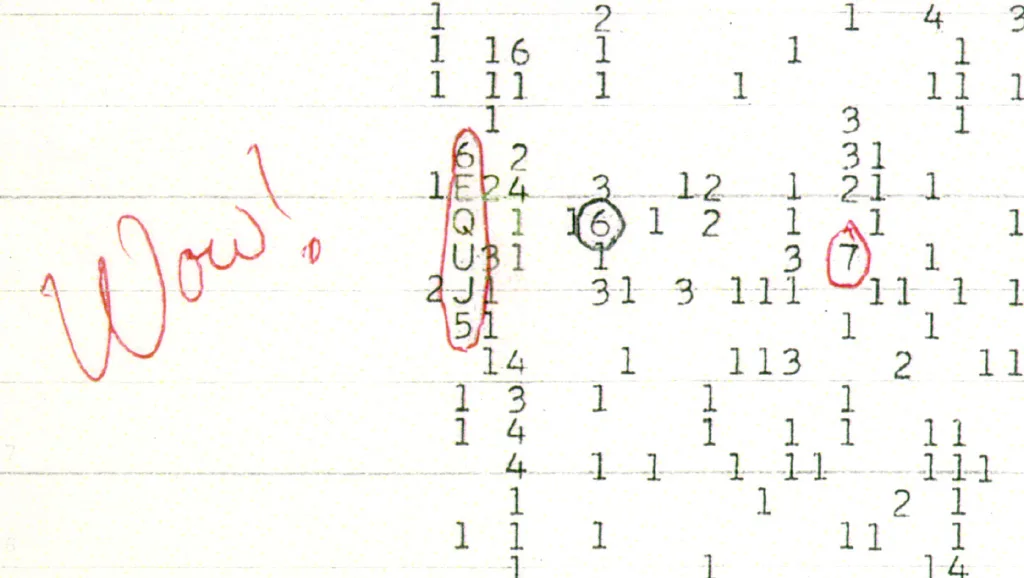
On August 15, 1977, the Big Ear radio telescope in Ohio recorded a strong, narrow signal near the hydrogen line from the direction of Sagittarius. Volunteer Jerry Ehman circled the printout and wrote ‘Wow!’ beside it. Decades of follow-up observations have never found it again, a 2017 comet explanation was rejected, and a 2024 hypothesis involving a flaring hydrogen cloud remains untested.

October 19, 2026

The Tunguska Event

At about 7:15 on the morning of 30 June 1908 a fireball crossed the Siberian sky and exploded above the Podkamennaya Tunguska river, flattening some 2,000 square kilometres of forest. The first scientific expedition did not reach the site until 1927 and found no crater. The event is now understood as an airburst, though the exact nature of the object is still debated.

October 19, 2026

The Max Headroom Signal Hijacking

On November 22, 1987, someone in a Max Headroom mask broke into the signals of Chicago’s WGN-TV and, two hours later, PBS station WTTW, where the takeover ran about 90 seconds with audio. The FCC opened a criminal inquiry and the FBI took part, but no suspect was ever named. The statute of limitations has long since run out.

October 19, 2026

The Mad Gasser of Mattoon

Between August 31 and September 13, 1944, more than two dozen households in Mattoon, Illinois, reported a sweet odor in the night followed by nausea, dizziness and numb legs, and several people said they saw a man running away. Police, state investigators and the FBI found no gas and no gasser. A 1945 study called it a textbook case of mass hysteria; a similar wave had swept Botetourt County, Virginia, in the winter of 1933–34.

October 19, 2026

The Loch Ness Surgeon’s Photograph

The most famous image of the Loch Ness Monster, published by the Daily Mail on April 21, 1934 and credited to a London doctor, was for sixty years the best evidence that something lived in the loch. In 1993 Christian Spurling, stepson of a big-game hunter the Mail had humiliated, confessed that he had built the ‘monster’ from plastic wood on a toy submarine. The photograph is a hoax; the loch’s other sightings stand or fall on their own.

October 19, 2026

The Hinterkaifeck Murders

On the night of 31 March 1922 the Gruber family and their new maid were killed one by one at Hinterkaifeck, a farm north of Munich. For days beforehand the farmer had found footprints leading to the house but not away, and heard someone moving in the attic. More than a hundred suspects were examined. Nobody was ever charged.

October 19, 2026

The Hessdalen Lights

Since late 1981 residents of Hessdalen, a valley in central Norway, have reported bright lights that hang in the sky or dart along the mountainsides. A volunteer research project began in 1983 and has run an automated monitoring station since 1998. Physicists have proposed everything from burning dust to a natural battery, but no theory has yet been confirmed.

October 19, 2026

Flannan Isles Lighthouse

On 26 December 1900 a relief boat reached the Flannan Isles lighthouse and found it empty. The three keepers were never seen again. The Northern Lighthouse Board concluded they were probably swept off the west landing by a huge wave, but nothing was ever recovered to confirm it.

October 19, 2026

Enfield Poltergeist

From August 1977 a council house in Enfield, north London, became the scene of knocks, moving furniture and a gruff voice that spoke through 11-year-old Janet Hodgson. Investigators from the Society for Psychical Research recorded hundreds of hours of tape. The girls later admitted faking some events, and sceptics argue the rest was never observed under controlled conditions.

October 19, 2026

The Dancing Plague of 1518

In July 1518 a woman known as Frau Troffea began dancing in a Strasbourg street and could not stop. Within a month contemporary chronicles put the number of dancers at around 400. The city first encouraged the dancing, then banned music and sent the worst cases to a shrine of Saint Vitus. Modern historians favor a psychogenic epidemic in a population worn down by famine and disease; ergot poisoning is now largely rejected.