
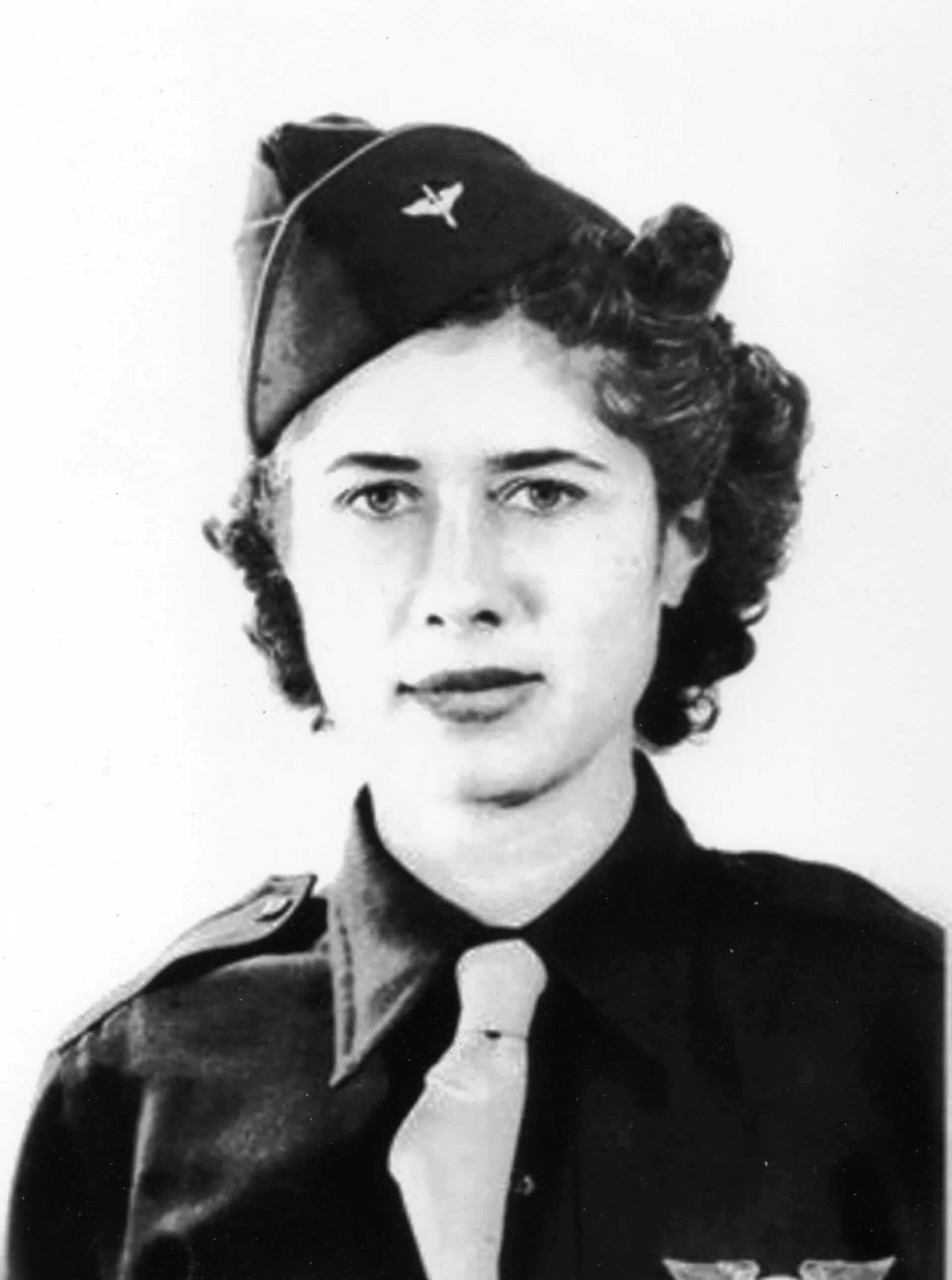
Of the 38 Women Airforce Service Pilots who died in the Second World War, 37 came home in some form. The exception is Gertrude Tompkins Silver, known to her friends as Tommy, who took off from a Los Angeles airfield in a brand-new fighter on the afternoon of October 26, 1944. Neither she nor the airplane has been seen since.
Who she was
Gertrude Vreeland Tompkins was born in Jersey City, New Jersey, on October 16, 1911, the daughter of a chemist whose company, Smooth-On, did well enough to move the family to Summit. As a child she stammered badly and, according to her sister Elizabeth, worked hard to master it. She trained in horticulture before she discovered flying, and joined the WASP, the civilian program that trained women at Avenger Field in Sweetwater, Texas, to ferry military aircraft, tow targets and test repaired planes so that male pilots could go overseas. She logged more than 500 hours and was trusted with fast fighters such as the P-51. In September 1944 she married Henry Silver, an Army technical sergeant, and went back to duty two days after the wedding. They never met again.
The last flight
In October 1944 Tompkins was one of several WASPs sent to North American Aviation’s factory beside Mines Field, the site of today’s Los Angeles International Airport, to collect new P-51D Mustangs bound for Newark, New Jersey, and shipment to Europe. Ferry pilots flew in daylight only, so the trip took several days; her first stop was to be Palm Springs, although a 1997 Los Angeles Times account names Tucson. Before leaving she taxied aside to have her cockpit hatch repaired. She was cleared to take off at about 4 p.m. and climbed westward over the ocean into an overcast and a bank of coastal fog. Nobody in the tower watched her go, and the tower never heard from her.
Her flight plan was misplaced. Because nobody at Palm Springs was expecting her, no alarm was raised that night, and the other pilots in her group carried on east. By most accounts it was four days, on October 30, before anyone realized she was missing. The Army Air Forces then searched the deserts and mountains along her route and the waters of Santa Monica Bay, where a military boat carried her new husband. Nothing was found, and in November she was declared missing and presumed dead.
The searches
The case lay largely forgotten until the 1990s, when members of her family approached G. Pat Macha, a Hawthorne high school teacher who had spent decades locating old crash sites in California. Working from weather records, military files and the airplane’s characteristics, Macha concluded that she probably never left the bay. The P-51D had a large fuel tank behind the cockpit; full, it moved the center of gravity aft and could make the airplane hard to control at low speed. A stall shortly after takeoff, or disorientation on breaking out of the cloud into the low sun, could have sent her into shallow water off what is now Dockweiler State Beach, probably within about a mile of the runway.
A sonar survey in 2001 marked an object buried in the general area. In October 2009 a larger effort, organized with the volunteer Missing Aircraft Search Team, put three boats on the bay with side-scan sonar, a remotely operated vehicle and teams of divers working through dozens of targets compiled from earlier surveys. The team said it had interviewed a man who, as a boy, may have seen the crash. Further dives followed in January 2010. None of them was the Mustang. In 2019 the Discovery Channel series Expedition Unknown searched both the departure corridor offshore and, inland, the San Jacinto range that stands between the coast and Palm Springs, again without result.
The explanations
The ocean theory has the most behind it: the takeoff direction, the weather, the airplane’s handling and the complete silence from the land search all point that way. Its weakness is that it has never been proved, and Macha himself has not ruled out a crash in the mountains near Palm Springs. One printed claim can be set aside. A 1991 history of the WASP said her remains had been found in her wrecked plane years later; no record supports it.
Where it stands
In 2010 the surviving WASPs, and Tompkins posthumously, received the Congressional Gold Medal. Her sister Elizabeth, the family’s link to the search, died that August at 101. The P-51 is presumed to lie under sand in Santa Monica Bay, a few minutes’ flight from one of the busiest airports in the world, but until a piece of it is recovered, Tommy Tompkins remains the only WASP still listed as missing.