
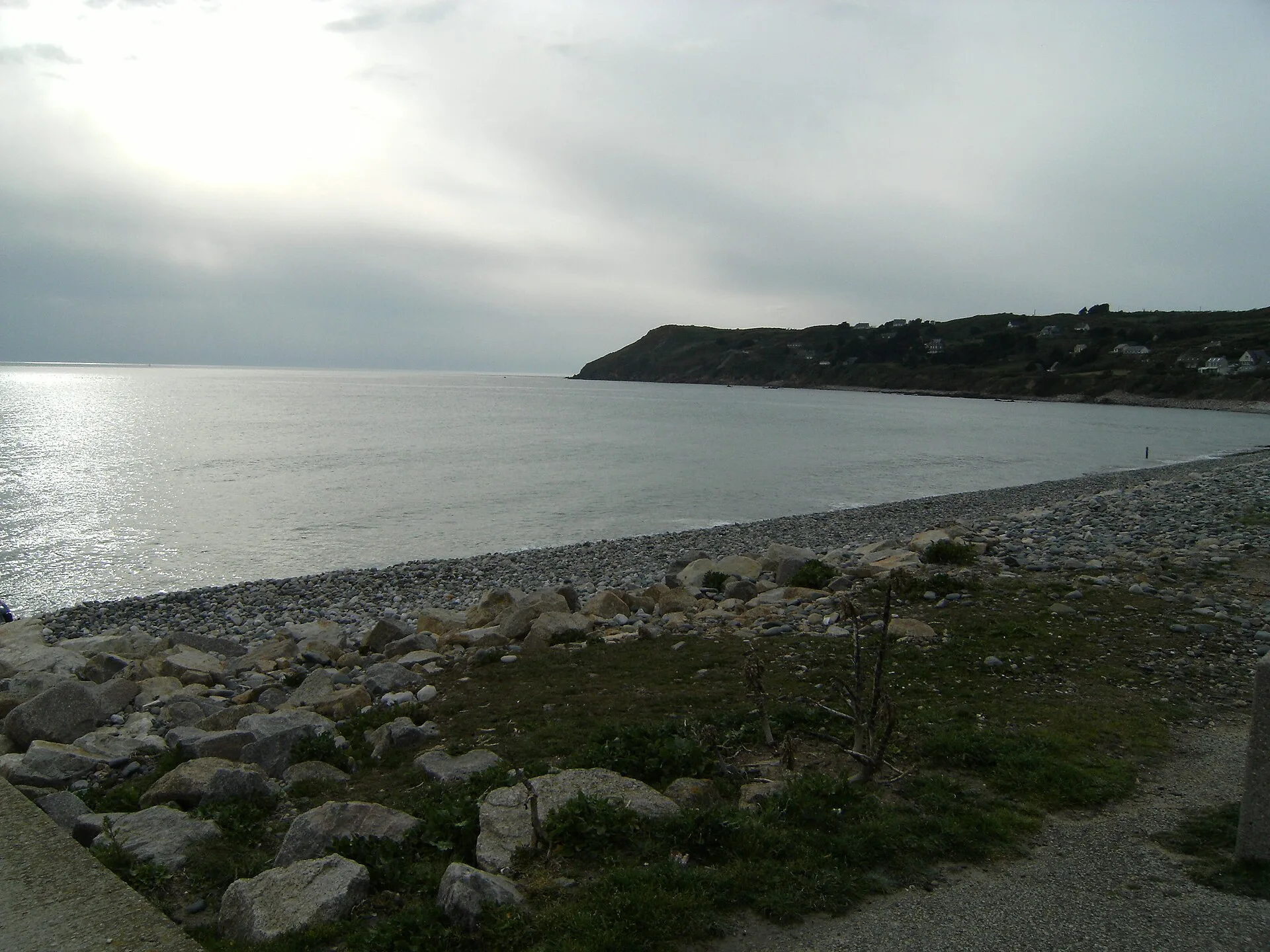
On the morning of October 17, 1917, a three-masted English trading vessel was found aground at Rozel Point on the Cotentin coast of Normandy, south of Cherbourg. She was upright and largely undamaged, some of her sails were still set, her boat was still on deck and her log was aboard. Her name was Zebrina, and the five men who had sailed her from Falmouth two days earlier were nowhere to be found. The case has since been retold as the “Mary Celeste of the First World War,” and in recent years as the story of a ghost ship.
The ship and her crew
Zebrina was built at Whitstable in Kent in 1873, a wooden vessel of about 189 tons with the flat bottom and square-sectioned hull of a barge but the three masts of a seagoing ship. Accounts describe her rig variously as a schooner, a brigantine or a barquentine. She was reputedly meant for the River Plate trade in South America, and spent most of her long life carrying cargo around the British coast and across the Channel. She was known as slow when sailing into the wind but quick before it.
By the autumn of 1917 she had a new owner in Liverpool and a new master, Archibald John Martin, 33, of Kent. Martin had already lost one ship to the war: in March 1917 his previous command, Huntleys, had been stopped by the German submarine UC 69 and scuttled off Beachy Head, with her crew allowed to escape. With him on Zebrina were the mate, George Steward, a 69-year-old from Brightlingsea in Essex, and three seamen: W. H. Beck of London, 26; William Bourke, 17; and Martin Faus, 31, from Russia, who had joined only days before.
The voyage
The Arun Valley Postcard Trail, a Sussex local history project, has pieced the voyage together from a 1932 account by the author David Masters and from genealogical research on the crew. Zebrina left Appledore in Devon on September 24, loaded about 300 tons of coal at Swansea for the French port of Saint-Brieuc, and sailed on September 30 so deeply laden that she had less than two feet of freeboard. Bad weather drove her into Falmouth. She tried to leave on October 12 and was back the next day; she finally sailed on October 15 in a light southwesterly breeze. That night thunderstorms were recorded in Jersey, and by the morning of the 16th a squally gale was blowing across the Channel. Some time after that, Zebrina’s crew disappeared. The vessel came ashore on the beach on the 17th.
The explanations
The first explanation was the war. German submarines often stopped small sailing ships, let the crew take to their boat and then sank the vessel. On this reading, a U-boat took Zebrina’s crew aboard, was interrupted before it could sink her, and was itself lost later with the five men as prisoners. The crew’s names were recorded among those lost through enemy action. But no German record has ever been found of an attack on Zebrina, a gale is poor weather for a submarine to work in, and a crew ordered off would normally leave in their own boat, which was still on deck.
Masters, who studied the episode for When Ships Go Down, concluded that the whole crew had gone over the side in a squall. The Arun Valley reconstruction explains how that could happen: a barge-built ship with almost no freeboard, sailing into a gale with waves breaking across her deck, could lose every man working the sails to one heavy sea; with nobody at the helm she would then run before the wind until she grounded. Its authors note that a downwind course from the scene would have taken her past Jersey and Guernsey to a soft landing on the Normandy sand.
How the legend grew
As the story passed into books of unexplained mysteries, details changed. Some versions have Zebrina adrift for days, her crew numbering 23, or her flat hull letting torpedoes pass harmlessly beneath; one suggests the large crew meant she was a disguised naval decoy, a Q-ship. The log found aboard records five men, and nothing supports the larger number. Her destination is often misprinted as “Saint Brieux.” The ship herself went back to work: she was refloated, towed to Cherbourg and repaired, fitted with an engine in 1918, and passed through eleven more owners before ending as a houseboat near Portsmouth. Her hull was burned in Velder Creek in Langstone Harbour in 1953.
Where it stands
The disappearance is real, and the five men were never found. No witness saw what happened, so their fate cannot be proved. The record points to an accident at sea in a dangerously loaded vessel during a Channel gale rather than to anything unexplained.