
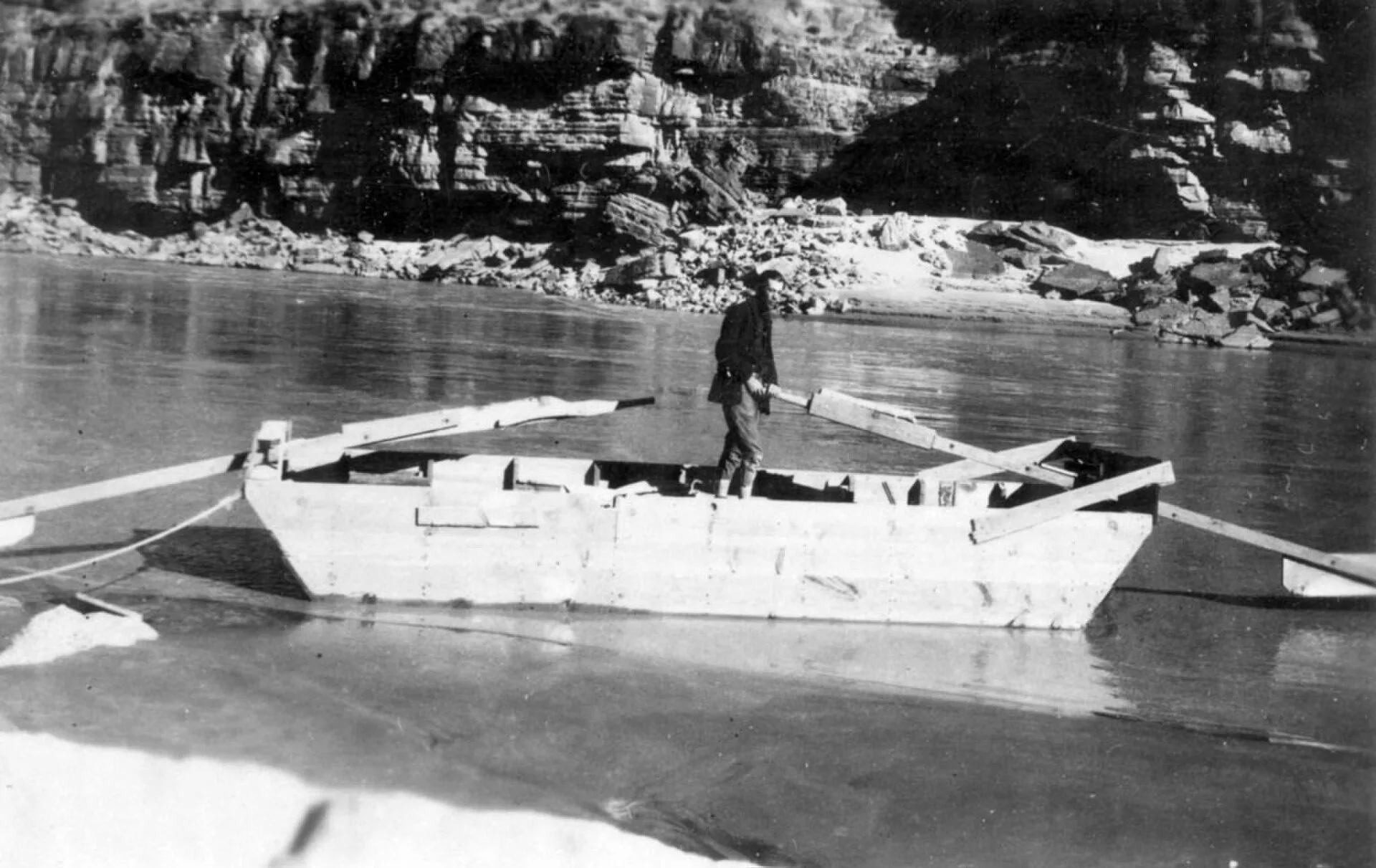
In 1928 there was no commercial boating through the Grand Canyon. The few parties that had made the run were mostly well-equipped survey or scientific expeditions, and no woman was known to have done it. Glen Hyde, a farmer from southern Idaho, and Bessie Haley, a young aspiring artist and poet originally from West Virginia, decided to change that on their honeymoon. They had met aboard a coastal passenger ship in 1927 and married in April 1928, once Bessie’s divorce from a first husband came through. Glen had run Idaho’s Salmon and Snake rivers in the big wooden sweep scows used there, steered by long oars at bow and stern. He meant to take one through the canyon faster than anyone before.
What happened
Glen built a scow about twenty feet long at Green River, Utah, and the couple launched on October 20, 1928. They carried no life jackets, which was not unusual for the time. By mid-November they had come through Cataract and Glen canyons and the upper Grand Canyon, and they climbed the Bright Angel Trail to the South Rim to restock. There they called on Emery Kolb, the photographer and veteran river runner whose studio stood at the head of the trail. Kolb photographed them, a handsome couple in their twenties, and by several later accounts urged Glen to take life preservers. He declined. Around November 18 they pushed off again; a visitor, Adolph Sutro, rode with them for a stretch before getting off at Hermit Rapid. No one is known to have seen them afterward.
When the couple failed to appear at Needles, California, in early December, Glen’s father, Rollin Hyde, raised the alarm and joined the search. In mid-December an aircraft spotted the scow far downstream, and a party that included the Kolb brothers reached it around Christmas near River Mile 237. It was floating upright and intact, its line snagged underwater, still loaded with supplies, the couple’s coats, Glen’s gun and Bessie’s journal. Her notes and the film in her camera showed that they had continued for more than ten days after leaving the rim and had camped as far down as Diamond Creek. The river historian Otis Marston later judged that they were most likely thrown into the water in the rough stretch around Mile 232.
The explanations
The ordinary explanation is drowning: a heavy, awkward boat, two people without life jackets, one capsizing or swamping in big water a few miles from the end of the canyon. Brad Dimock, a Flagstaff river guide and author who built a replica scow in 1996 and took it down the river, concluded that the craft was close to unmanageable in Grand Canyon rapids and that it was remarkable the Hydes got as far as they did.
The story of a quarrel at the rim, used to suggest that Glen was brutal and Bessie unwilling, has been more durable than accurate; Dimock found no credible source for it. It fed the most famous rumor. On a commercial raft trip in 1971 an elderly woman, Elizabeth Cutler, reportedly told fellow passengers that she was Bessie Hyde and had stabbed an abusive Glen and walked out of the canyon. The Arizona Daily Sun later called her claims thoroughly disproved: she was taller than Bessie, she had a documented birth in Ohio, and she later denied ever making them, although they reached a national audience on Unsolved Mysteries in 1987. A second rumor followed the death in 1992 of Georgie White Clark, a celebrated river runner, when friends sorting her belongings found documents relating to the Hydes, a pistol, and papers showing that her own original first name was Bessie. Clark’s early life is well documented, and nothing has ever placed her on the Hydes’ river trip.
Suspicion even fell on Emery Kolb after a man’s skeleton with a bullet hole in the skull was found in his garage in 1977, shortly after his death. Forensic examination showed it was not Glen, and in 2008 a retired park investigator working with the Grand Canyon Museum Collection matched it to an unidentified man found dead at Shoshone Point in 1933, an apparent suicide.
Where it stands
Neither body has ever been found, and no agency is actively investigating. Every specific claim that one of the Hydes survived has collapsed under examination. That they drowned in the lower canyon in late November 1928 cannot be proved, but it is what the boat, the journal and the river all suggest.