
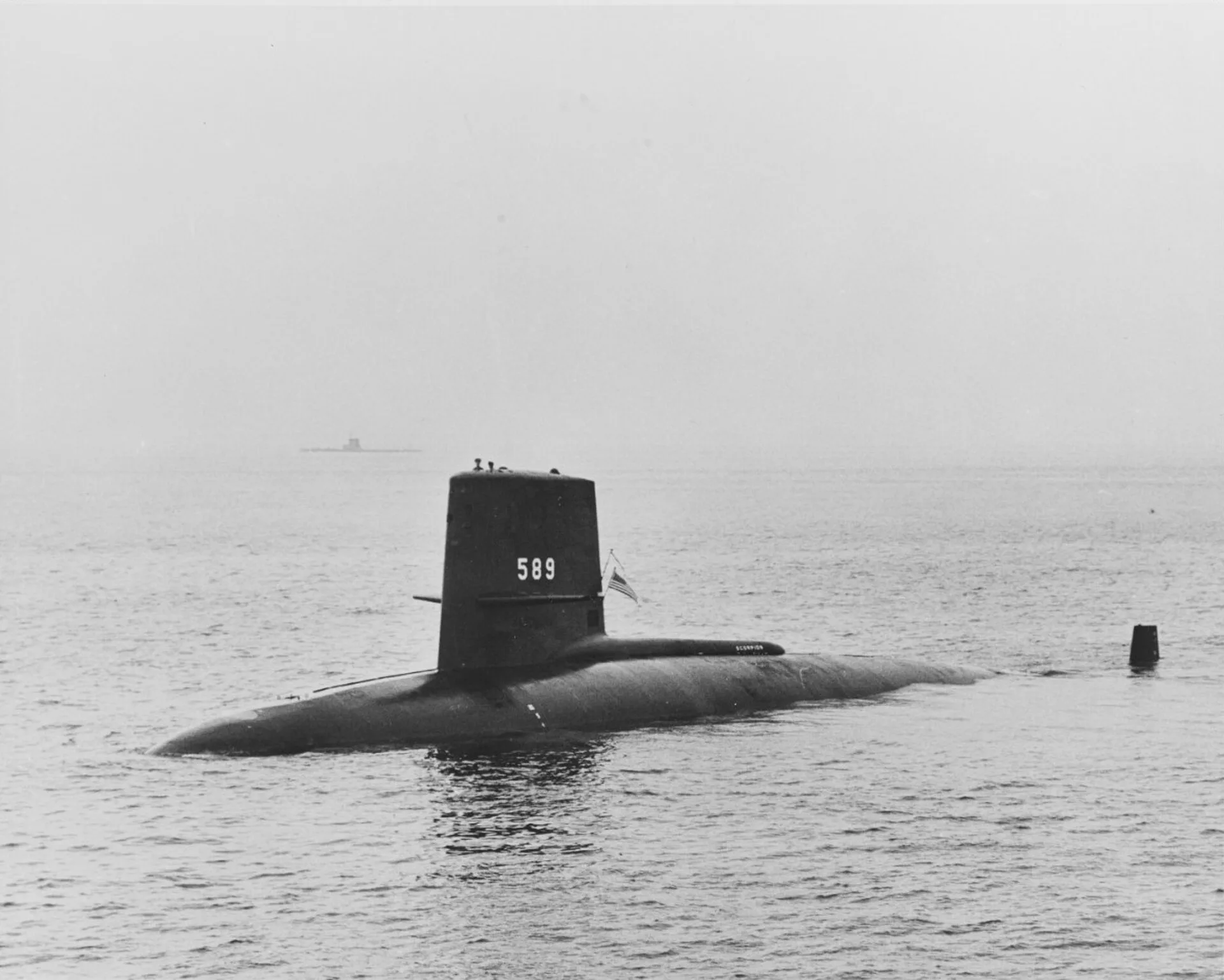
USS Scorpion belonged to the Skipjack class, six nuclear attack boats that were fast, teardrop-hulled boats built for the Cold War contest under the sea. In May 1968 she disappeared in the Atlantic with all 99 men aboard. The wreck was located on the ocean floor that autumn. More than fifty years later the Navy has still not said, with certainty, what sank her, and the gap has been filled with theories ranging from a faulty valve to a Soviet torpedo.
What happened
Scorpion left Norfolk, Virginia, in February 1968 for a Mediterranean deployment with the Sixth Fleet. Heading home in mid-May, she slipped out past Gibraltar and paused off Rota, Spain, to drop off two crewmen and some messages. Once in the Atlantic she came under Vice Admiral Arnold Schade, commander of the Atlantic submarine force, who on May 20 diverted her toward a small group of Soviet ships, including an Echo II nuclear submarine, gathered southwest of the Canary Islands. On the evening of May 21 her radioman sent what proved to be her last message, giving her position southwest of the Azores and an arrival time at Norfolk of 1 p.m. on May 27.
On the 27th families waited on the pier in the rain. When Scorpion failed to answer routine signals about tugs and berthing, the Navy declared her missing and launched a search by dozens of ships, submarines and aircraft along her expected track. According to the historian Mark Bradley, senior officers had already begun a quiet search on May 24, and by the 28th classified underwater sound recordings had convinced them that the boat had suffered a catastrophic event on May 22 and been crushed as she sank. On June 5 the Navy declared her presumed lost with all hands. At the end of October the oceanographic ship Mizar found and photographed the broken hull roughly two miles down, some 400 miles southwest of the Azores. The bathyscaphe Trieste II made nine dives to the wreck the following summer.
The investigation
A court of inquiry under retired Vice Admiral Bernard Austin, who had also led the inquiry into the 1963 loss of USS Thresher, heard weeks of testimony, reconvened after the wreck was found, and studied thousands of photographs. It concluded that the certain cause could not be determined. It set aside a Soviet attack, sabotage, collision and reactor accident, among others, and was less sure about a weapons accident. The months before had given reason for concern: in December 1967 the crew had ejected a Mark 37 torpedo whose motor started accidentally in its tube.
Much of the court’s record stayed classified until 1993, when its findings of fact turned out to put torpedo accidents at the head of its list of possible causes: a Mark 37 that started running in its tube, a weapon launched by mistake, or one set off by stray voltage. A technical group led by the Navy scientist John Craven read the sound data as showing Scorpion heading east, not west, at the moment of the first blast, and argued that she had made an emergency turn to shut down a torpedo that had started itself, only for it to circle back and hit her. Senior admirals and the Navy’s weapons bureau disputed it. In 1970 a Navy Structural Analysis Group went over the wreck photographs and recovered debris. It found the torpedo room intact, noted that the sound recordings lacked the bubble pulse that any underwater explosion produces, and reported signs that the main battery had exploded before its compartment flooded.
The explanations
Three accounts have dominated since. The torpedo theory has Craven’s acoustic reading behind it but sits awkwardly with the intact torpedo room and the missing bubble pulse. A second theory, backed by Scorpion’s former executive officer Robert Fountain, holds that seawater flooded in through a fault such as the trash disposal unit, which had leaked before, and reached the battery; Bradley notes that the boat had not received the full SUBSAFE modifications introduced after Thresher, including an emergency ballast-blow system. A third, set out by Bruce Rule, for decades the Office of Naval Intelligence’s lead acoustic analyst, uses the 1970 metallurgical findings and a 2008 reanalysis of the recordings to argue that two small battery explosions inside the hull crippled her depth control at 18:20 GMT on May 22, and that the hull collapsed at about 1,500 feet some 22 minutes later. Rule found no sign of any explosion outside the hull.
The Soviet theory, set out in books by the journalist Ed Offley and the former submariner Kenneth Sewell, who suggest Scorpion was sunk in retaliation for the loss of the Soviet submarine K-129 that March, rests on the boat’s mission and the long secrecy rather than on physical evidence. The Austin court rejected it, Bradley judges that the Soviet navy lacked the capability at the time, and the US kept Scorpion’s sister ships in front-line service for nearly two decades.
Where it stands
Officially, the cause of the loss remains undetermined; later reviews, including a second structural analysis in 1987, did not change that. The weight of the technical evidence favors an internal accident, most likely involving the battery, over hostile action, but no account has been proven.