
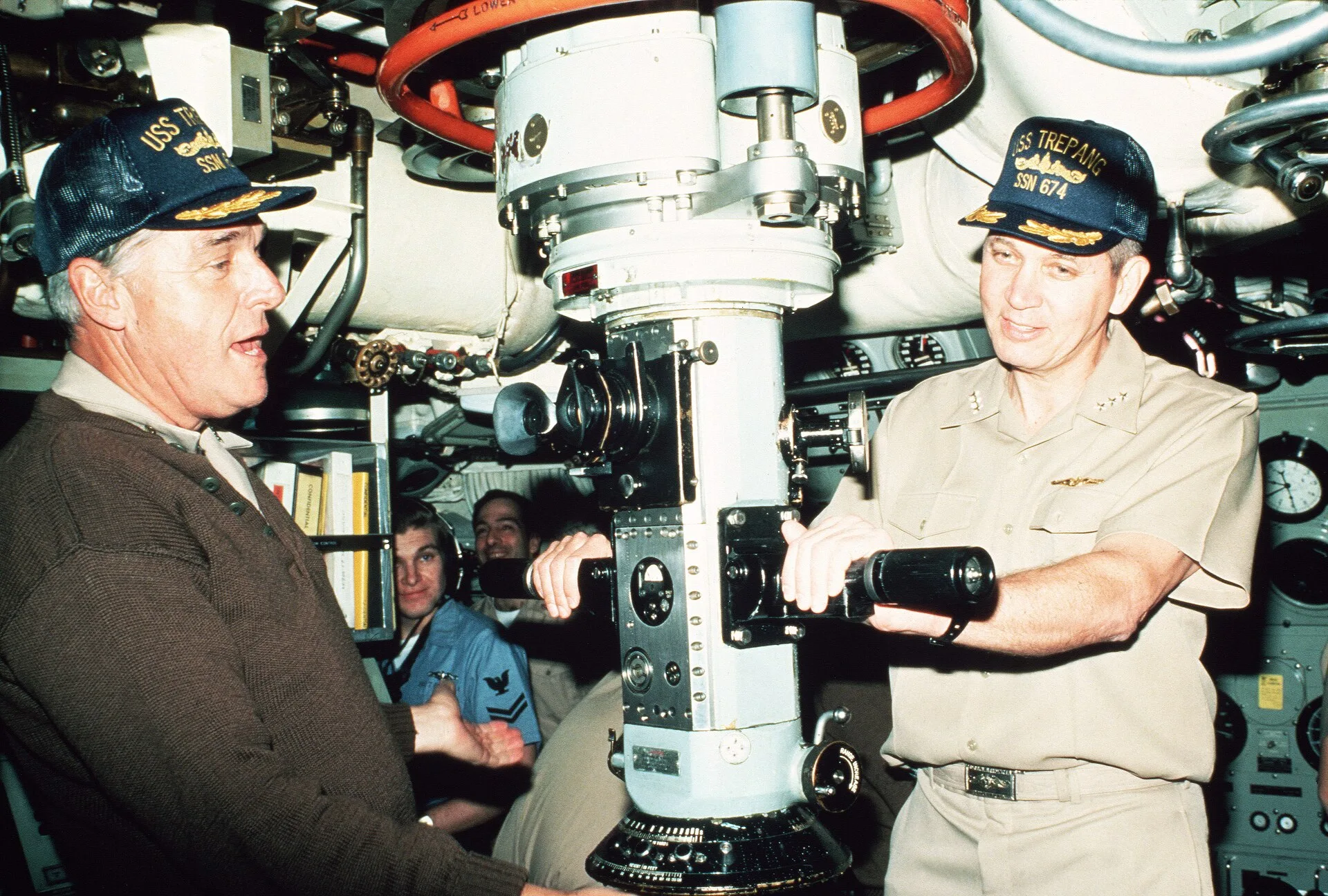
Few UFO pictures arrive with a better pedigree on paper than the Trepang set: a nuclear attack submarine, a named captain, a named lookout, a precise month and a stretch of Arctic water, plus security stamps in the corners. Every element of that pedigree, however, came from one anonymous letter, and none of it has survived contact with the people it names.
What the photographs show
The images are black-and-white and grainy, framed like views through a periscope, some with a crosshair reticle. They show a gray sea and sky and, above the water, a variety of objects: a long cigar that seems to be bursting or rising from the surface, a dark triangular shape, and an egg-shaped body apparently falling into the sea. They first appeared in print in the French paranormal magazine Top Secret, which said it had received them, with a covering letter, from a source it did not identify. The magazine itself was unsure what order they belonged in, whether the craft were entering or leaving the water, and whether one picture was simply too good to be real.
The letter’s claims, as relayed by the researcher Alex Mistretta to The Black Vault archive in mid-2015, were that the photographs were taken in March 1971 from USS Trepang (SSN-674), between Iceland and the Norwegian island of Jan Mayen, during a joint military and scientific expedition; that a crewman named John Klika first saw the object through the periscope; and that an admiral, Dean Reynolds Sackett, was aboard. Faint marks on some prints were said to read “Official Photograph. Not to be released” and to warn of criminal sanctions for unauthorized disclosure under a security certificate for SSN 674.
Checking the story
Part of it checks out, which is why the photographs traveled so far. The Navy’s official history of Trepang records that the submarine went to the Arctic early in 1971 and from February 22 to March 22 operated under the polar ice, testing its weapons systems and studying the ice cap, before returning to New London by way of Faslane in Scotland. Its first commanding officer was Commander Dean Sackett Jr., who later became a rear admiral. A John Klika did serve aboard.
The people did not confirm the rest. Contacted in July 2015 by a former Navy pilot working with Mistretta, Sackett said he had seen only ice; after looking at the photographs he said he could not identify what they showed and that nothing unusual had been seen. Klika confirmed he was aboard in March 1971 and said neither he nor anyone else saw anything strange in the Arctic. Mistretta concluded that Trepang was not involved in taking the pictures, though he left open what they did show.
Tim Printy, a former submariner who publishes the skeptical newsletter SUNlite, pointed out that the letter’s details read like an outsider’s. Klika was an enlisted interior communications technician, not the officer who would normally man the periscope at depth, and the “admiral aboard” was simply the commanding officer, whose later rank the writer had read backward into 1971. Most of the true details, Printy noted, were available online. In June 2017 the Belgian researcher Wim van Utrecht circulated his finding that one of the frames contains two identical patches of cloud, a mark of digital copying that would not occur in a genuine periscope photograph.
Where it stands
The photographs resurfaced on social media in 2024, labeled as official Navy pictures. A Navy spokesman told PolitiFact the service was unable to verify them as official Navy photographs, and Sackett, then 89, said there were no sightings and that the story was not accurate. PolitiFact rated the claim false. With no known photographer, no original negatives, denials from the two named witnesses and evidence of manipulation in at least one frame, the Trepang set is best regarded as a fabrication built around a real submarine’s real voyage.