
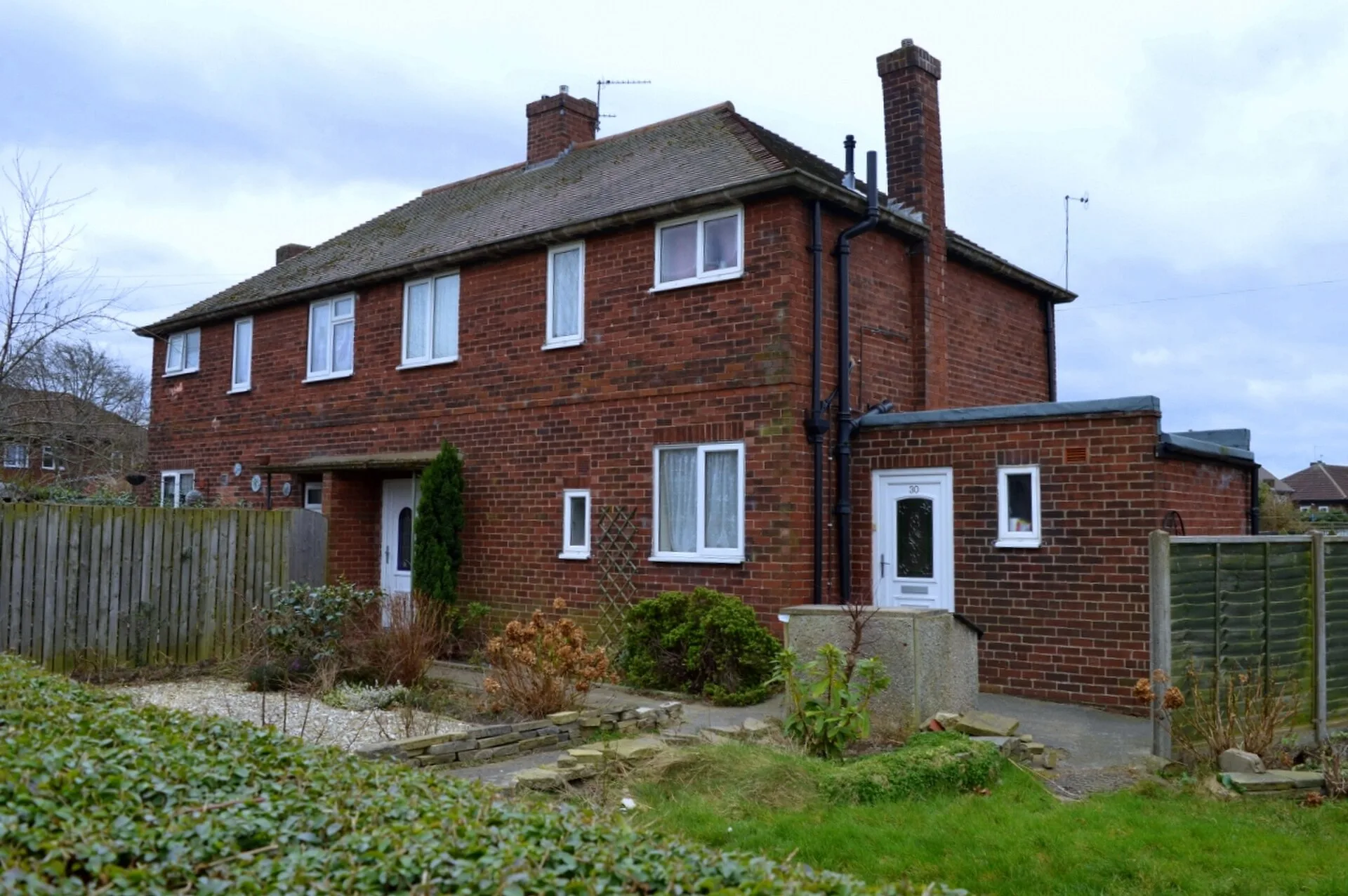
The Chequerfield estate in Pontefract, West Yorkshire, is a postwar development of council houses on the edge of a market town best known for its ruined castle and its licorice. Number 30 East Drive is an ordinary semi-detached house on that estate. In the late 1960s it became the setting for what its promoters now call Britain’s most violent poltergeist, a case known as the Black Monk of Pontefract.
What happened
The Pritchard family moved into the house in 1966: Joe and Jean Pritchard, their teenage son Phillip and their younger daughter Diane, with Jean’s mother staying for periods. The best-known account, assembled by the writer Colin Wilson from interviews with the family and their neighbors more than a decade later, describes two separate bursts of activity. The first came in the late summer of 1966, while the parents were away on vacation and the son and grandmother were at home. A fine white powder was said to drift down through the air of the living room, pools of water kept reappearing on the kitchen floor, and green froth spurted from the taps. The disturbances stopped after a few days.
Two years later, by Wilson’s account, they returned and lasted for months, now centered on the daughter. The list of reported incidents is long: crockery and ornaments thrown, furniture overturned, lights switched off, a heavy grandfather clock sent down the stairs, plants uprooted from their pots, photographs slashed, sugar and paint spilled, loud crashes at night. Relatives and neighbors said they saw some of it. The most serious claim is that Diane was dragged up the staircase by an unseen force. The family nicknamed the presence Fred, and some witnesses described a tall figure in a dark monk’s habit.
The investigation
There was no scientific investigation at the time, and no contemporary report by a psychical research society has surfaced. Wilson’s version includes a local clergyman who came to the house to discuss an exorcism. Pat Holden, a film director whose aunt’s family lived in the house, told Screen Daily in 2012 that he was eight or nine at the time, that the story was famous in the town, and that police, neighbors, relatives, priests and even the mayor had seen something at first hand. That is his description; none of those witnesses left a contemporary written account that has been published.
Most of what is known therefore rests on recollection gathered years after the event. Wilson interviewed the people involved and published the case as the centerpiece of his 1981 book Poltergeist! A Study in Destructive Haunting, presenting it as among the strongest cases in Europe. The book is the source for nearly every later retelling, including the monk.
The explanations
The monk is the weakest part of the story. Wilson linked the figure to a legend that a Cluniac monk from Pontefract’s medieval priory was hanged on gallows that once stood on the land, for the rape and murder of a girl. No documentary record of such a hanging has been produced, and the legend appears to have been attached to the case after the fact to explain the figure in the habit.
For the poltergeist itself, Wilson argued for a force that drew on the energy of adolescents in the house, and his own theories ranged as far as underground water and earth energies. Skeptics treat poltergeist cases generally as a mixture of misperception, exaggeration over years of retelling, and trickery by someone in the household that no outside observer was present to catch. In this case no outsider documented events while they were happening, so neither the paranormal reading nor a specific ordinary one can be tested. The 1966 and 1968 episodes are known almost entirely from what the family and their circle told Wilson later.
Where it stands
The Pritchards lived in the house for many years afterward. In 2012 Holden released a horror film loosely based on the case, When the Lights Went Out, and said he had embellished the story to fit the genre. The house was later sold, and its owner now rents it to paying ghost hunters for overnight stays, with a waiting list stretching about two years by 2025. Television crews and paranormal groups have filmed there repeatedly. The events of 1966 to 1969 remain unproven: vividly remembered by those involved, but recorded only in hindsight.