
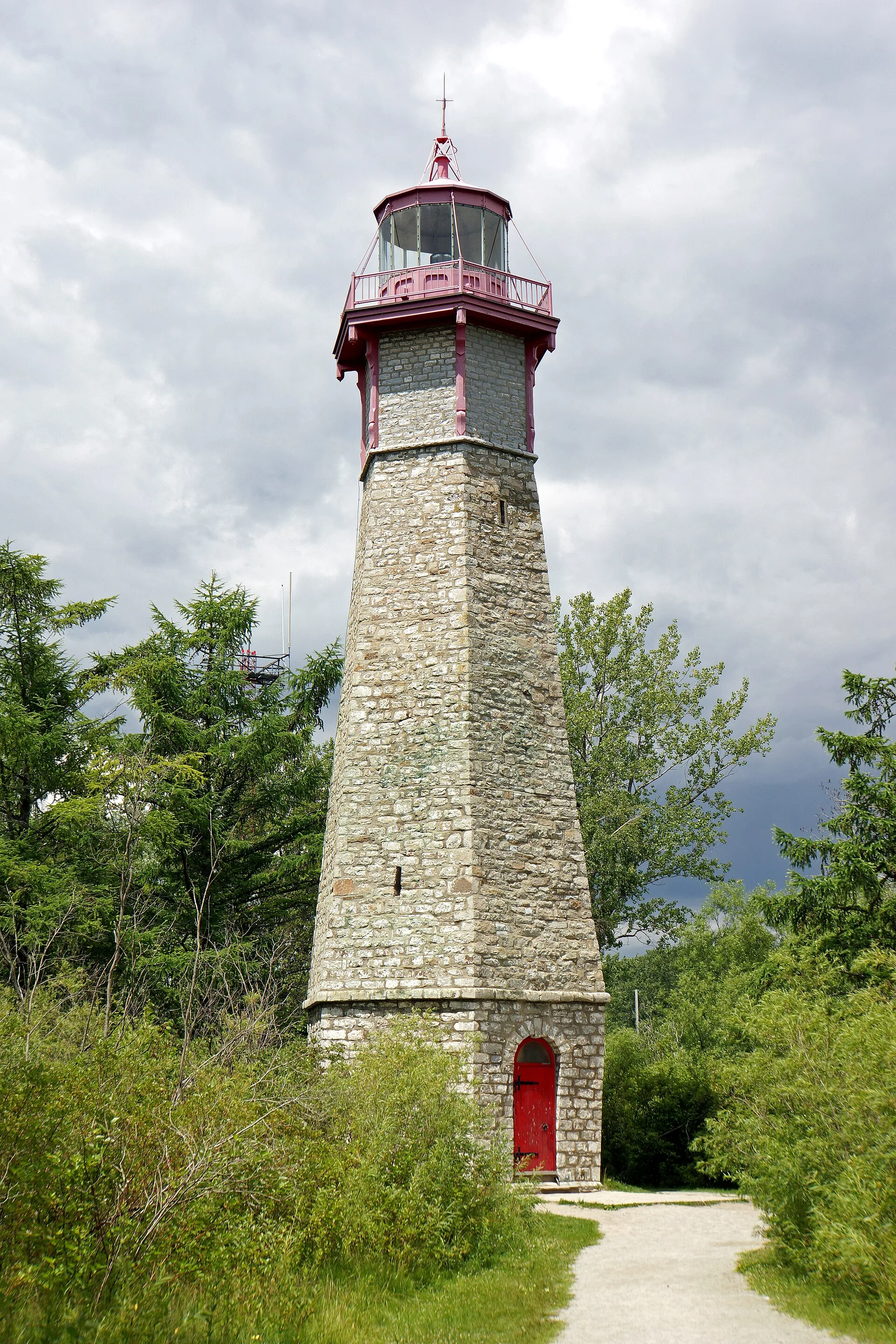
The Gibraltar Point Lighthouse stands among trees near the southwest shore of the Toronto Islands, the chain of sandbars that shelters Toronto’s harbor. Built of stone starting in 1808 and lit in 1809, no older lighthouse survives anywhere on the Great Lakes, and few buildings in the city predate it. It was originally close to the water; shifting sand has since left it well inland. It is also the home of what is probably Toronto’s best-known ghost story, the murder of its first keeper, John Paul Radelmüller.
The legend
The traditional version runs like this. On the evening of January 2, 1815, as the War of 1812 was ending, soldiers from Fort York crossed to Gibraltar Point to buy beer from the keeper, who was said to brew and sell it on the side. They drank too much, he refused to serve them more, and a fight ended with the soldiers beating him to death. To hide the crime they cut up his body and buried the pieces around the lighthouse. Radelmüller was never seen again, and his ghost has climbed the tower stairs ever since, with blood said to seep from one of the steps. Later keepers, visitors and island residents have reported footsteps, moans and a figure in the lantern.
The story first appeared in print nearly a century after the event, in the Toronto publisher and historian John Ross Robertson’s Landmarks of Toronto. Robertson had it from George Durnan, keeper from 1854 to 1908, who had heard it from his father, an earlier keeper. Durnan said that in 1893 he and his uncle had dug west of the lighthouse and found pieces of a coffin and part of a man’s jawbone four feet down in the sand. Robertson did not believe it. He wrote that the story had been embellished in the telling, suspected it was invented entirely, and noted that he could find no record of any soldiers being tried for murder in those years.
The 2015 findings
In December 2015 the historian Eamonn O’Keeffe, who had spent a decade with the Fort York Guard, published the results of a search through the colonial records in the Friends of Fort York newsletter, The Fife and Drum. The core of the legend held up. The York Gazette of January 14, 1815, reported a “horrid crime” at the lighthouse, described the keeper’s death as a barbarous murder and said the men last seen with him had been jailed as the likely killers. Court minute books show that two men, John Blueman (recorded as “Blowman”) and John Henry, were tried for murder on March 31, 1815, before Chief Justice Thomas Scott. Regimental pay lists identify both as Irish-born soldiers serving with the Glengarry Light Infantry, a unit that fought through the war and wore green rather than the red coats of legend. Seven witnesses testified for the prosecution, at least three of them fellow soldiers. Both men were acquitted, and the Gazette announced in April that there had been no conviction. The trial proceedings themselves do not survive.
O’Keeffe also filled in the victim. Born around 1763 in Anspach, in what is now Bavaria, Radelmüller had spent decades as a servant in British royal households, including that of Prince Edward, Duke of Kent, whom he followed to Halifax, before settling at York in 1804. He was appointed keeper in 1809, married in 1810 and had a daughter. Contemporaries described him as gentle and well regarded.
The explanations
The records contradict the most gruesome part of the tale. No source from 1815 suggests the body was hidden or cut up, and the official reports treat his death as a known fact, with a coroner involved. The jawbone and coffin fragments Durnan claimed to find, if they were Radelmüller’s at all, point to an ordinary burial near the lighthouse rather than a scattered corpse. The keeper did not disappear; he was killed, found and buried. The murder probably took place in the keeper’s cottage beside the tower, demolished around 1950, not on the staircase. The ghost reports rest on anecdote, and the story of the haunted step depends on a version of events that the evidence does not support.
Where it stands
The lighthouse was decommissioned in the twentieth century and is now owned by the City of Toronto, which opens it for occasional tours and during Doors Open. Ghost walks and many popular accounts still tell the older story. The murder is real and documented, the killers were never convicted, and the dismembered keeper of legend belongs to folklore.