
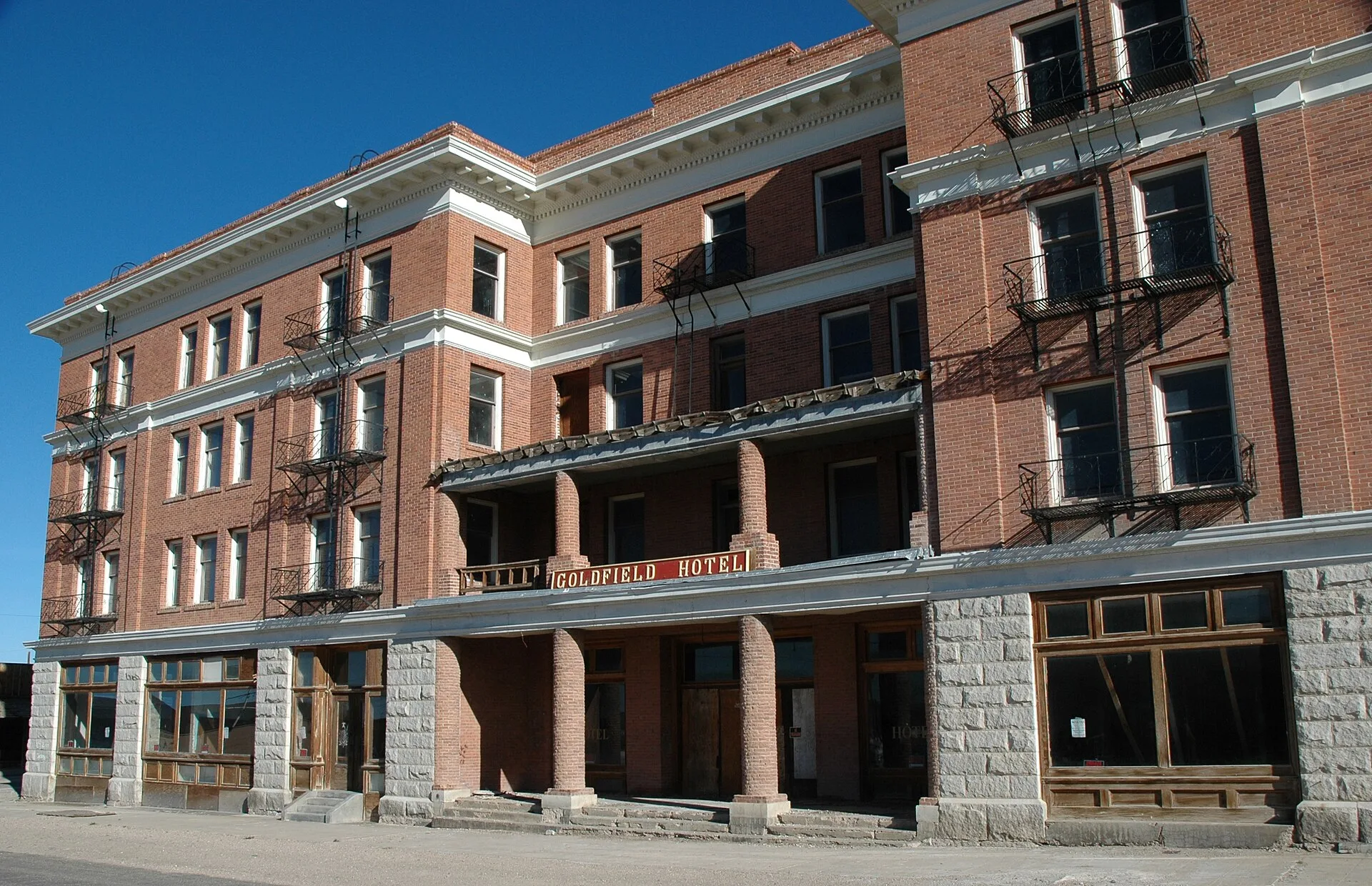
Gold was found near Goldfield, in the high desert of Esmeralda County, in 1902. Within a few years the camp had become the largest town in Nevada, with banks, newspapers, a stock exchange and, from June 1908, a hotel that its backers claimed was the finest between Chicago and San Francisco. The boom was already turning when the doors opened, and the Goldfield Hotel has spent far longer closed than it ever spent taking guests. It is that long emptiness, and a piece of 2004 television, that made it one of the most talked-about haunted buildings in the American West.
What happened
The hotel was designed by the Reno architects Curtis and Holesworth and built between April 1907 and mid-1908 on the site of two wooden hotels of the same name that had burned in 1905 and 1906. It is a four-story U-shaped block, 180 feet along Columbia Street, with a ground floor of gray granite shipped from Rocklin, California, and red brick above. It had about 150 rooms, steam heat from its own power plant, and a mahogany-paneled lobby with crystal chandeliers. The mining magnate George Wingfield, who controlled the Goldfield Consolidated Mines Company, soon held the majority interest through the Bonanza Hotel Company, though his partner Casey McDannell ran the place.
Production at the mines fell off after 1910, the population drained away, and in 1923 a fire took 27 blocks of the town. Newton Crumley, a hotel man from Elko, bought the building that year and in 1925 sank two shafts beneath it hoping for ore; both were dry. By the 1930s the hotel was a cheap rooming house. During the Second World War it housed Army Air Corps personnel from the Tonopah base, and when they left in 1945 it closed and has never reopened. It was placed on the Nevada State Register in 1981 and became a contributing property in the Goldfield Historic District on the National Register in 1982.
The investigation
Owners have come and gone. A San Francisco investor, Lester O’Shea, began a restoration in 1985 that reportedly reached 85 per cent before his company went bankrupt and the property reverted to the county. At a 2003 auction a Carson City rancher and engineer, Edgar “Red” Roberts, bought it for about $360,000 and talked of opening the lower floors; little was finished before his death in October 2020, and in 2022 his heirs listed the hotel with an assay office and other parcels for $4.9 million.
The ghost stories came into the open in the 1980s and 1990s and reached a national audience in 2004, when three Las Vegas film-makers, Zak Bagans, Nick Groff and Aaron Goodwin, shot an independent documentary in Nevada mining towns. In the hotel’s basement their camera recorded a brick that appeared to lift from a pile and fly across the room, followed by both men running for the stairs. The film was finished in 2006, aired on the Sci Fi Channel on July 25, 2007, and became the pilot for the long-running series Ghost Adventures, whose crews returned to Goldfield in 2011, 2013 and 2021.
The explanations
The best-known legend concerns a woman called Elizabeth, said to have been a prostitute who became pregnant by Wingfield and was chained to a radiator in room 109 until the baby was born, after which she died or was killed and the infant was dropped down a mine shaft. The story has two problems that local historians have pointed out. The versions that give a date put her death in the 1930s, when Wingfield had not owned the hotel for a decade, and the shafts under the building were dug by Crumley in 1925, two years after Wingfield sold. Other residents of the hotel’s folklore include a knife-wielding figure in the former dining room, two suicides on the third floor, children by the staircase and Wingfield himself, announced by cigar smoke.
Virgil Earp, the elder brother of Wyatt and a survivor of the Tombstone gunfight, is often added to the list. He really did come to Goldfield, arriving in July 1904, working as a special officer at the National Club saloon and being sworn in as an Esmeralda County deputy sheriff in January 1905. But he caught pneumonia that winter and died at St Mary’s hospital in Goldfield on October 19, 1905, three years before the hotel existed. Any Earp haunting there has to be borrowed from the town rather than the building.
As for the brick, nothing in the 2004 footage can be checked independently. The basement was dark, the camera was hand-held, there were three men in the building, and the sequence has never been reproduced under controlled conditions. Skeptics regard it as either a thrown object or an edit; the film-makers have always said it was neither. Decades of empty rooms, broken windows and a town of a few hundred people have given every later visitor a reason to expect something.
Where it stands
The building is sound but unrestored, visited by paranormal tour groups and occasionally by vandals, and still waiting for an owner with the money to finish what O’Shea and Roberts started. Its history is a real one of boom, fire, dry shafts and slow decline. The haunting is a legend assembled from that history, with a few of the dates in the wrong order.