
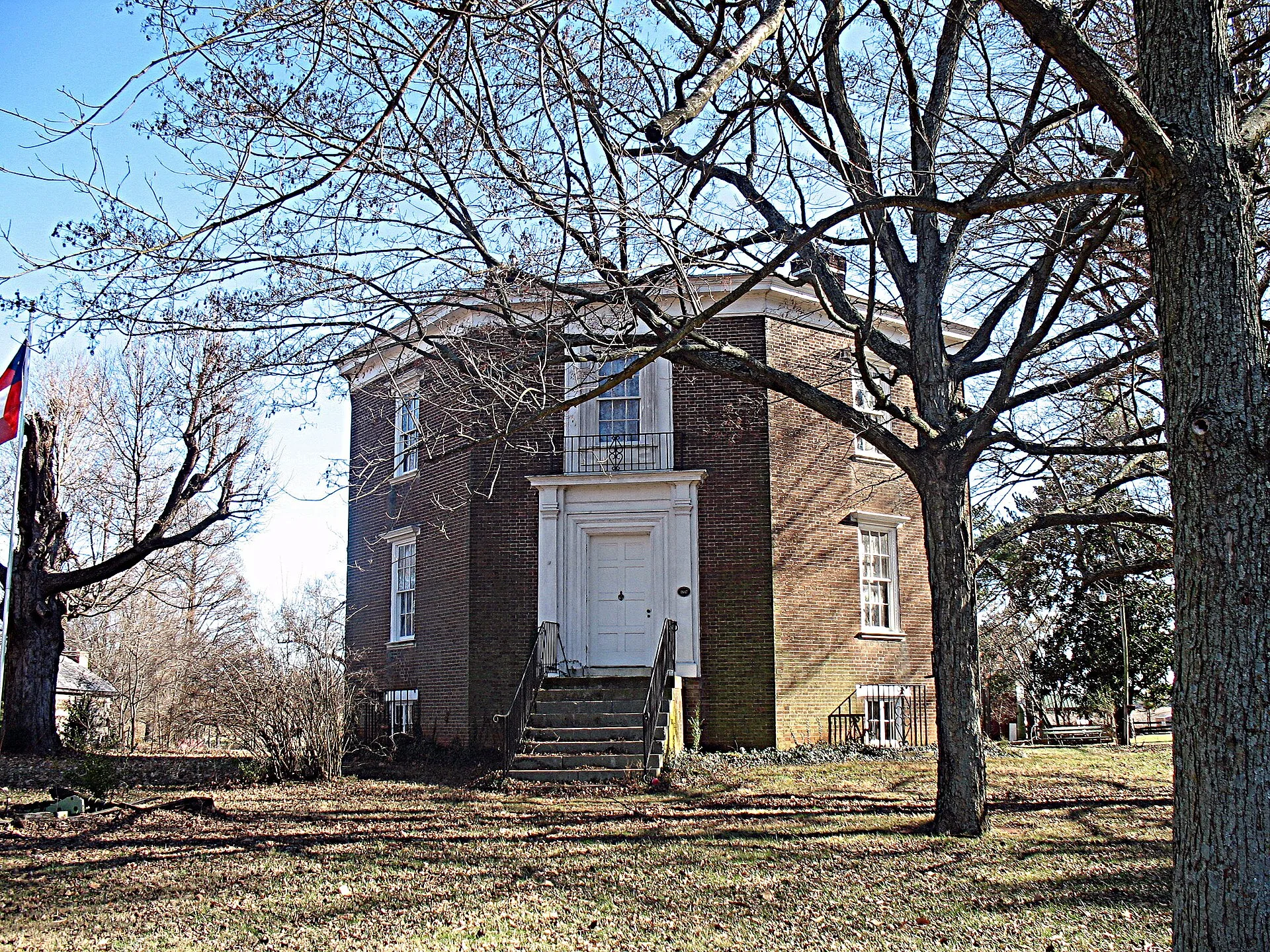
Octagon Hall is an eight-sided brick house on the old Bowling Green road a few miles north of Franklin, in Simpson County, Kentucky. It was built by a Confederate sympathizer in the decade before the Civil War, had both armies on its lawn in a single week in 1862, and is now a volunteer-run museum that pays its bills largely by selling ghost hunts. Its director took the job as a skeptic.
What happened
Andrew Jackson Caldwell, born in 1818, laid the foundation in 1847 and, by the museum’s reckoning, finished the house in 1859; the National Register nomination dates it to around 1860. The design followed a fashion set off in 1848 by the phrenologist Orson Fowler, whose book on octagonal houses argued that eight sides enclosed more floor with less wall and let in more light. Caldwell’s version is two stories of red brick over a high basement, with Flemish bond on the three sides facing the road, a central stair hall from which the rooms radiate, and a cupola on the roof. By 1980 it was one of fewer than ten octagon houses left in the state.
The 1860 census recorded Caldwell at home with his wife Harriet, three daughters (Frances, Mary and Martha) and a son, Henry, along with the enslaved people who worked the farm. An older daughter, Mary Elizabeth, from his first marriage, had died in 1851 at the age of seven when her dress caught fire in the basement kitchen. In February 1862, after Forts Henry and Donelson fell, the Confederate army abandoned Bowling Green and marched south; the museum’s account has eight to ten thousand soldiers camped on the Caldwell land on February 13 before crossing into Tennessee, with the house used as a field hospital, and Union troops arriving two days later. The nomination records the local tradition that Caldwell, an ardent Southerner, hid Confederate soldiers in the house, and the family’s guides point to the cupola, the hollow under the front stairs and spaces in the walls. Caldwell died in 1866. Harriet stayed on for years, and in 1918 Dr. Miles Williams, an osteopath from Nashville, bought the property and lived there until his death in 1954. His heirs rented it out for almost half a century.
The investigation
The house was added to the National Register of Historic Places on April 10, 1980, for its architecture. In 2001 Billy Byrd and his brother Barry formed the Octagon Hall Foundation, bought the house and opened it as a museum with a Confederate studies archive, a library, period furniture, a slave cemetery and gardens. Nobody is paid; the foundation gets no public money and says most of its income comes from after-dark tourism. Novice ghost hunts on October weekends, at $50 a ticket, are the biggest fundraiser, and experienced teams can rent the house overnight for a minimum of $600. The rules ban Ouija boards, séances and provocation.
Byrd has said in interviews that he did not believe in ghosts when he took the house on and that he has since seen full apparitions, shadow figures, objects moving and doors opening. The assistant director Barry Gaunt told Kentucky Monthly that shadow figures walk the grounds, that he has seen full-body apparitions, and that visitors have sent the museum more than six thousand photographs they believe show spirits. Investigators report a girl’s voice giving her age as eleven, which the museum matches to Mary Elizabeth despite the records saying she was seven, greetings in the stair hall and an occasional order to get out. In May 2020 a regional group, Uncommon in the Commonwealth, reported cold breezes, shadows, a recorded voice and a full-body apparition of a soldier. The house has been filmed by A&E, Syfy, History, Discovery and the Travel Channel, including a live Haunted Live episode in 2018.
The explanations
The hauntings are assigned to the Caldwells, to the people they enslaved, and to the wounded of both armies, with the basement, where the museum says amputations were done, as the center of activity. The historical weight behind them is real but thinner than the tours suggest: the 1862 encampment and hospital use rest on local tradition and the museum’s account rather than on army records, and the stories of Union atrocities against the family and their slaves come from the same source. The one documented death in the house is a child’s accident in 1851.
The brick house has deep basement rooms, an attic cupola and a highway outside. Ghost hunts are run at night by people who have paid to find something, and the museum itself notes that skeptics put the experiences down to suggestion. Six thousand photographs taken in the dark will contain six thousand things that look like someone.
Where it stands
The house, the Caldwells, the Civil War occupation and Mary Elizabeth’s death are on record in the National Register nomination and the museum’s own history. The ghosts are reported by the people who run the house and by the visitors they bring in, which is not nothing, but has produced no evidence beyond impressions and photographs. The hunts keep the roof on, which is more than most Kentucky octagons managed.