
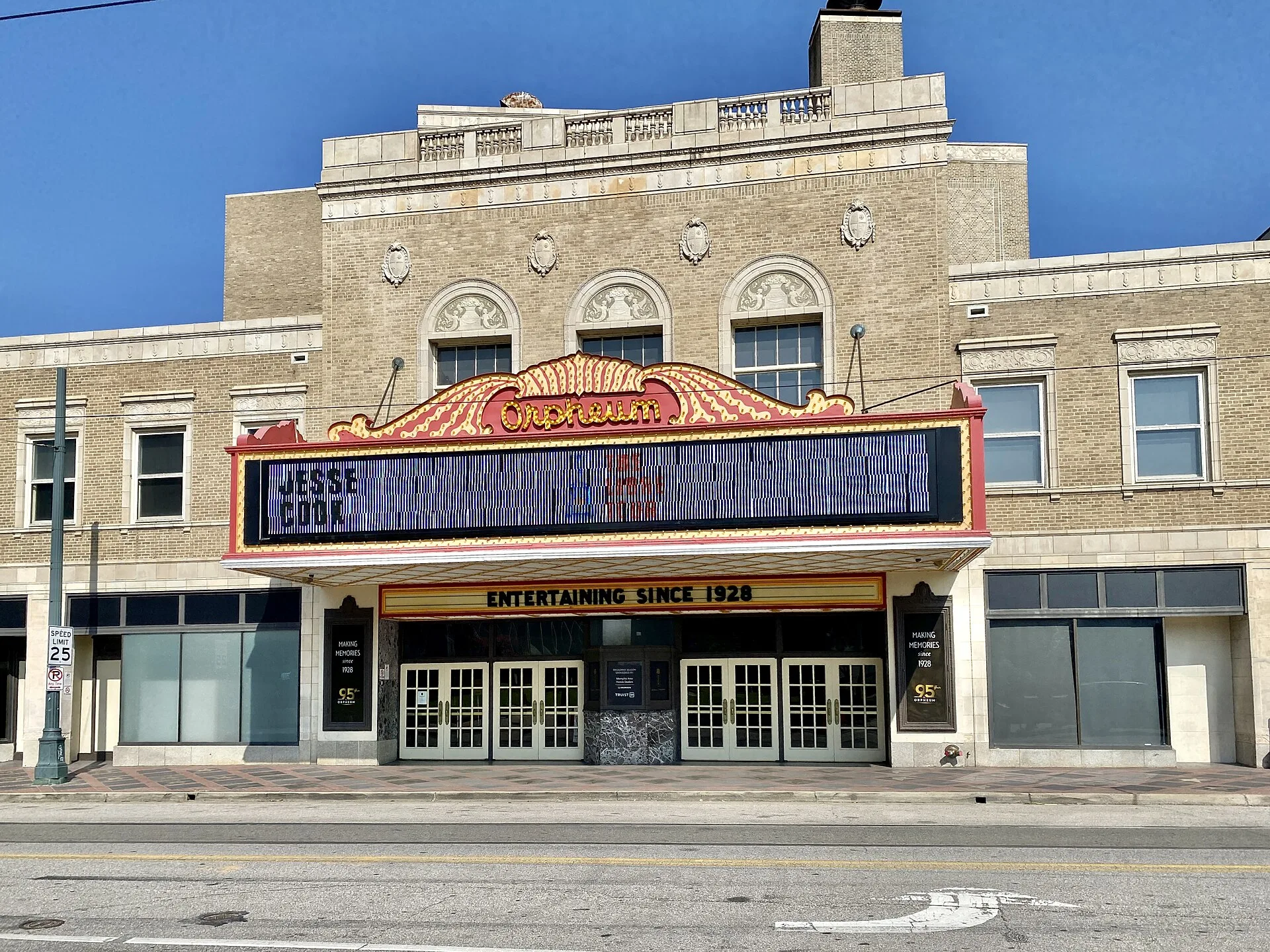
The Orpheum Theatre stands at the corner of Main and Beale in downtown Memphis, a 1928 vaudeville and movie palace that now hosts touring Broadway shows. It has a resident ghost called Mary, a girl of about twelve in a white dress, who is said to sit in seat C-5 and whose story the theater tells on Halloween tours. How she died depends on who is telling it.
What happened
In the late 1880s, with Memphis recovering from the yellow fever epidemics that had emptied it, twenty-five businessmen raised $60,000 to build a theater worthy of the city. The Grand Opera House opened on the southwest corner of Main and Beale on September 22, 1890, and over the next two decades hosted Sarah Bernhardt, Lillian Russell, W. C. Fields and John Philip Sousa. In 1907 it joined the Orpheum vaudeville circuit and took the Orpheum name. On the night of October 16, 1923, about half an hour after the audience had left a performance by the singer Blossom Seeley, fire broke out, probably on the third floor, where a women’s clothier rented space, and burned the building to the ground in front of the largest crowd the theater ever drew. The house was empty and no one died; the cause was never established.
The circuit rebuilt on the same site. The Chicago architects C. W. and George L. Rapp designed a new Orpheum in the French Renaissance style, twice the size of the old one, at a cost of about $1.6 million, with crystal chandeliers, gilded moldings and a Wurlitzer organ. It opened on November 19, 1928, with Corinne Griffith in the silent film Outcast and a vaudeville bill. Vaudeville did not survive the Depression. In 1940 Michael A. Lightman’s Malco chain bought the theater for $75,000, renamed it the Malco and ran first-run films there until 1976, when the company put it up for sale and demolition was discussed. A citizens’ group formed the Memphis Development Foundation, bought the building in 1977 and restored the Orpheum name; it was listed on the National Register of Historic Places on August 15, 1977. The theater closed on Christmas Day 1982 for a $5 million renovation, reopened in January 1984, enlarged its stage in 1996–97 and added the Halloran Centre next door in 2015.
The investigation
Mary arrived with the Foundation. In the accounts collected in the late 1970s and 1980s, she is a girl of eleven or twelve with brown or black braided hair, a white dress, shy, seen in a side box or on the mezzanine, and never known to interrupt a show. The theater’s own representatives have talked about her freely since the 1990s. In 2006 the Orpheum’s Alice Donohoe told the trade paper Pollstar that performers regularly reported a girl in seat C-5 and asked why a seat marked off the manifest was occupied; she said earlier managers had kept Mary quiet for fear of frightening audiences, and that the Discovery Channel had since made a documentary about her. Donohoe also described Mary dancing in the lobby when the organ played and hiding crew members’ tools and an actor’s makeup. Wikipedia’s account, citing local sources, says a group of Memphis State University researchers held séances and used a Ouija board in the building and decided she had died in a fall downtown in 1921 and simply wandered in afterward.
Seat C-5 is the fixed point of the story. It is kept out of sale, and performers and tour guests report seeing a small figure in it when the house is empty. The Daily Memphian put the question directly in October 2025, under the headline “Does a ghost named Mary really haunt the Orpheum?”, and found believers among staff and audience members, but no documents.
The explanations
Mary has no record. The most common version says she was struck by a streetcar on Beale Street in 1921 and carried into the old theater, where she died; other tellings move the accident to 1928, or have her die in the 1923 fire, in which nobody died. No newspaper report, death certificate or theater record of a girl killed outside the Orpheum has been produced, and the building Mary supposedly entered burned to the ground five years before the present one opened. Her age, hair color and seat shift between tellings. The story first appears in the years after the theater’s rescue, when a nonprofit needed public attention and a reason for people to visit a grand old building, and the séances that fixed her biography were conducted by students with a Ouija board.
A dim 2,300-seat auditorium is a good place to see things. Seat C-5 is off the manifest in the first place because, as Donohoe acknowledged, its sight lines are poor; a seat nobody sells is a seat nobody disturbs, and an empty seat in a side box is easy to furnish with a small figure in the half-light.
Where it stands
The Grand Opera House, the 1923 fire, the 1928 rebuild and the 1977 rescue are documented in the theater’s own history and in the National Register. Mary is a theater tradition, treated with affection by staff and sold on Halloween tours, with no documented death behind her. She is unlikely to leave; the Orpheum has every reason to keep her seat.