
What happened
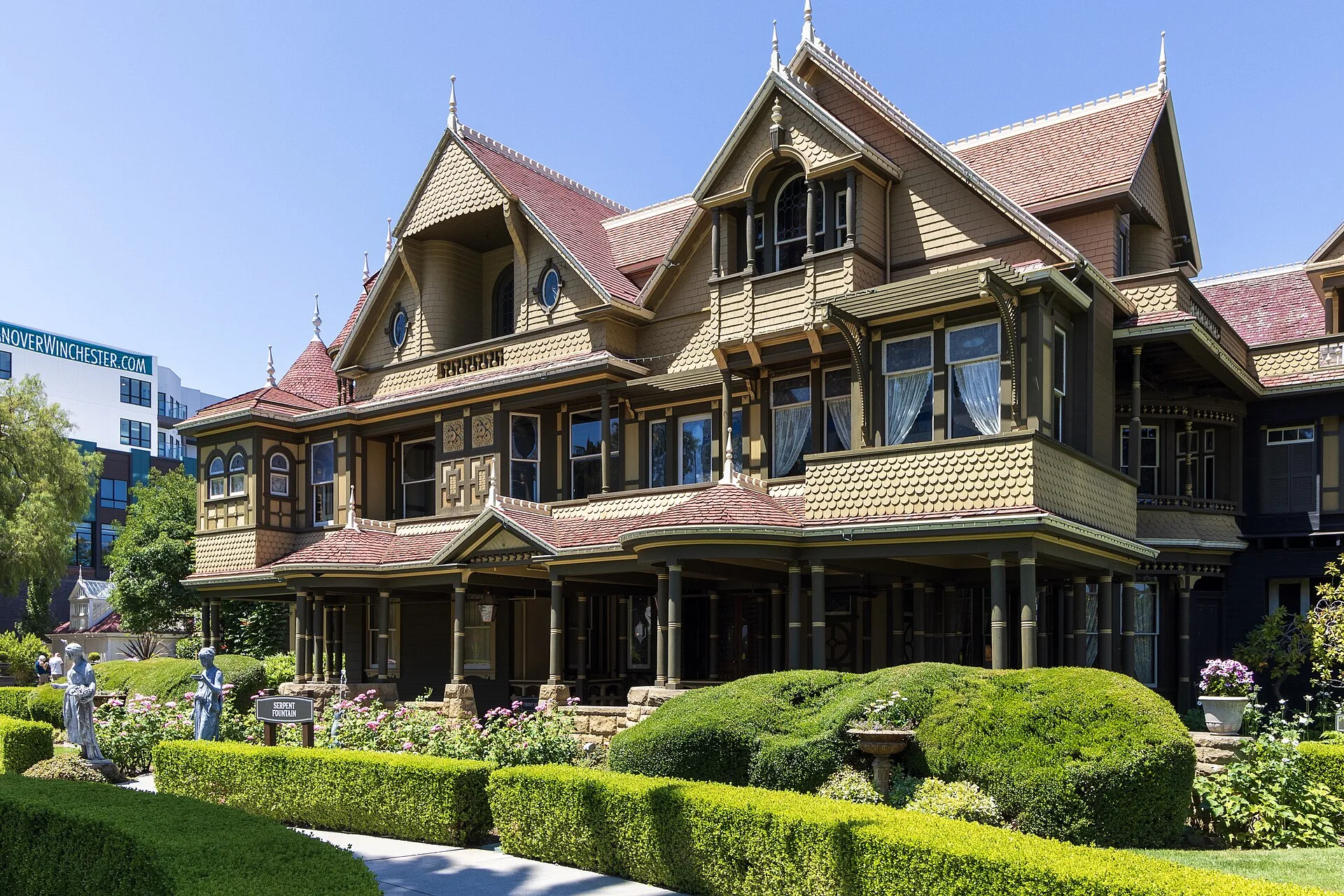
Sarah Lockwood Pardee was born in New Haven, Connecticut, in 1839 and married William Wirt Winchester, son of the founder of the Winchester Repeating Arms Company, on September 30, 1862. Their only child, Annie, was born in July 1866 and died within weeks of a wasting illness. Oliver Winchester died in December 1880 and William, of tuberculosis, in March 1881, aged 43, leaving his widow several hundred thousand dollars, a large block of company stock and a dividend income that made her one of the richest women in the country. In 1886 she bought an eight-room farmhouse and orchard outside San Jose, in the Santa Clara Valley where her sister’s family had settled, named it Llanada Villa, and began to enlarge it.
She went on enlarging it, with interruptions, for 36 years. She had no architect and changed her mind constantly; stairways were rerouted, rooms were built around rooms, and by the turn of the century the house rose seven stories with a tower. The earthquake of April 18, 1906 brought the tower and much of the fourth floor down, and she never rebuilt them, sealing off the damaged sections and leaving the stairs and doors that now open onto walls. She also owned other houses in the Bay Area and lived in them for long spells. She died at Llanada Villa on September 5, 1922, leaving large sums to a tuberculosis hospital in New Haven and to the workers who had served her for decades, several of whom she named in her will. By then the house, much reduced, had 160 rooms, some 2,000 doors and dozens of staircases, numbers the tours still quote.
Within months John and Mayme Brown had leased the property, moved their family in and, on June 30, 1923, opened it to the public with Mayme as the first guide. Harry Houdini came at Halloween 1924 and is credited with the name Winchester Mystery House. The Browns’ descendants still own it and still run it for profit, which is the fact that explains most of the rest.
The investigation
The legend has a traceable construction history of its own. In March 1895 a San Jose newspaper reported that Mrs Winchester believed she would die when her house was finished; a friend denied it in print two years later, but the item was the seed. The séance room is first mentioned in a 1928 promotional piece, six years after her death. A 1929 magazine article, The Strangest House in the World, supplied the obsession with the number thirteen; a carpenter who had worked on the house said in a 1983 interview that the thirteens were added after she died. The Boston medium who supposedly told her to build for the spirits, named as Adam Coons, enters the story in Susy Smith’s 1967 book Prominent American Ghosts, and no earlier mention of him or of any medium has been found; searches of Boston directories and Spiritualist papers of the period turn up nobody of that name. The federal Historic American Buildings Survey wrote the superstitions into its 1981 record as fact, and the house joined the National Register and the state’s historical landmarks in 1974.
The historian Mary Jo Ignoffo spent years with Winchester’s letters, accounts and legal papers for Captive of the Labyrinth, published in 2010 and revised in 2022. She found that Winchester sent her workmen away for months at a time, that construction stopped and started with her travels and her finances, that nobody who knew her ever mentioned a séance, that the so-called séance room was the head gardener’s office, and that she showed no sign of guilt about the rifles; in her world the company was a success story. A 1951 San Jose State master’s thesis by Bruce Spoon had reached the same conclusion from interviews with surviving workers: she enjoyed designing, and she kept hundreds of people in work through a regional slump, paying well and housing them.
The explanations
What is left when the inventions are removed is a wealthy, childless widow with arthritis, no architect and an unlimited budget, who liked building and disliked waste, and whose house was then wrecked by an earthquake she chose not to repair. Her reclusiveness was real and the local press punished it with gossip. The Browns needed a story to sell tickets in the 1920s and the story that sold was the one about ghosts; each later writer added a detail, and the house’s own marketing has repeated them for a century. Visitors who report cold spots and footsteps are touring a vast, dark, half-ruined wooden house that has told them it is haunted before they enter.
Where it stands
The house remains one of the most visited attractions in the Bay Area, inspired a 2018 film with Helen Mirren and still advertises its spirits. Sarah Winchester’s bequest to the New Haven hospital outlived the stories about her, and the Winchester Mystery House is best understood as the most successful piece of ghost marketing in American history, attached to a woman who did not believe in any of it.