
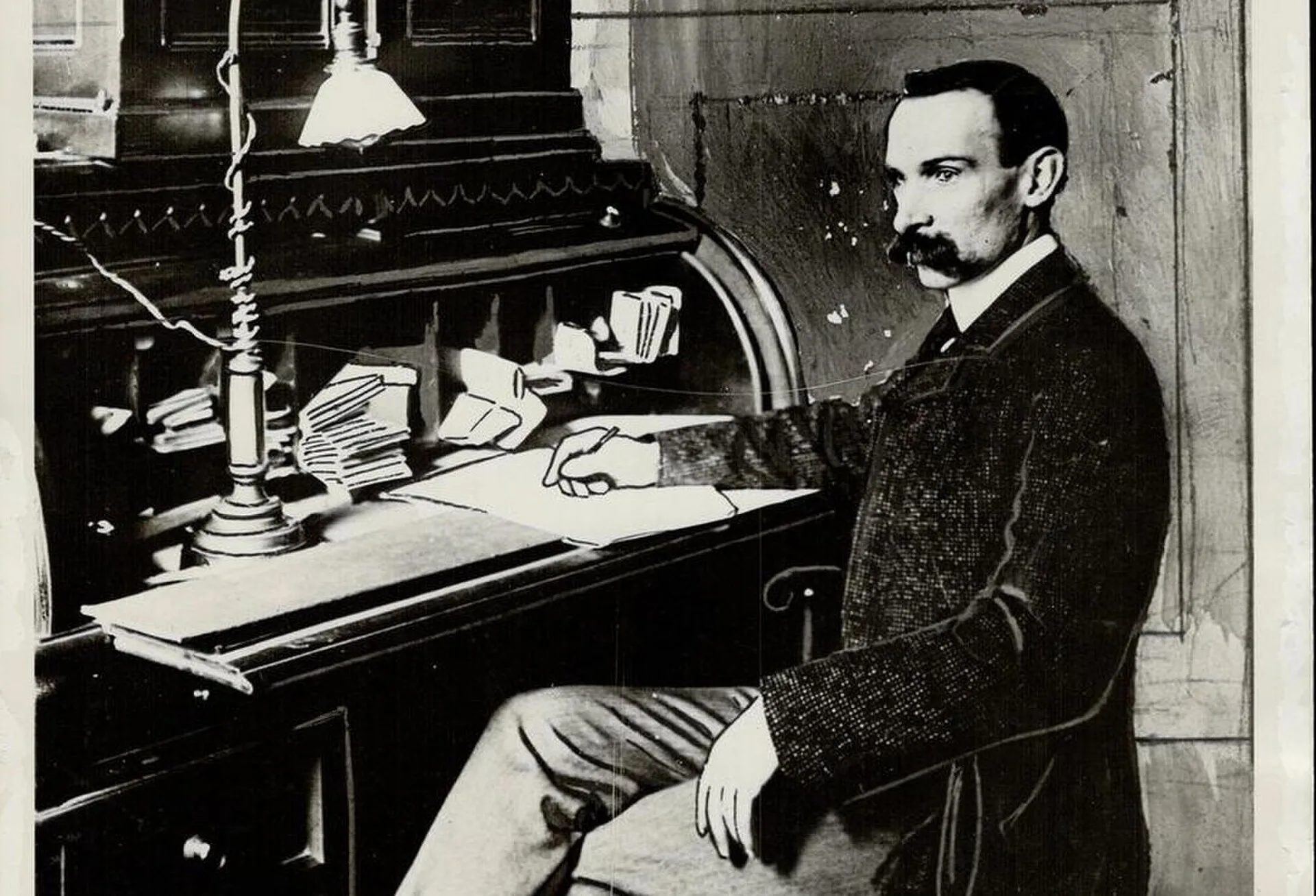
Ambrose Small was born in Bradford, Ontario, in 1866 and grew up in Toronto, where his father kept a hotel saloon. He started as an usher and barman at the Grand Opera House on Adelaide Street, became its treasurer in 1889, and in 1903 bought it with help from the inheritance of his new wife, Theresa Kormann. Within a few years he controlled a circuit of more than thirty theaters in Ontario and beyond, booking touring shows into them. He was known as a hard bargainer and a heavy gambler at the racetrack.
What happened
In the autumn of 1919, with his lawyer E. W. M. Flock handling the negotiations, Small agreed to sell the whole chain to Trans-Canada Theatres Limited of Montreal for about $1.7 million. On December 1, at a Toronto law office, he and Theresa received a check for $1 million on account, with the rest to follow in annual instalments. The next morning Theresa deposited it. Small ordered gifts for her that day, including a car, a fur coat and jewelry, and had lunch with her and Flock.
That afternoon Flock met him at his office in the Grand. He later said Small seemed in good spirits when he left him there at about 5:30 pm on December 2. Nobody is known for certain to have seen Small after that. The sale money stayed in the bank.
The investigation
Theresa did not report her husband missing. She later said she feared a scandal and believed he was with another woman. The public learned of it only on January 3, 1920, when the Toronto Daily Star reported that relatives and business associates were worried. Theresa then offered a reward, raising it to $50,000, and the case became an international sensation. Thousands of false sightings and psychic tips followed. When Arthur Conan Doyle passed through New York, reporters asked whether he would help Canadian police.
Suspicion soon fell on Small’s secretary, Jack Doughty, who had vanished at about the same time. So had roughly $100,000 in Victory Bonds from Small’s safety deposit box. Doughty was traced to Oregon, arrested and brought back. He was convicted of stealing the bonds, but the charges of conspiring to kidnap Small were dropped for lack of evidence. Police also questioned Small’s mistress, Clara Smith, and checked a story that New York gangsters had taken him, which came to nothing.
Detectives dug up the basements of the Small house and the Grand Opera House and searched a ravine in Rosedale, and found nothing. Small’s sisters, Gertrude and Florence, hired a private detective, Patrick Sullivan, whose published accusations against her ended in libel and obscenity cases rather than evidence. In 1923 the Supreme Court of Ontario declared Small dead and upheld his 1903 will, which left most of an estate valued at just over $1 million to Theresa. Toronto police closed the case in 1960.
The explanations
One theory is that he was murdered. Inspector Edward Hammond, who worked the case, came to believe Doughty killed Small and that Theresa protected him, a view the journalist Katie Daubs found the most persuasive in her 2019 book. The historian Orlo Miller argued in 1978 that the body was burned in the furnace of the Grand Theatre in London, Ontario, one of Small’s houses. Neither idea has physical proof behind it.
Another is that he left on purpose. Small had just turned his life’s work into cash at a time when Spanish flu closures, a 1919 actors’ strike and the rise of cinema were hurting live theater. Writers have suggested he wanted to be free of the business, his marriage or gambling debts, though the debt idea is speculation. Against that, he took none of the sale money with him, and no reliable sighting was ever confirmed. Suicide and accident have been suggested too, with no body to support either.
Where it stands
Small’s disappearance is one of the most investigated in Canadian history, and it later inspired Michael Ondaatje’s 1987 novel In the Skin of a Lion. The record shows he vanished on December 2, 1919. Murder, flight and suicide all remain possible, and none of them has been shown to be true, so the case is unproven.