
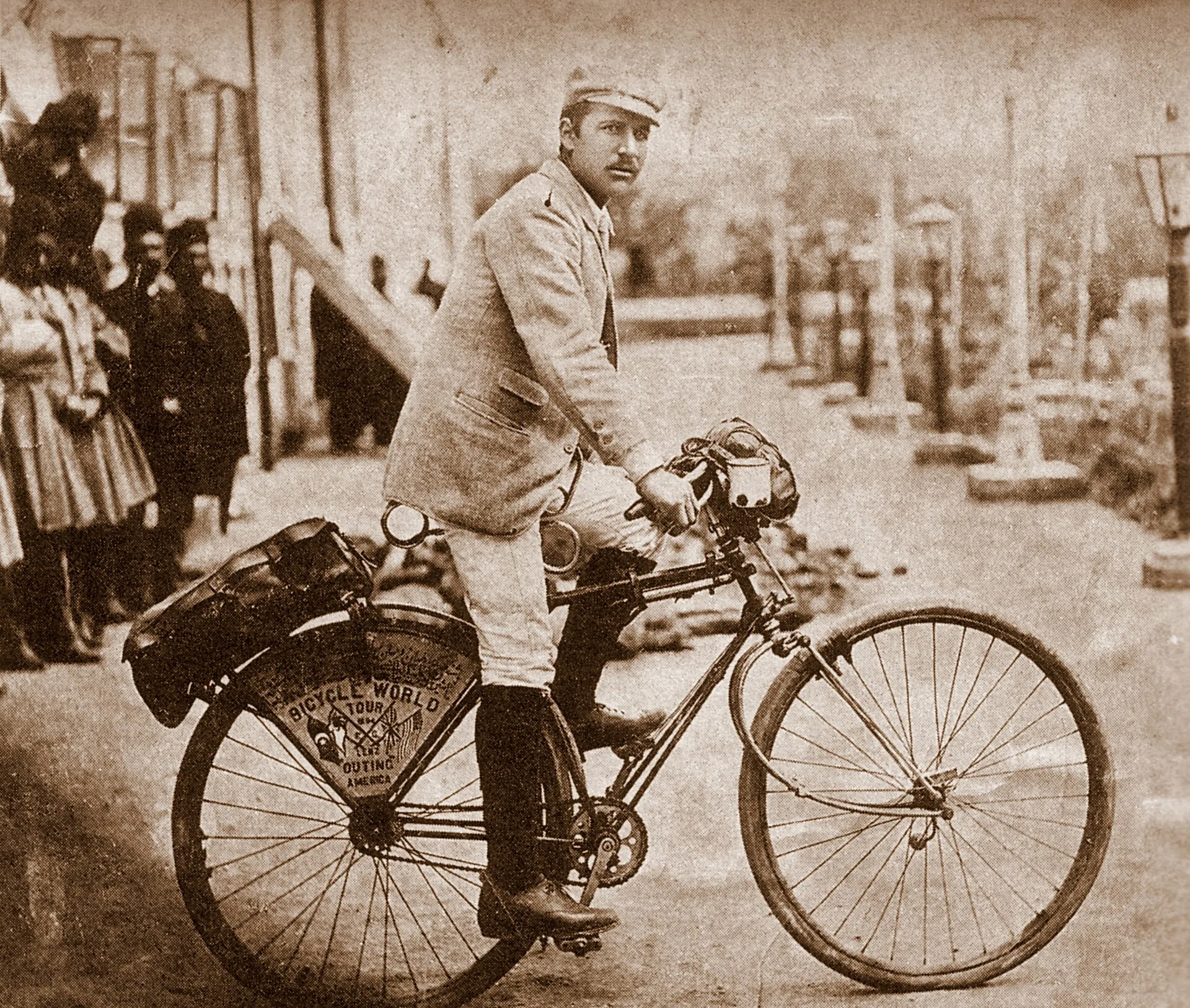
In the early 1890s the bicycle was changing fast. The tall high-wheeler was giving way to the low safety machine with pneumatic tires, and magazines were hungry for long-distance exploits to prove what the new design could do. Frank Lenz, a slight, determined bookkeeper from Pittsburgh who had spent his twenties touring and racing and lugging a heavy camera on long rides, wanted to outdo the Englishman Thomas Stevens, who had circled the globe on a high-wheeler in the mid-1880s. He persuaded Outing, the leading sporting magazine of the day, to sponsor him and a bicycle maker to supply a Victor safety, and on May 15, 1892 he rode out of Pittsburgh. Outing gave him a send-off in New York and agreed to run his dispatches and photographs.
What happened
For almost two years the plan worked. Lenz crossed the United States, shipped to Japan, which he enjoyed, and then fought his way across China in a winter of bad roads and suspicious crowds, a stage that took twice as long as he had planned. Burma brought monsoon rain and malaria; India and Baluchistan were easier. He reached Persia and, in late April 1894, arrived in Tabriz, where the crown prince received him. After about a week he set off for Erzurum in Ottoman Turkey, the next stop on a route that was meant to carry him through Constantinople and across Europe to home. Outing expected a fresh packet of reports from Erzurum in about ten days. Nothing came.
Because the magazine published his letters months after they were written, the public did not notice the silence at first. His mother, Anna, did. By July his trunk was still waiting uncollected in Constantinople, and her letters from him had stopped. Relatives and friends pressed the magazine, wrote to the State Department and gave the story to the newspapers. Missionaries and the British consul in Erzurum began asking along the road, and by early 1895 they had traced Lenz to a village called Chilkani, east of Erzurum, where he had spent the night of May 9, 1894. After that the trail ended.
The investigation
Outing finally sent William Sachtleben, a young American who had cycled across Asia with a friend a few years earlier and knew the region. He reached Constantinople in the spring of 1895, found the American minister unhelpful and the Ottoman authorities unwilling to let foreigners into a province torn by the massacres of Armenians, and had to talk his way to Erzurum, arriving in May. With the help of the missionary William Nesbitt Chambers and the British consul, Robert Graves, he hired an Armenian informant who worked the villages around Chilkani.
The picture that emerged, as the historian David Herlihy reconstructs it from Sachtleben’s papers, was this. A local Kurdish chief and his followers had come to the house where Lenz was sleeping; Lenz woke to find the chief handling his revolver and snatched it back, shaming him in front of his men; the next morning they waylaid the cyclist outside the village and killed him. Boys had found a broken mirror and box in a nearby river, a naked body matching his description was said to have washed up and been buried in a Kurdish village, and the informant saw bicycle tubing and managed to buy a fragment of a bicycle bell. In the fall of 1895 Sachtleben joined the touring party of a senior Ottoman official, Shakir Pasha, who had the chief and his men arrested.
The explanations
No serious rival account has emerged. The alternatives considered at the time, drowning at a river crossing or a kidnapping that would end in a ransom note, faded as months passed without a word. Some skeptics even suggested the disappearance was a publicity stunt by the magazine, which Lenz’s riding partner dismissed out of hand. The doubts that remain concern the details: an earlier report placed the attack farther west, in the Deli Baba pass, and Herlihy notes that without a grave it is impossible to be sure where, or exactly by whose hand, Lenz died.
Where it stands
The accused men escaped from custody and were never brought to trial. Under American pressure the Ottoman government eventually paid Anna Lenz an indemnity of roughly $7,500, without admitting responsibility, years after her son vanished. She never had a body to bury. That Lenz was robbed and killed on the road east of Erzurum is the conclusion of everyone who investigated; the last miles of his ride, and where he lies, are still unknown.