
Australia’s navy was barely three years old when it went to war in 1914, and its two submarines, AE1 and AE2, had arrived from the Vickers yard at Barrow-in-Furness only that May. Less than a week after Australian troops first went into action in the war, AE1 and the 35 men aboard were gone. For 103 years nobody could say where, or why.
What happened
In September 1914 an Australian expedition was sent to seize German New Guinea and its radio stations. AE1, a 55-meter E-class boat commanded by Lieutenant Commander Thomas Besant of the Royal Navy, sailed with the fleet; her officers were British and her ratings a mix of Royal Navy and Australian sailors. Rabaul surrendered on September 13. Early the next morning AE1 left Blanche Bay to patrol off Cape Gazelle in company with the destroyer HMAS Parramatta. The two lost touch during the day; later analysis puts the sinking in mid-afternoon near the Duke of York Islands, in the strait between New Britain and New Ireland. She was due back by evening. When she had not appeared by 8 p.m., ships were sent out to look for her.
The search found nothing that anyone recognized at the time. HMAS Encounter reported an oil slick the next day but put it down to passing ships and did not log the position. The destroyer Yarra ran aground and dropped out. There was no wreckage, no distress signal and no survivor, and the navy recorded the boat as lost with every man aboard, the first Australian warship lost and the first Allied submarine lost in the war. Among the Tolai people of the islands, a story was later recorded of a “devil fish” seen offshore on the day she vanished.
The searches
Nobody looked seriously for sixty years. In the 1970s a naval officer working in Port Moresby, John Foster, began going through the records and persuaded the navy to send the survey ship HMAS Flinders in 1976. What followed was a long run of near misses. Jacques Cousteau’s Calypso checked a sonar contact in 1990; expeditions with the Western Australian Museum dived reported sites around Mioko Island in 2003; a navy ship found a promising shape on Wirian Reef in 2007 that turned out to be rock; a 2012 contact in Rabaul’s Simpson Harbour was a Japanese midget submarine from the next war. The seabed is volcanic, rough and deep, magnetic readings are unreliable, and the area is littered with Second World War wrecks. Foster died in 2010; the private group Find AE1, led by retired Rear Admiral Peter Briggs, carried on.
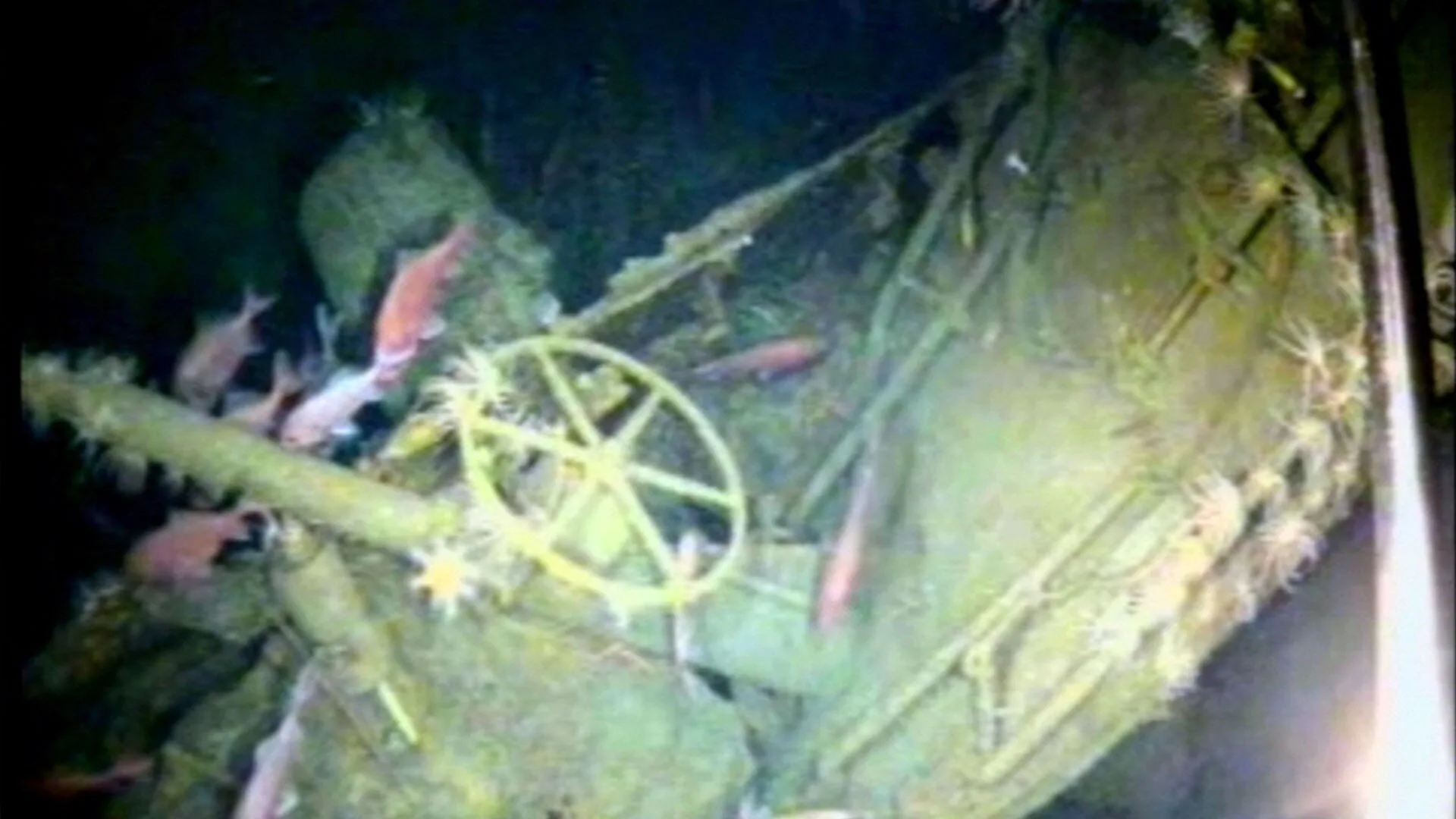
The thirteenth search, funded jointly by Canberra, the private Silentworld Foundation, Find AE1 and the national maritime museum, used the Dutch survey ship Fugro Equator. Its autonomous vehicle located a target on December 18, 2017, and on December 20 a drop camera confirmed it: an intact submarine more than 300 meters down off the Duke of York Islands. The government announced the discovery on December 21 and withheld the exact position to protect what it treats as a war grave.
The explanation
In April 2018 the research vessel Petrel, owned by Paul Allen and offered free of charge, filmed the wreck with a remotely operated vehicle. The resulting report, published by Find AE1 and the maritime museum and reviewed by Australia’s Defence Science and Technology Group, found the hull valve for the ship’s ventilation system about 60 percent open. Its conclusion is that AE1 dived with that valve open, flooded at the stern, lost control and sank past her crush depth, where the hull imploded and killed everyone instantly before she struck the bottom stern first. Both the bow and stern torpedo-tube caps were also open, which the authors read as preparation for attacking a German steamer reported near the islands the night before. Why the valve was open is unknown; it may have been left open to cool a hot, stuffy boat on the surface. The team noted that Besant and his officers were all new to this class of submarine, and calculated that the strong current would have carried any oil or debris tens of miles away overnight, past ships searching in the dark.
Where it stands
The location of AE1 is now known, and the loss is explained as a diving accident in an early and unforgiving type of submarine, with one detail, the open valve, that will probably never be accounted for. The wreck is corroding fast. The 2018 survey predicted a major collapse within five to twelve years and expected that, in about eighty, little more than the conning tower, propellers and engine beds would remain.