
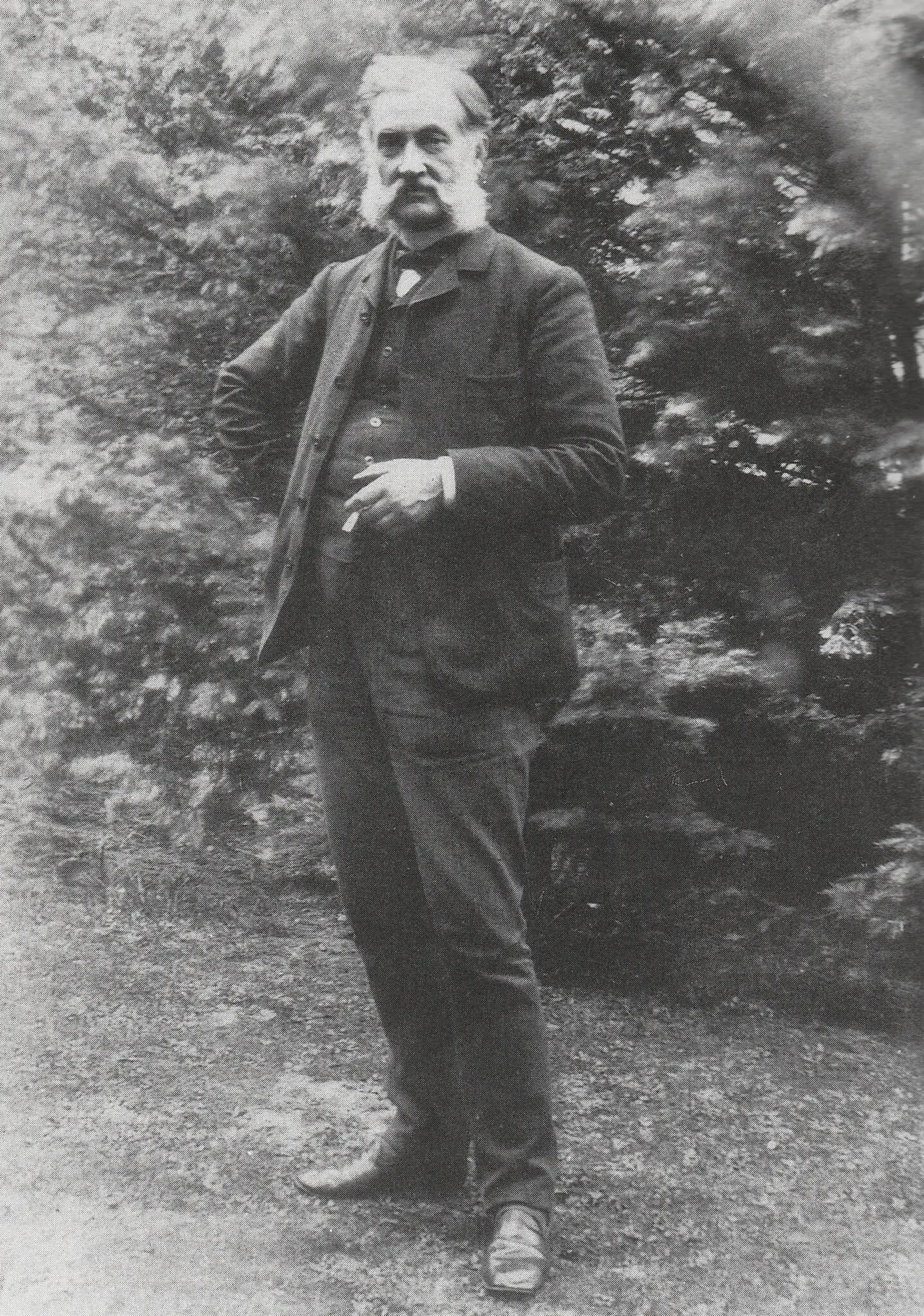
Louis Aimé Augustin Le Prince was born in Metz on August 28, 1841 and moved to Leeds in the 1860s to join Whitley Partners, a brass foundry run by the family of Elizabeth Whitley, whom he married. The couple ran an art school in the city and spent the early 1880s in New York, where Le Prince began experimenting with cameras that could record movement. He filed his first American patent application in November 1886, was granted it on January 10, 1888, and applied for a British patent the same day. By then he was back in Leeds with a workshop on Woodhouse Lane, building a bulky wood-and-brass single-lens camera that he called a receiver.
What happened
On October 14, 1888 he set the camera up in the garden of Oakwood Grange, his in-laws’ house in Roundhay, and recorded Joseph and Sarah Whitley, his son Adolphe and a family friend walking in a circle on the lawn. The strip of unperforated paper film lasted about two seconds. Sarah Whitley died ten days later, on October 24, which is how the family was later able to date the footage. The same day Le Prince filmed Adolphe playing an accordion on the steps, and later that month he pointed the camera out of a window at horse traffic crossing Leeds Bridge. The camera survives in the Science Museum Group’s collection, donated by the family in 1931, and is displayed at the National Science and Media Museum in Bradford. The garden scene, surviving as copies of twenty frames, is the oldest motion picture known.
Two years later Le Prince had a projector working and was planning a public demonstration in New York, where Elizabeth and the children were living. In September 1890 he went to France to see his family, and on September 16 his brother Albert saw him onto the train from Dijon to Paris with his luggage. When friends met the train in Paris he was not on it. No passenger or railwayman recalled seeing him, no luggage was found on the train or along the line, and no body was ever recovered. The Paris police and Scotland Yard both searched. He was 49. Under French law he was declared dead in 1897, seven years after he was last seen.
The investigation
The disappearance was never solved, and the case passed from the police to the family and then to film historians. Elizabeth Le Prince believed to the end of her life that Thomas Edison had her husband removed. The suspicion had a context: Edison filed for his Kinetoscope in 1891, and when he later sued the American Mutoscope Company for infringing his motion-picture patents, Mutoscope’s defense was that cameras had been in use before Edison’s. Adolphe Le Prince, who had taken a year away from Columbia University to assemble his father’s papers, testified for Mutoscope in December 1898 and produced his grandmother’s death certificate to prove the Roundhay film predated her death. His father’s cameras were not admitted in evidence. The court found for Edison in 1901; the decision was reversed on appeal in 1902, and a decade of patent litigation followed.
Adolphe did not see the reversal. In the summer of 1901 he was found shot dead in the dunes near the family’s summer cottage at Point O’ Woods on Fire Island, New York, with his duck gun beside him. He was 29. The death was recorded as suicide; the family thought it was murder, and nothing conclusive was ever established either way.
The explanations
Four theories have been argued over since. The Edison version rests on motive and on timing, and on nothing else; no document or witness has ever placed anyone acting for Edison in Dijon or Paris. The suicide theory points to debts, but his business was still solvent, he stood to inherit half his mother’s estate, and he was days away from the showing he had worked toward for years. A third version, that he arranged his own vanishing to spare his family the shame of bankruptcy or to start a new life, was given a twist in the 1970s when the writer Léo Sauvage reported being shown a note in Dijon claiming Le Prince had died in Chicago in 1898; the note has never been produced. The fourth, that Albert killed him for the other half of the inheritance, rests only on Albert being the last person to see him. The brothers’ surviving letters suggest they were close, and the family has always rejected it.
In 2003 researchers working through the Paris police archives found a photograph, filed in 1890, of a drowning victim who resembled Le Prince in features and beard. It fits the simplest explanation of all, a robbery on the walk from the Gare de Lyon late at night, but the body in the picture appears to be of ordinary height, and Le Prince stood six feet four. No identification has been made.
Where it stands
Le Prince’s priority in the history of film is no longer seriously contested; the Roundhay footage, the Leeds Bridge footage and the camera are in public collections. His fate is where it was in October 1890. A tall, well-known man carrying luggage boarded a three-hour train and did not get off it, and in more than 135 years nobody has produced a witness, a body or a confession to say why.