
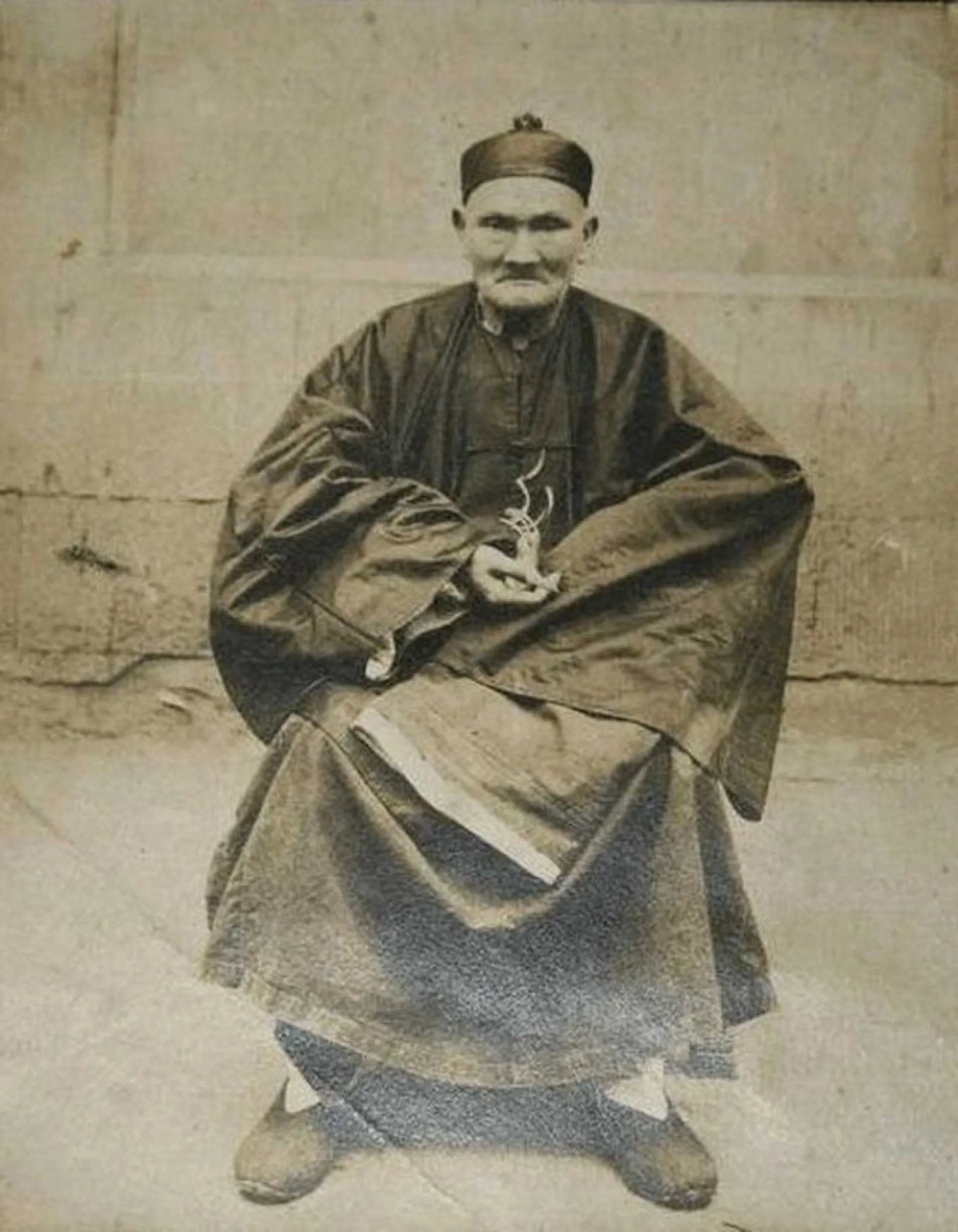
In May 1933 a wire dispatch from Chongqing reported the death of an old herbalist in Kai County, in the eastern part of Sichuan province. His name was Li Qingyun, spelled Li Ching-yun or Li Ching-Yuen in the English papers of the day, and the obituaries ran in the New York Times and Time because of one detail. By his own reckoning he had been born in 1736 and was 197 years old. By a rival reckoning, based on documents a Chinese professor said he had found, he was 256.
The man and the stories
What the American press printed came largely secondhand, from Chinese newspapers and from the tales told in his home district. Li was said to have been literate as a child and, before he was ten, to have traveled through Gansu, Shanxi, Tibet, Annam, Siam and Manchuria collecting medicinal herbs. He gathered herbs for a century, the story went, and then sold herbs others had gathered. He lived on herbs and rice wine. One account had him bury twenty-three wives and live with a twenty-fourth, a woman of sixty; another, from 1928, credited him with fourteen marriages and 180 living descendants across eleven generations. The fingernails of his right hand were reported to be six inches long.
He was also a minor celebrity among China’s military men. The warlord Wu Peifu was said to have taken him into his household to learn how to live so long. The advice attributed to him, quoted ever since, came down to four animal-like habits: keep the heart quiet, sit like a tortoise, walk with a pigeon’s brisk step, and sleep like a dog. A photograph said to show Li, usually dated to 1927, still circulates with the story.
The documents
The figure of 256 rests on a single discovery. In 1930, as Time and the New York Times reported, Wu Chung-chieh, a dean of education at a university in Chengdu, announced he had found records showing that the imperial government had congratulated a Li Qingyun on his 150th birthday in 1827 and his 200th in 1877. That would place his birth in 1677. A Times correspondent had written in 1928 that elderly men in Li’s neighborhood said their grandfathers had known him as a grown man when they were boys.
Neither paper reported examining the records itself. Time added the qualification that matters: the man who died in 1933 was 256 only if he was the same Li Qingyun named in the 1827 document, which Chinese admirers preferred to believe. The two claimed birth years, 1677 and 1736, are also sixty years apart, and Li’s own figure was the lower one. Western reporters noticed the problem in his face. Time wrote that to skeptical eyes he looked like an ordinary Chinese man of about sixty, and the Times obituary ended with its own correspondent’s remark that people who had seen him said he looked no different from men two centuries younger.
What gerontologists say
The longest human life that has been fully documented is that of Jeanne Calment of France, who died in 1997 at 122 years and 164 days. No validated case comes close to 197, let alone 256. Asked about Li by the Australian fact-checking unit AAP FactCheck in 2020, the Boston University longevity researcher Thomas Perls said that, demographically, a claim of 256 is impossible. Nir Barzilai of the Albert Einstein College of Medicine noted that World Health Organization efforts to confirm reported ages above 150 had failed, and that people have sometimes taken on a grandparent’s identity, for instance to avoid military service. Dmitri Jdanov of the Max Planck Institute for Demographic Research said verification requires documents covering a whole life, from birth to death, which do not exist for Li.
A 2010 paper co-authored by Perls, “Typologies of extreme longevity myths,” uses Li as a textbook example of one category: the claim that a spiritual discipline or way of life produces extreme age. It also points out that 256 is a multiple of eight, a lucky number in Chinese tradition. Snopes, rating the claim unproven, suggested the likeliest explanation is that records belonging to an older relative or namesake became attached to him.
Where it stands
Li Qingyun was real, and he may well have lived to a great age; nothing in the record rules out his being a man in his nineties or older when he died. The ages of 197 and 256 rest on his own word, on village memory and on imperial papers that no one has tied to him and no independent reporter examined. Against a documented human maximum of 122, neither figure survives. The tortoise, pigeon and dog advice lives on regardless, on wellness posts that still give his age as 256.