
The south end of Lincoln Park, between North Avenue and the zoo, was Chicago’s municipal cemetery for a generation. Burials began in 1843, after the young city closed two smaller graveyards and moved their occupants to a strip of sand dunes along the lake at what was then the northern edge of town. By the time it stopped taking bodies the City Cemetery, with the Catholic cemetery beside it, held roughly 35,000 graves: paying lot holders, a potter’s field, cholera and smallpox victims buried in shallow trenches, and several thousand Confederate prisoners who died at Camp Douglas on the South Side.
What happened
The site was a bad choice from the start. The ground was low and sandy, the graves were shallow, and the lake a few hundred feet away was the city’s drinking water. In the late 1850s the physician John H. Rauch argued that decay from the burials was seeping into the water and rising into the air as miasma, and citizens began asking for a park instead. The city set aside sixty unused acres as Lake Park in 1860, and in the early 1860s agreed to close the cemetery and move the graves to the new private cemeteries at Rosehill, Graceland and Oak Woods. The removals were slow and piecemeal. In 1869 the state created the Lincoln Park Commission, which took over the land and kept digging up coffins as it laid out drives and lawns; the Confederate dead went to Oak Woods in 1867, and the last recorded payments to exchange cemetery lots for plots elsewhere date from 1886.
In October 1871 the Great Fire swept north through the cemetery, burning the wooden markers, cracking stone vaults and exposing remains, which made the record of who lay where even less reliable than before. Pamela Bannos, a Northwestern University artist and professor whose Hidden Truths project is the most thorough study of the cemetery, concludes that about a third of the dead, some 10,000 to 12,000 people, were never moved at all. Most were paupers, unidentified epidemic victims and the unclaimed dead of the fire, people with no family to pay for a reburial.
The investigation
The city has known this for a long time. In January 1903 the Chicago Tribune reported that an 1875 chart drawn by the park engineer J. H. Lindrooth had turned up in a workshop, showing 145 bodies clustered in a plot of about 130 by 200 feet at the north end of a baseball field, six more to the south, and a note that there might be many more; it listed 132 tombstones, nearly twenty of which had been built into a decorative waterfall in the 1890s. Remains have surfaced at intervals since, including on a construction site inside the old boundary in 1998 and under several Gold Coast blocks that were once the Catholic section. Any new parking lot in the park carries the possibility of finding more.
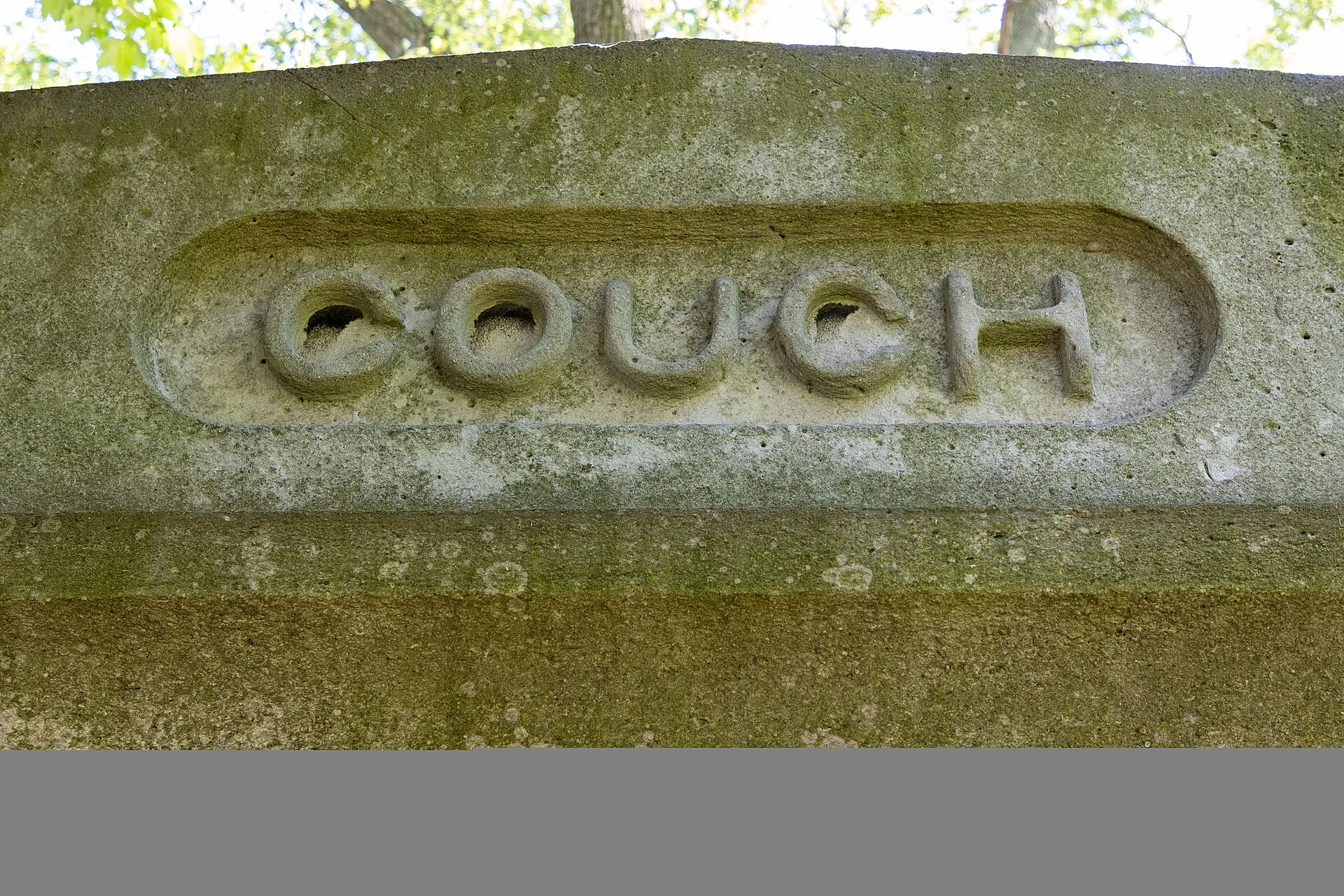
Two monuments survive. The Couch tomb, a fifty-ton Greek Revival vault designed by John Van Osdel for the hotelier Ira Couch, who had run the Tremont House and died in 1857, was built in 1858 and stands today in the curve of LaSalle Drive behind the Chicago History Museum. Why it alone was left is not settled: one tradition says the family fought the removal in court, another that the vault was simply too heavy to move economically. Who is inside is less settled still. Couch is the only person known to be there, some records suggest he was reburied at Rosehill, and the two marble plaques by the door are blank. A short walk away a boulder marks the approximate grave of David Kennison, a Revolutionary War veteran buried about 320 feet northwest of the tomb.
The glass case at Rosehill
The cemetery’s most-told ghost story left the park early. Frances M. Pearce, the nineteen-year-old wife of the businessman Horatio O. Stone, died in 1854, and their ten-month-old daughter followed within months. Stone commissioned the sculptor Chauncey B. Ives to carve the two of them in marble, mother and child lying together, and the finished work, cut in Rome in 1856, was set over their graves in the City Cemetery. Stone was among the first lot holders to leave for Rosehill after it was incorporated in 1859, and the memorial went with the bodies in the early 1860s. There it was enclosed in a glass case to protect the marble from Chicago weather, and there the legend attached itself: that on the anniversary of Frances’s death the case fills with a white mist. Rosehill’s own guides and the reporters who have checked note that condensation forms inside a sealed glass box whenever the temperature outside changes, which in Chicago is most days.
Where it stands
Lincoln Park is haunted in the plain sense that it is built on thousands of graves nobody emptied, a fact the city acknowledged in 1903 and has confirmed with a shovel every few decades since. Nothing beyond that fact has ever been documented. The Couch tomb is a legal and engineering puzzle rather than a supernatural one, and the mist at Rosehill is the weather. The dead are there; they have not been seen.