
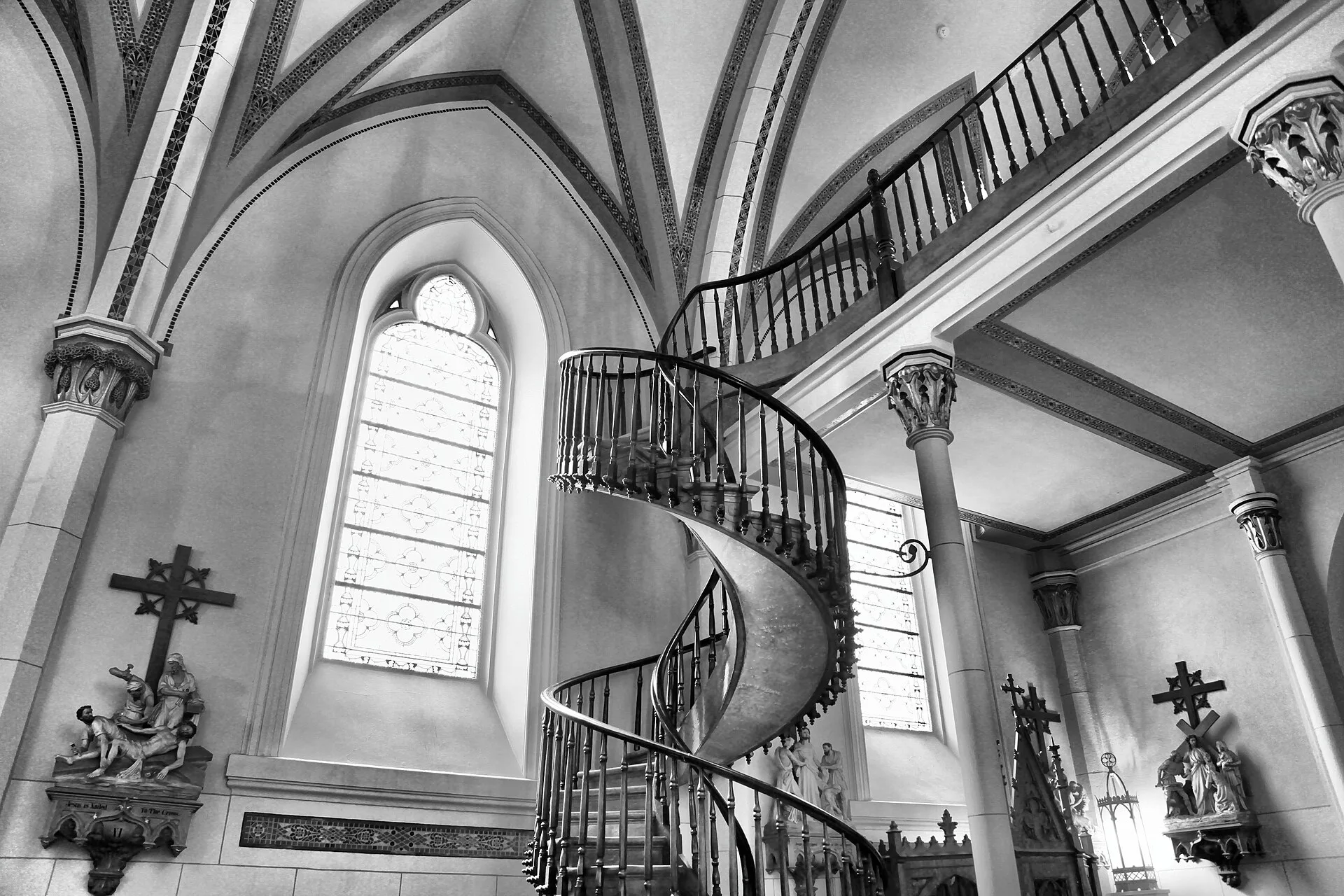
The Loretto Chapel stands on the Old Santa Fe Trail in Santa Fe, New Mexico, a small Gothic Revival church in local sandstone that looks as though it belongs in France. In a sense it does. It was commissioned in 1873 for Loretto Academy, the girls’ school run by the Sisters of Loretto, and designed by Projectus Mouly, a French architect brought to Santa Fe with his father by Archbishop Jean-Baptiste Lamy to work on the cathedral. Its model was the Sainte-Chapelle in Paris. It was consecrated in 1878.
The legend
What the chapel lacked was a way up to the choir loft, some 20 feet above the floor. In the version the sisters handed down, carpenters were consulted and none could fit a conventional stair into the cramped back of the nave. The nuns then made a novena, nine days of prayer, to St. Joseph, the patron of carpenters. On the last day an elderly, bearded man arrived with a donkey and a box of tools and offered to do the job. He worked alone for months, finished, and left without asking for payment or giving his name. Many concluded that he had been St. Joseph.
His staircase is remarkable to look at. It climbs in 33 steps through two complete turns with no central pole, the treads cantilevered from twisting side pieces, and it is said to be held together with wooden pegs rather than nails. The wood has been described as a spruce that nobody has matched precisely. As built it had no handrail, and nuns and students are said to have come down it on hands and knees. A railing was added in 1887 by another craftsman, and an iron bracket now ties the outer side of the stair to a nearby column.
The investigation
The stair does not defy physics. A spiral staircase is normally carried by a central post, but this one is held up by its stringers, the long boards that carry the ends of the steps, each bent into a helix. The inner stringer turns on such a tight radius that it does much of the work a central post would, a point the investigator Joe Nickell made in the Skeptical Inquirer in 1998. When some 170 stair builders visited the chapel during a 2018 conference in Santa Fe, they praised the craftsmanship and saw French design in it, but said they would build it in much the same way today. One estimated that a single skilled maker would have needed a year or two.
The builder’s identity has also been largely recovered. Working through the sisters’ records and local newspapers, the historian Mary Jean Straw Cook found an entry for March 1881 noting a payment of $150 for wood to a Mr. Rochas. She linked it to François-Jean Rochas, a French-born carpenter who had come to New Mexico and later lived on a ranch near La Luz, in the south of the territory. A short notice in an 1895 issue of the Santa Fe New Mexican, reporting his death, described him as well known in town as an expert woodworker and credited him with the staircase at the Loretto chapel and another at St. Vincent’s sanitarium. Cook published her findings in a 2002 edition of her book on the chapel and suggested the stair may have been made in France and fitted in Santa Fe.
The explanations
Not everyone accepts the identification. Credits of this kind are easy to make: in 1970 the New Mexican named a Viennese craftsman on the word of his grandson, who later admitted he could prove nothing. Writing in the National Catholic Register in 2022, John Clark pointed out that the 1895 credit appeared in a gossip column, that the 1881 payment seems to have been for work on a school rather than the chapel, and that it came after the stair was supposedly finished. The sisters’ surviving accounts record no payment for the staircase itself. Cook’s own view is that those who knew the builder’s name chose not to spoil the story, and that by the time the legend had grown famous they were dead.
Where it stands
Loretto Academy closed in 1968, and the chapel is now a privately owned museum and wedding venue. The staircase is closed to climbing but remains one of the city’s best-known sights. The engineering question is answered: it stands because it was cleverly made. The historical question is mostly answered, with Rochas as the strongest candidate on the documents available. The miracle remains a matter of faith rather than evidence.