
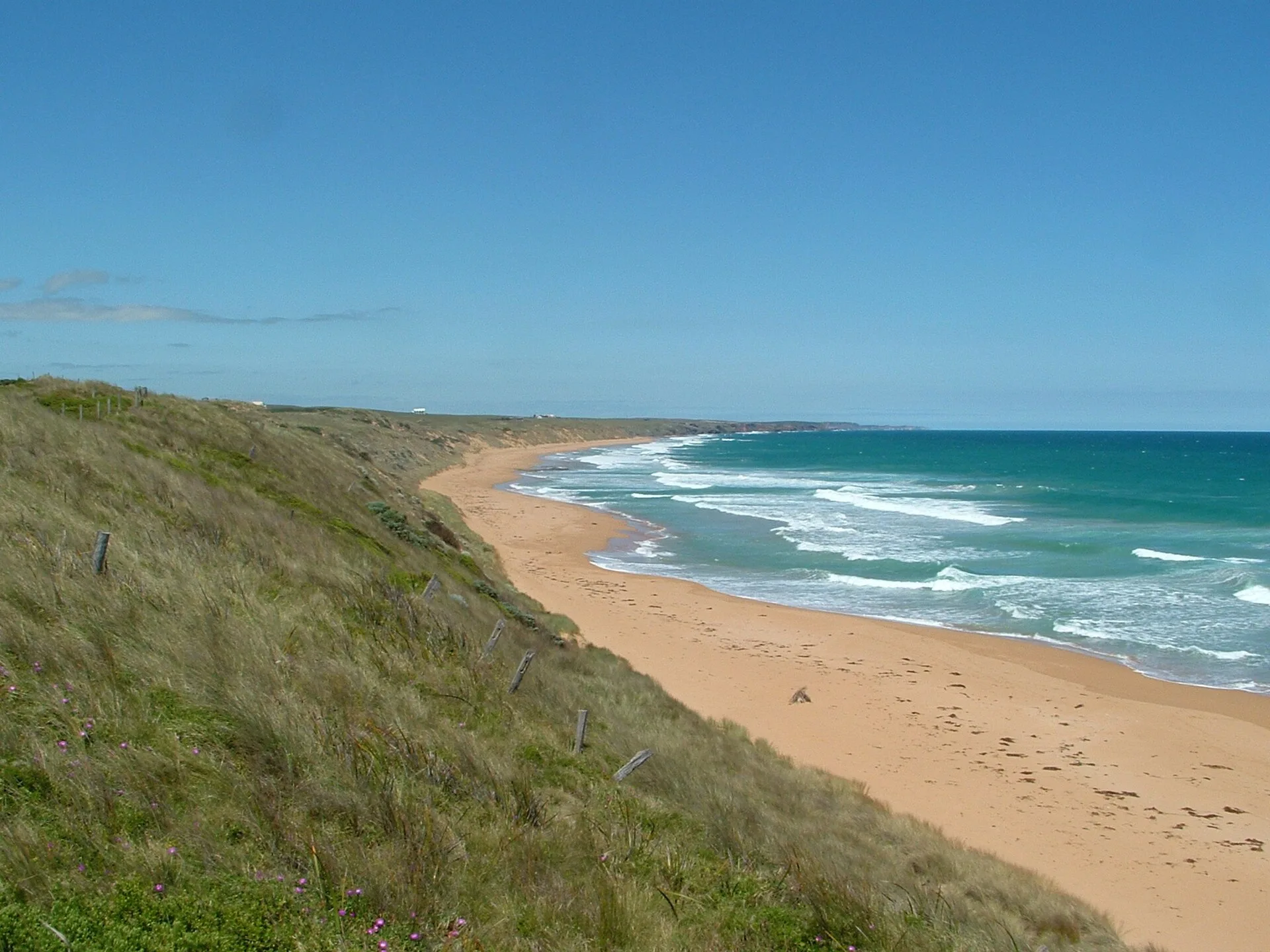
West of Warrnambool, on Victoria’s southwest coast, a belt of grassy sand hills runs toward Port Fairy below the old volcano of Tower Hill. For much of the nineteenth century, settlers, whalers and farmers said an old wooden wreck lay somewhere in or near those dunes. Nobody knew what ship it had been, and in the 1880s it stopped being seen. Since then the “Mahogany Ship” has been searched for with shovels, metal detectors and radar, and has never been found.
What happened
The best-known version of the story starts in January 1836. A whaling boat from Port Fairy capsized in the surf near the mouth of the Hopkins River, and the survivors walked naked back along the beach, passing a strange wreck on the way. This tale reached print in a popular book of 1898, but the researcher Jenny Fawcett has called it a foundation myth: the man who supplied it had not seen the wreck, and Captain John Mills, the harbor master often named as having taken bearings on it, never wrote about a buried hull himself. Another widely quoted witness, the whaler Hugh Donnelly, admitted in 1881 that he had never laid eyes on it, then spent his later years telling a far grander version.
Even with those accounts set aside, a good deal remains. The geologist and historian Murray Johns counted about forty primary reports from people who said they saw an unidentified wreck between Levy’s Point and Gorman’s Lane at various times between the 1830s and about 1881. Many were collected by Joseph Archibald in 1890 and by other local researchers around 1910. Observers described dark, red-brown timber so hard that a knife glanced off it, and puzzled over how a vessel had come to rest so far from the waterline.
How it became a caravel
The name came late. In 1876 a Port Fairy man, John Mason, wrote to the press recalling a wreck in the dunes whose wood looked like cedar or mahogany, and wondered if it was an early Spanish or Portuguese ship. In 1890 he walked that back, saying many Australian hardwoods would look the same and that he doubted it was mahogany at all. By then the Argus journalist John James, who wrote as “The Vagabond,” had already called it a “Spanish Mahogany Ship” in 1884, and the label stuck.
In 1977 Kenneth McIntyre’s book The Secret Discovery of Australia gave the wreck a starring role. McIntyre argued that a Portuguese squadron had charted Australia’s east and south coasts around 1521, citing the sixteenth-century Dieppe maps, and that the Warrnambool wreck was one of its caravels. The idea caught on locally. A Portuguese-style stone padrão now stands in Warrnambool, and the town hosted Mahogany Ship symposia in 1981, 1987 and 2005. In January 1992 the Victorian government offered a reward of $250,000 for the wreck, setting off a rush of searchers in the dunes.
The explanations
Johns, presenting at the 2005 symposium, re-read the original witnesses and found they did not agree on the most basic point. Some put the wreck in the surf, visible only at low tide; others had it high on the beach; others again buried in the dunes. He concluded that the reports described at least two and probably three different wrecks. Witnesses who described the hull compared it to a lighter, a coal barge or a flat-bottomed punt, and three of them specifically denied it looked anything like an old Spanish or Portuguese vessel. Timber said to come from the wreck has been identified as Australian, including one piece found in 1980 to be turpentine. Johns suggested the dune wreck might be the Sydney schooner Unity, stolen by escaped convicts in Tasmania in 1813 and never seen again.
Victoria’s heritage register lists the Mahogany Ship as a protected historic shipwreck, noting there is no historical evidence that it was an early European ship of discovery. The register suggests it could equally have been an early whaler or drifting wreckage. Other researchers have pointed to a French whaler lost on that coast around 1841, whose fittings were found on the beach.
Where it stands
No piece of the wreck has been recovered from a known location, the 1992 reward went unclaimed, and modern ground-penetrating surveys of the dunes have come up empty. Dunes move, and some of the landmarks witnesses used for their bearings, such as old churches, have long since been demolished. A real wreck, or several, probably lay west of Warrnambool in the nineteenth century. Whether any of them was Portuguese is a separate question, and the surviving evidence points away from it.