
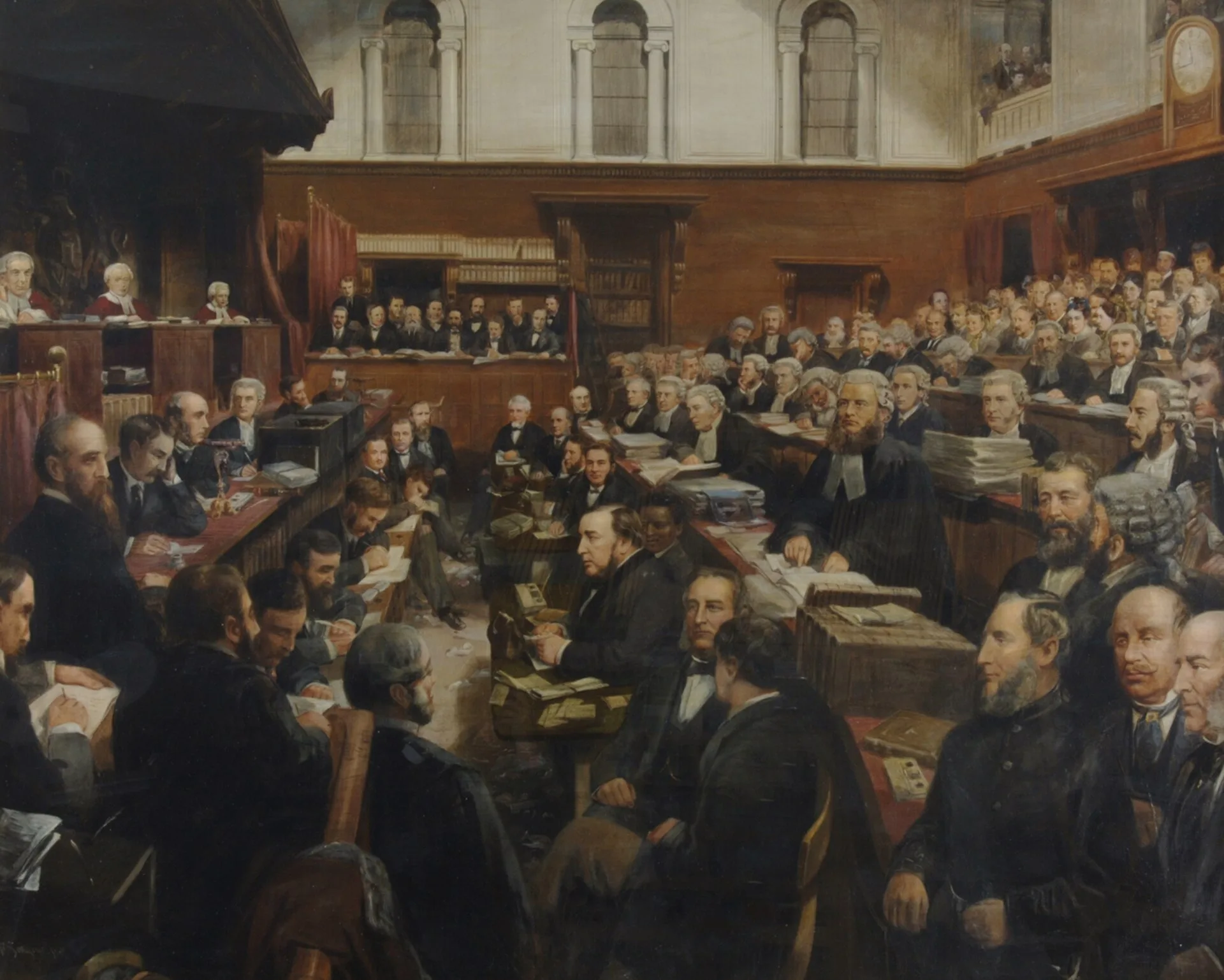
In the 1860s a heavyset butcher in the New South Wales town of Wagga Wagga, known locally as Tom Castro, announced that he was Roger Tichborne, the lost heir to one of the oldest Catholic baronetcies in Hampshire. The claim ran through two of the longest trials in English legal history and split the country along lines of class. It was settled in court in 1874, but the man at the center of it never stopped insisting, apart from one paid confession in 1895, that he was who he said he was.
What happened
Born in 1829, Roger Charles Tichborne grew up largely in Paris, so that French was his first language. After Stonyhurst College and three years with the 6th Dragoon Guards he sold his commission and went traveling in South America. In April 1854 he left Rio de Janeiro on a ship called the Bella, bound for Jamaica. She never arrived; a capsized boat carrying her name and some wreckage were found, and she was taken to have gone down with everyone aboard. Roger’s will was proved in 1855.
His mother, Henriette, Lady Tichborne, refused to accept it. She kept placing newspaper advertisements, and in late 1865 an agency in Sydney told her that a man fitting the description had turned up in Wagga Wagga. Castro, nudged by a local solicitor, had answered the notice. The letters that followed were barely literate and full of errors about Roger’s life, but the dowager wanted to believe. Castro sailed for England and reached London on Christmas Day 1866. In January 1867 she met him in a dim Paris hotel room, recognized him as her son, and gave him an allowance of a thousand pounds a year.
The investigation
The rest of the family rejected him at once. Roger had been slight and narrow-faced; the claimant weighed well over twenty stone and had no French. Yet he gathered real support. The old family solicitor backed him, as did a Winchester antiquary who knew the Tichbornes well, and he recruited a former servant of the family, Andrew Bogle, and some of Roger’s old troopers, from whom he picked up details that convinced more than a dozen officers of the regiment. Lady Tichborne died in 1868, but by then the claimant was raising money on “Tichborne Bonds” to pay for his lawsuit.
The trustees of the estate had been digging too. They found that on his first night in England the claimant had gone to Wapping in east London, asking after a butcher’s family named Orton. Arthur Orton, the youngest son, had gone to sea as a boy, jumped ship in Chile and stayed with a family called Castro at Melipilla, then emigrated to Australia in 1852 and fallen silent in 1854. An inquiry in Chile found that Orton had been at Melipilla and Roger never had.
The civil action, an attempt to eject the trustees, opened in May 1871 and ran for 102 days. Under 22 days of cross-examination by Sir John Coleridge, the claimant could not recall his school, his books, or his mother’s language. Witnesses described tattoos Roger had acquired at Stonyhurst; the claimant had none. In March 1872 his counsel abandoned the case and the judge had him arrested for perjury. The criminal trial, before Lord Chief Justice Cockburn and two other judges, ran from April 1873 to February 28, 1874, when the jury took about half an hour to find that he was Arthur Orton. He was sentenced to fourteen years.
The explanations
The verdict did not end the argument. Many working people had paid for his defense and saw the case as gentry and lawyers, some said Jesuits, ganging up on an outsider. His barrister, Edward Kenealy, was disbarred for his conduct, won a seat in Parliament, and in 1875 asked for a royal commission into the trial; the House of Commons voted it down 433 to 1. The claimant was freed in 1884 and toured music halls. In 1895 he sold a signed confession to The People newspaper describing how the fraud began, then took it back. He died poor in London in April 1898, and the name on his coffin was Sir Roger Charles Doughty Tichborne.
A few writers have proposed that he was neither Roger nor Orton, or that he was an illegitimate Tichborne, which might explain some family resemblance. No evidence for either idea has been produced.
Where it stands
The courts heard the evidence at a length no modern trial would allow, and the identification with Orton rests on his own movements, the Chilean inquiry, the missing tattoos and his ignorance of Roger’s life. The Australian Dictionary of Biography treats him as Orton while noting that a little doubt remains because he withdrew his confession. Nothing from the Bella’s crew or passengers was ever recovered to test against, so the verdict rests on documents and testimony rather than science, but on that record the claim fails.