
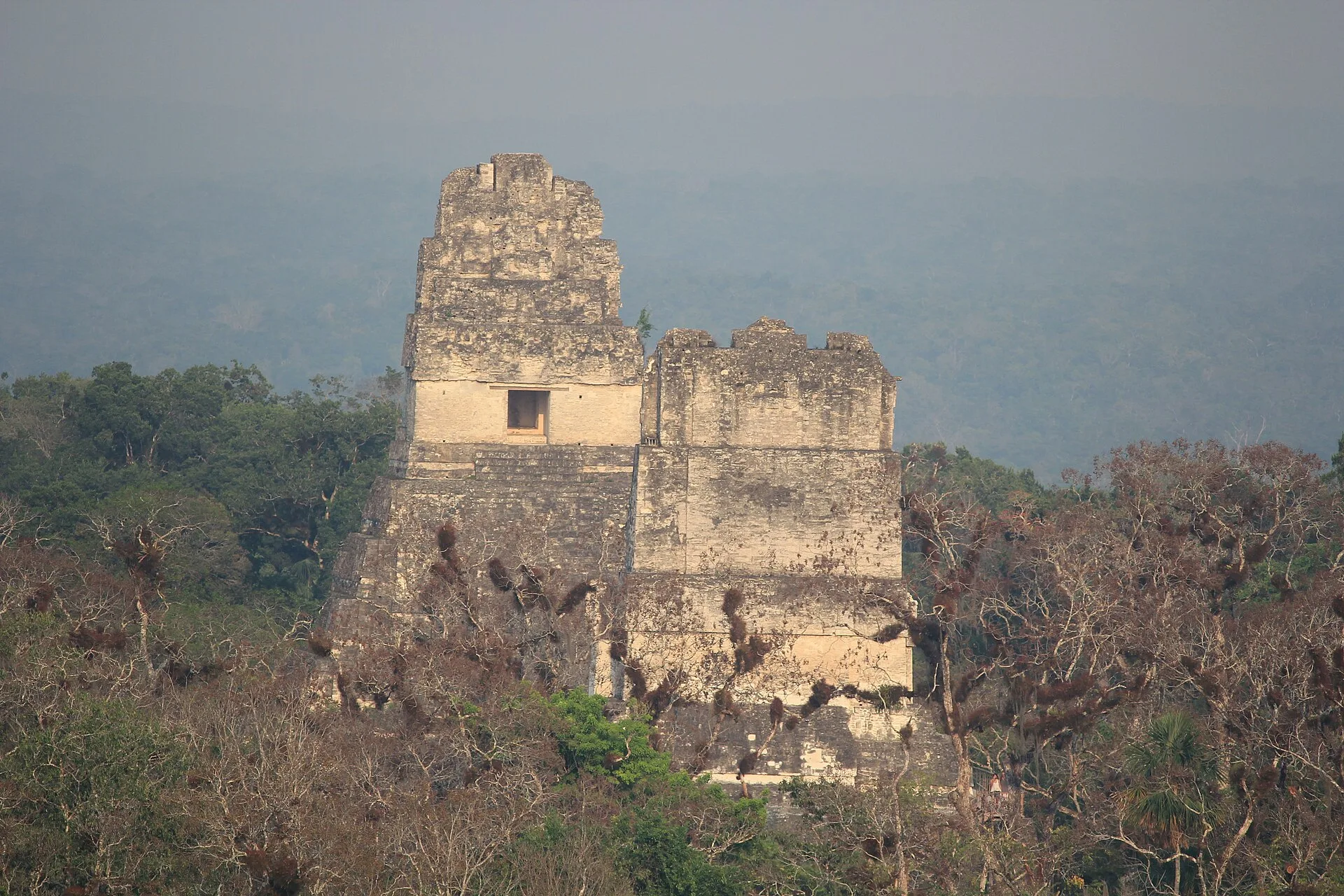
The temples of Tikal rise out of the forest canopy of the Petén lowlands in northern Guatemala, the tallest of them more than sixty meters high. For most of the first millennium AD the city, which its rulers called Mutal, was one of the two or three great powers of the Maya world. Then, over a few generations, it emptied, and the forest took it back. A place that size, abandoned that completely, was always going to gather ghosts.
What happened
Tikal was occupied for well over a thousand years. At its height around AD 700 it supported a population that David Lentz of the University of Cincinnati puts at roughly 45,000 on the basis of the food and fuel its land could yield, with other estimates running higher. The city depended on rain. It had no rivers or lakes, and its dry seasons were bridged by a system of plastered reservoirs filled during the wet months. In the Late Classic period the surrounding forest was cut back by about 60 percent for fields, timber and lime-burning. The last dated monument at Tikal was raised in AD 869, and by around 870 the center had been abandoned, with survivors drifting toward the lakes to the south and into what is now Belize.
Spanish friars reached the ruins in 1695 and a Guatemalan expedition under Modesto Méndez and Ambrosio Tut produced the first formal report in 1848. Carved wooden lintels were cut from Temples I and IV in 1877 and shipped to Europe. The University of Pennsylvania Museum ran the first large-scale excavations from 1956 to 1970, and the Guatemalan national project took over in 1979. Visitors today enter a national park where the main plazas have been cleared and the rest of the city still lies under trees.
The investigation
The archaeology of the collapse is unusually direct. Mineral deposits in regional caves record a run of severe droughts in the mid-ninth century, exactly when the monuments stop. Pollen and soil cores show the extent of the deforestation, which would itself have reduced local rainfall. In 2020 Lentz’s team published sediment analyses from four of the city’s reservoirs showing that the two largest, the Palace and Temple reservoirs at the heart of the ceremonial center, were loaded with mercury, phosphate and the DNA of cyanobacteria that produce lethal toxins. The mercury came from cinnabar, the red pigment painted on buildings and burials, washed into the tanks for centuries. In a drought the city’s rulers would have been drinking from poisoned pools while the population starved.
The ghost lore has been examined less rigorously. A Penn Museum film of 1963 already called Tikal the place of whispering voices, a folk reading of the name that guides still repeat. In July 2012 the travel-and-cryptid series Destination Truth devoted an episode, Spirits of Tikal, to the claim that locals had witnessed paranormal activity among the temples, framed around the human sacrifices once performed there. In June 2020, during the pandemic closure, a park ranger recorded a sound near Temple IV, the tallest pyramid, and the park’s own social media posted it with the invitation to turn up the volume. On July 6 the Venezuelan YouTuber Dross Rotzank shared it as Three Terrifying Screams, insisting it was neither fake nor a prank, and within days it had 1.5 million views. Guatemalan commenters recognized La Llorona, the weeping woman of Central American legend. Park officials said it was impossible to determine where the cries came from or whether a wild animal had made them.
The explanations
The empty-city story needs no spirits; drought, soil exhaustion, bad water and the failure of a political order that promised rain explain it. The voices have mundane candidates too. Tikal’s forest is full of black howler monkeys, whose roaring at dawn and dusk carries for kilometers and sounds, to the uninitiated, like something in pain. Wind moving across the temple comb of a sixty-meter pyramid produces moans of its own. A city that practiced human sacrifice, told to tourists before dawn at the top of a tomb, supplies the rest.
Where it stands
Tikal is a national park and a World Heritage site, and the clearest case we have of how a great Maya city died. Its ghosts belong to the guides and the night tours, and to a ranger’s phone recording that nobody has identified. Both stories, the real one and the told one, are about the same thing: a crowded place that fell silent.