
Alexander I ruled Russia for almost a quarter of a century and led it to victory over Napoleon. He came to the throne in 1801 through a palace coup in which his father, Paul I, was murdered, and those around him said the knowledge never left him. In his last years he grew withdrawn and religious and spoke more than once of giving up the crown to live quietly. That wish, and the strange circumstances of his death, gave Russia its most enduring royal legend.
What happened
In the autumn of 1825 Alexander took his ailing wife, Empress Elizabeth Alexeievna, to Taganrog, a small port on the Sea of Azov far from the capital. A few weeks after arriving he fell ill with a fever, and on December 1, 1825 (November 19 in the Julian calendar then used in Russia) he died, aged 47. His body was embalmed and carried slowly north to St. Petersburg, and it was buried in the Peter and Paul Cathedral the following March. Elizabeth died a few months later. Doubts began almost immediately. A healthy man had died suddenly in a remote town; witnesses said the face in the coffin had changed badly; the coffin was kept closed.
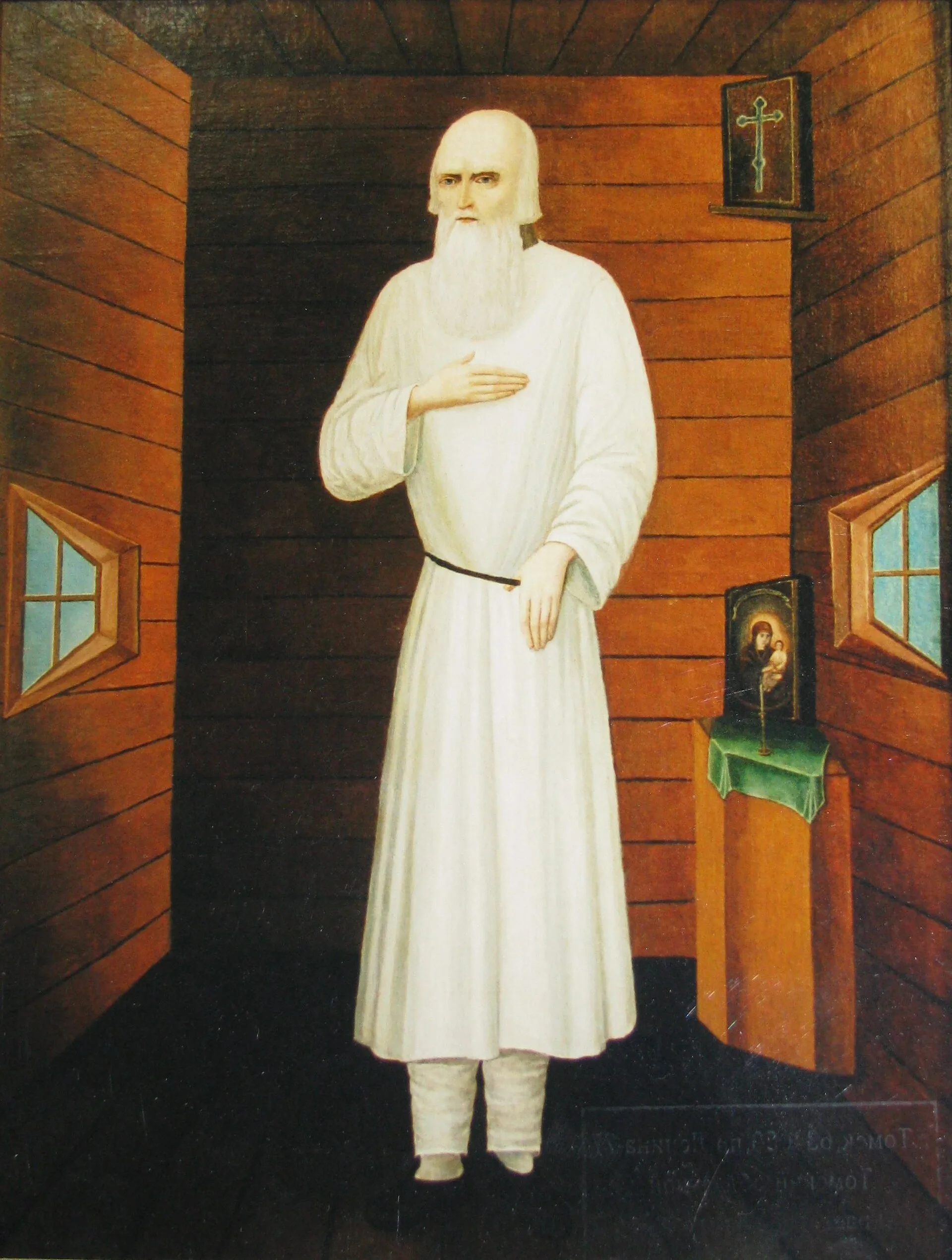
Eleven years later, in September 1836, a gray-bearded man appeared in Krasnoufimsk in Perm province riding in a horse-drawn cart. He had no documents and would not explain himself. Arrested as a vagrant, he gave his name as Feodor Kuzmich, received twenty lashes and was sent east to Siberia with a party of exiles. He spent five years at a distillery, then lived as a hermit in the Tomsk region, and finally settled in a cell on the property of a Tomsk merchant, Semyon Khromov, where he died on February 1, 1864.
The legend
The people who knew Kuzmich found him hard to fit with his story. He was a vagrant who read and spoke French, talked knowingly about St. Petersburg society and the campaigns of 1812, carried himself like a gentleman and was about the right height and age. Asked on his deathbed whether he was Alexander, he gave an answer that his followers took as a hint. After his death Khromov passed his belongings to Konstantin Pobedonostsev, a senior official close to the court. The future Nicholas II visited his grave as heir to the throne in 1891, and a chapel was raised over it. The writer Alexis Troubetzkoy reported that Grand Duchess Olga Alexandrovna, the last tsar’s sister, told him in the 1950s that the family had no doubt Kuzmich was the emperor. Leo Tolstoy, fascinated by the idea, began a novella in Kuzmich’s voice and never finished it.
The investigation
The most thorough early study came from inside the dynasty. In 1907 Grand Duke Nicholas Mikhailovich, a historian of Alexander’s reign, published a documentary examination and concluded that the identification was a seductive legend with no ground beneath it, noting among other things that a cryptic note said to be in Kuzmich’s hand depended on the word of one family.
Supporters have kept adding material since. In 2015 Svetlana Semyonova, president of the Russian Graphological Society, said samples of Alexander’s and Kuzmich’s handwriting showed the same writer, a graphological opinion rather than a forensic finding. The State Historical Museum in Moscow notes that researchers at the Siberian State Medical University judged Alexander’s death mask likely to have been taken from a living man. Kuzmich’s remains, recovered in 1995 when his grave was reopened, were reported to be missing the skull. Stories that Alexander’s own tomb was opened and found empty, most often dated to 1921, have never been confirmed by any record.
Where it stands
The Russian Orthodox Church canonized Feodor Kuzmich in 1984 as the Righteous Theodore of Tomsk, and the Tomsk diocese said in 2015 that it did not oppose a DNA test. None has been carried out on either set of remains. Without one, the case stays open: the documents describe a sick emperor dying in Taganrog, and the legend describes a penitent who walked away from the throne. The Moscow museum’s own label puts it plainly: historians have not definitively settled whether the two were the same man.