
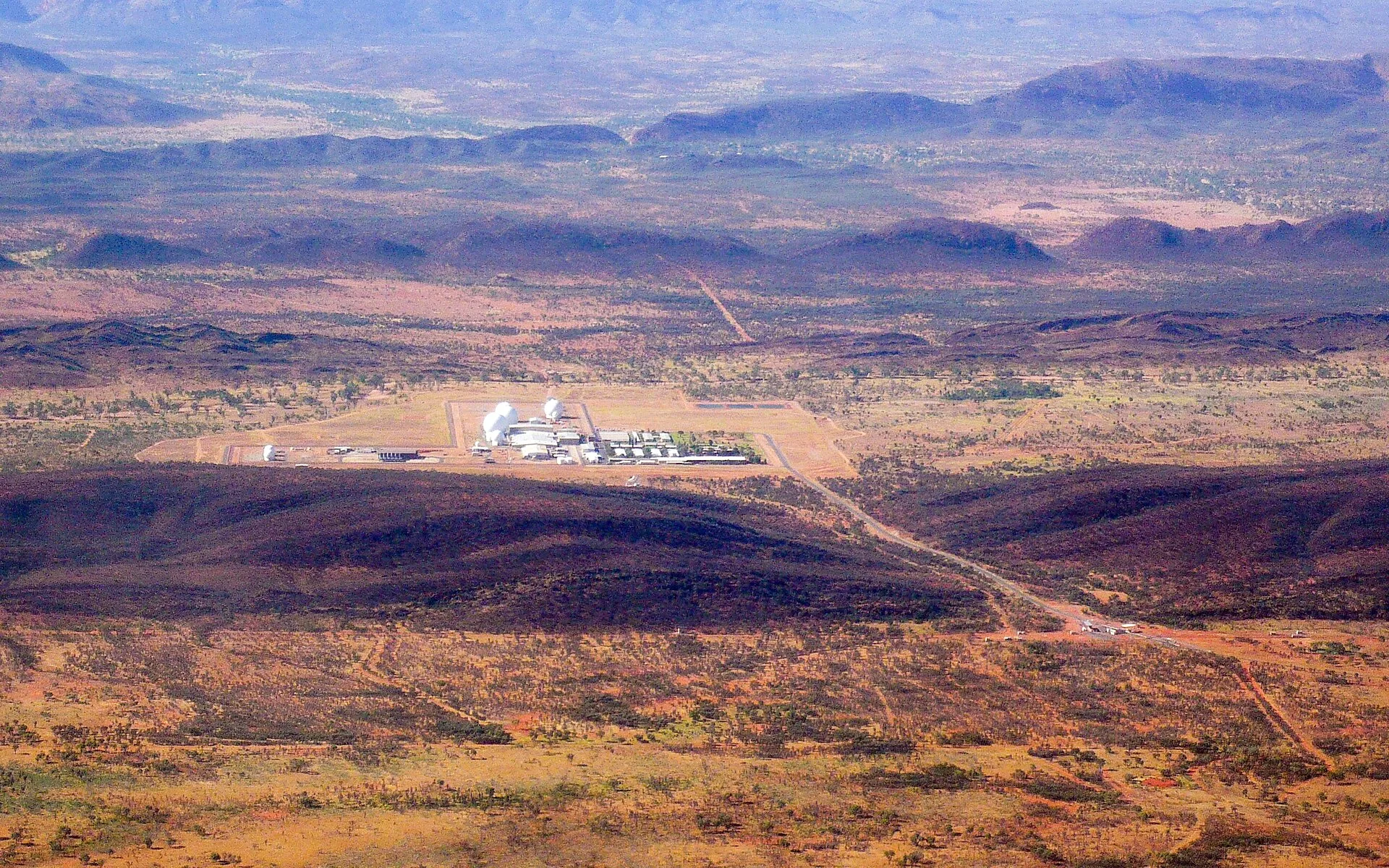
Drive a few minutes south of Alice Springs, in the middle of the Australian continent, and the road ends at a checkpoint and signs warning of a prohibited area. Beyond them, folded into a valley of the MacDonnell Ranges, sit dozens of white domes that look like giant golf balls. Officially this is the Joint Defence Facility Pine Gap. For most of its life almost nothing about it was officially explained, and that silence has been filled with everything from documented espionage to flying saucers.
What happened
Australia and the United States signed the agreement for the facility on December 9, 1966. The town, then in the grip of a long drought, was told it was getting a “space research” station that would bring American families, new houses and money. Operations began around 1970. In an ABC podcast series in 2024, Alice Springs residents recalled how little anyone was told: the local member of parliament, Charles Orr, complained to the prime minister that the town did not know the true picture, newcomers who talked too much were quietly sent home, and newspaper headlines even suggested the base might attract flying saucers.
The truth, pieced together over decades by the defense analysts Desmond Ball and Richard Tanter and later by leaked documents, was that Pine Gap is a ground station for American signals-intelligence satellites in very high orbit. It was run in its early years by the CIA, with the National Security Agency and National Reconnaissance Office closely involved. It intercepts missile telemetry, radar signals and communications across Asia, the Middle East and beyond. Files released by Edward Snowden and published by ABC News and The Intercept in August 2017 described satellite missions controlled from the base and its role in geolocating targets for American military operations. The name was changed to Joint Defence Facility in 1988; the “space research” label had lasted more than twenty years.
The theories
The most consequential theory concerns Gough Whitlam. Elected prime minister in 1972, he resented how little Canberra had been told about the base, and by 1974 he was signaling reluctance to extend foreign bases on Australian soil. On November 11, 1975 the governor-general, Sir John Kerr, dismissed him in a budget crisis. Victor Marchetti, a former CIA officer, later said that Whitlam’s threat to the base had alarmed Washington. Christopher Boyce, an employee of an American satellite contractor convicted in 1977 of selling secrets to the Soviet Union, claimed during his case that the CIA had meddled in Australian politics, including the dismissal. No document has confirmed a CIA role in the dismissal, and the ABC’s 2024 series concluded the rumors endure without proof.
The stranger layer of lore holds that the domes cap a deep underground complex, sometimes said to extend far below the desert floor, where alien craft or alien technology are studied, and that unexplained lights over the ranges are its visitors. These stories draw on the same pattern seen at Area 51: an off-limits government site, real secrets and no public explanation. They turn up in podcasts, websites and fiction, including Mark Frost’s novel The Secret History of Twin Peaks, in which a character describes the base as an extraterrestrial facility. None of it is backed by any document, witness on the inside or physical evidence.
The explanations
What is known about Pine Gap accounts for the secrecy without any need for aliens. The domes protect antennas pointed at satellites; the facility’s isolation was chosen because it is hard for foreign ships to eavesdrop on its downlinks from international waters; and staff are bound to silence because the work is classified, not because it is unearthly. The deeper suspicion locals felt was justified in a narrower way: they were misled about what the base was for.
Where it stands
Pine Gap remains in operation with several hundred Australian and American staff and around 38 radomes. Peace activists have protested at its gates since the 1980s, most recently over intelligence it may supply to wars in the Middle East. The verdict divides cleanly. The cover-up of the base’s purpose was real and lasted decades. The CIA-coup claim is plausible to some historians but unproven. The underground alien city is folklore.