
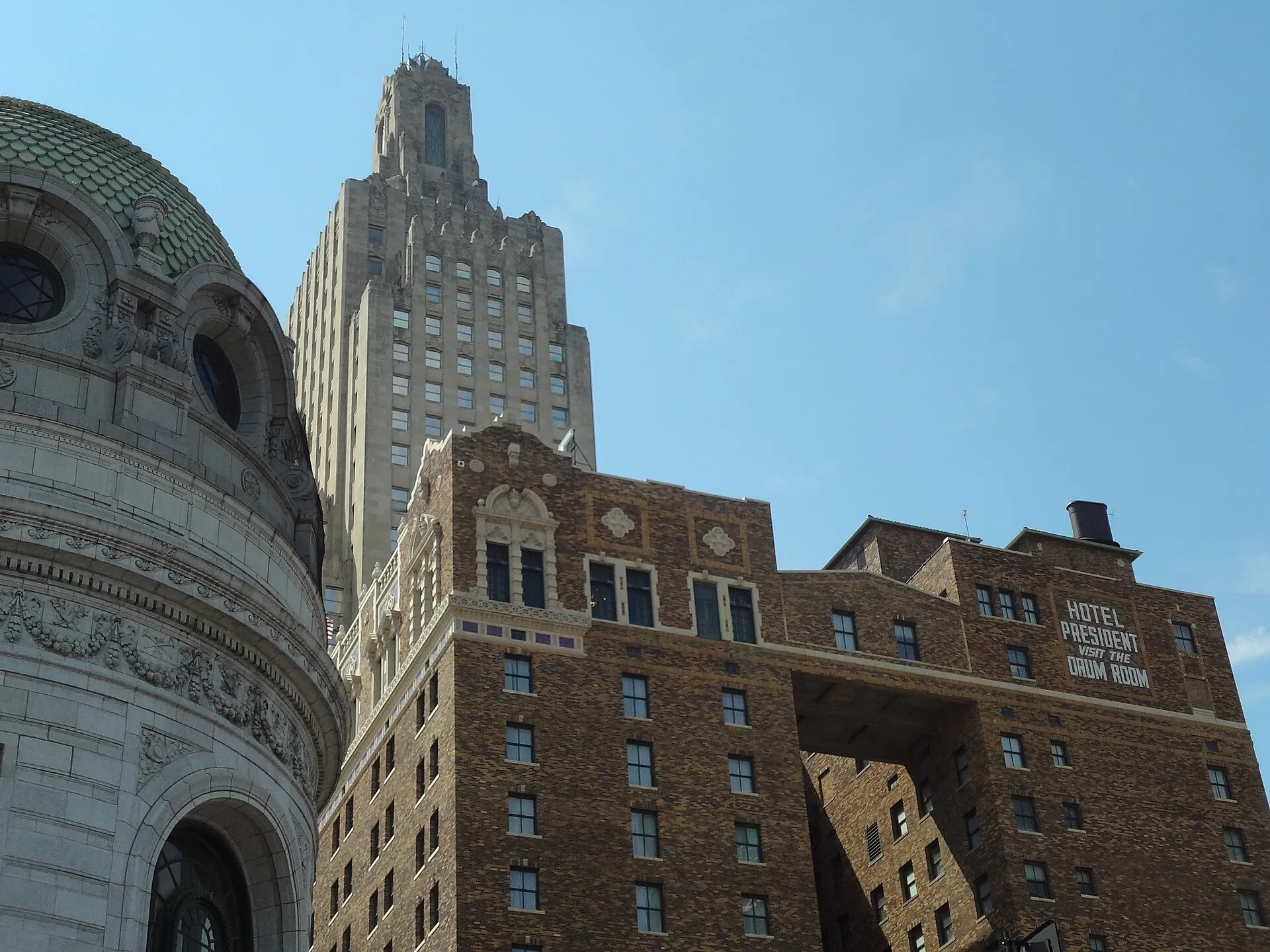
Kansas City in 1935 was a wide-open town run by the Pendergast machine. On the afternoon of January 2 a young man with no luggage walked into the Hotel President on Baltimore Avenue, registered as Roland T. Owen, giving his home as Los Angeles, and asked for an inside room a few floors up. He was given Room 1046. Within two days he had been bound, stabbed and beaten in that room, and within three he was dead. The name he used was false, and almost every lead it generated turned out to be false as well.
Two days in Room 1046
The staff remembered him well. He was neatly dressed and well spoken, with a cauliflower ear and a large scar on the side of his scalp, and the only things he unpacked were a comb, a hairbrush and a tube of toothpaste. A maid, Mary Soptic, told police he kept the shades drawn and sat in the dark, and that he seemed worried or afraid. On her first visit he told her not to lock up after her, since a friend would be along shortly. Later she saw a penciled note on the desk telling someone called Don that he would be back in fifteen minutes. The next morning she let herself in with a passkey and found him sitting in the dark again, although the door had been locked in a way only possible from the outside. While she cleaned he took a call and told the caller, whom he addressed as Don, that he was not hungry. That afternoon she heard two men talking inside, and a rough voice told her through the door that no towels were needed.
Early on January 4 the switchboard noticed that the phone in 1046 was off the hook. A bellboy knocked and was told by a deep voice to come in and to turn on the lights, but the door stayed locked. Around 8:30 another bellboy used his key and saw the guest lying naked on the bed with dark patches on the sheets, took him for a drunk, put the phone back and left. When the line went dead again a couple of hours later, the first bellboy went in and found the man on his knees with his head bleeding and blood on the walls, the bed and the bathroom.
The investigation
A doctor found cord tied around his neck, wrists and ankles, several stab wounds in the chest, a punctured lung and a skull fractured by repeated blows. From the dried blood he put the attack several hours earlier. Newspapers later reported that the victim denied anyone had attacked him, saying he had merely fallen in the bathroom. He sank into a coma and died at General Hospital in the early hours of January 5. Almost nothing personal was left in the room: no clothes, no luggage, only a glass bearing what detectives took for a woman’s fingerprints, a label torn from a necktie, a hairpin and a cigarette that had never been lit.
Los Angeles police could find no Roland T. Owen. The Muehlebach Hotel, where he said he had stayed the night before, had a similar guest registered under another invented name. Thousands of people filed past the body at a funeral home without naming him. When he was about to be buried in a pauper’s grave, an anonymous man telephoned to pay for a proper plot, saying the dead man had not played fair and that cheaters get what is coming to them. Money arrived by mail, and thirteen roses came with a card signed Louise. Detectives watched the grave and nobody came.
A name, and a stranger’s letters
In late 1936 a woman in Birmingham, Alabama, recognized the scar in a Sunday magazine story. Ruby Ogletree confirmed that the dead man was her son Artemus, who had left home in the spring of 1934 to hitchhike west with a friend. She had already had reason to worry. After his death she had received typed letters in his name, although he could not type, and in August 1935 a man phoned her from Memphis claiming her son was living well in Cairo, Egypt. No shipping line or consulate had any record of him abroad.
In 1937 New York police arrested a drifter for a murder in which the victim’s body was shipped in a trunk. One of his many aliases was Donald Kelso, the name Ogletree’s companion had signed at other Kansas City hotels, and the New Yorker reported that Kansas City detectives had matched his handwriting to the letters. A 1950 FBI comparison found the hotel signature was not his. Kansas City magazine, which later obtained the full police file, found that Ruby Ogletree came to suspect someone else, a suspicion detectives never pursued far.
Where it stands
The case was never closed and no one was charged. The police file shows detectives revisiting it into 1950, and some details repeated in later retellings, such as the caller’s mention of his sister, do not appear in the file at all. The documented core is strange enough: a victim who used a false name and refused to name his attacker, and a killer who seems to have spent months writing to the victim’s mother as if her son were still alive.