
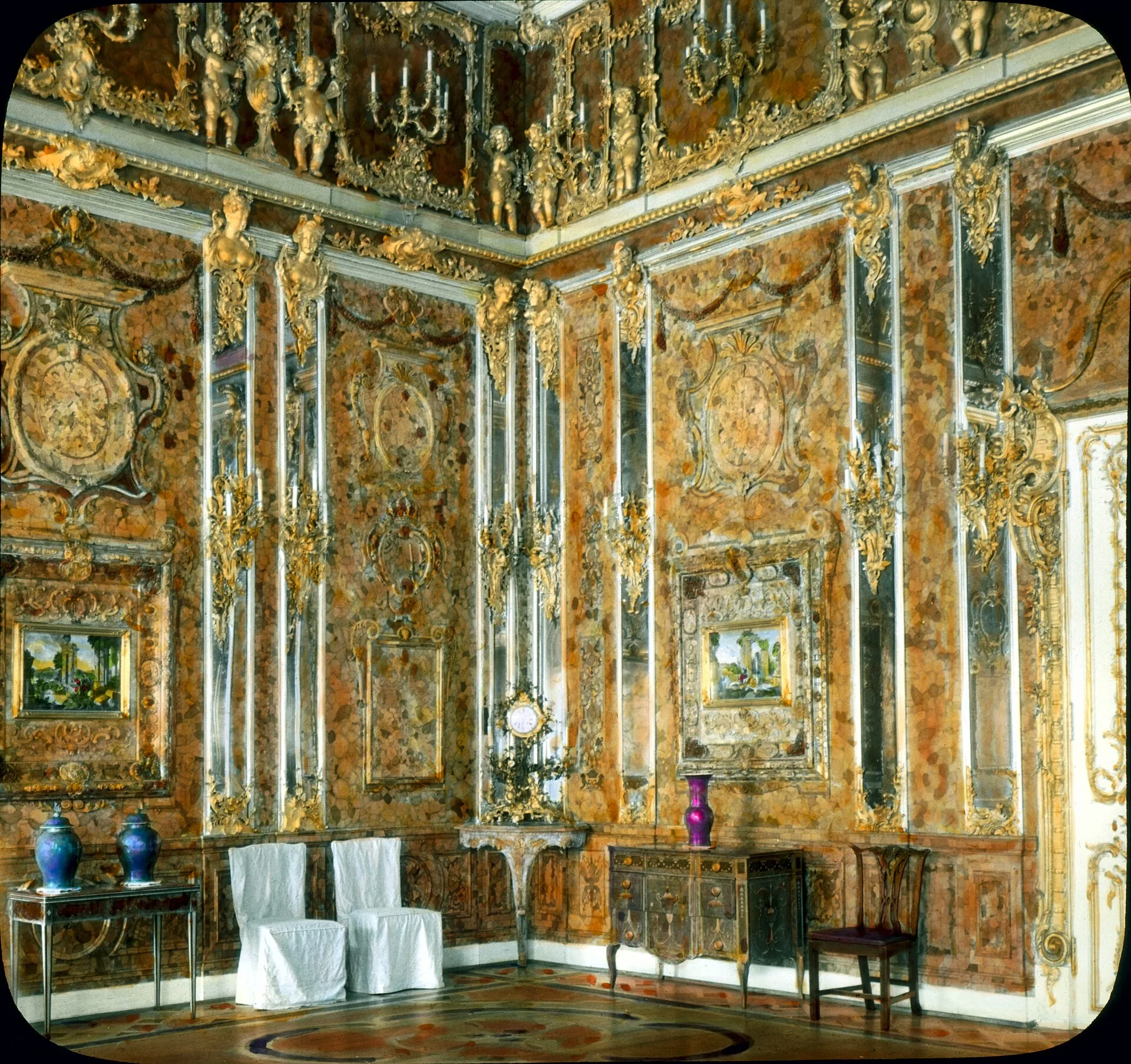
For almost two centuries a small reception room in the Catherine Palace at Tsarskoye Selo, south of St. Petersburg, was lined floor to ceiling with carved and polished Baltic amber, framed by mirrors and gilded wood. Visitors called it the eighth wonder of the world. In 1941 German soldiers stripped it from the walls and took it west. After early 1945 nobody can show where it went.
What happened
The room began as a Prussian project. In 1701 Frederick I, newly crowned King of Prussia, ordered amber wall panels for a cabinet in Charlottenburg Palace in Berlin, designed by the court architect Andreas Schlüter and made by the Danzig amber masters Gottfried Turau and Ernst Schacht. His son, Frederick William I, cared little for such things. In 1716, sealing an alliance against Sweden, he gave the panels to Peter the Great, who sent back a company of tall grenadiers, a lathe and a goblet he had turned himself. Under Peter’s daughter Elizabeth the architect Bartolomeo Rastrelli fitted the panels into the Winter Palace, and in 1755 he moved and enlarged them in the Catherine Palace, adding mirrored pilasters, gilt carving and four Florentine stone mosaics.
When Germany invaded the Soviet Union in June 1941, the curator Anatoly Kuchumov evacuated the smaller amber objects but judged the brittle panels too fragile to move. His staff covered them with cloth, padding and plain wallpaper. It did not work. German forces took Pushkin, as Tsarskoye Selo was then called, in September 1941; a looting unit dismantled the room in about 36 hours, packed it into 27 crates and sent it by rail to Königsberg in East Prussia, where it went on display in the city’s castle museum.
The investigation
The castle museum’s director, Alfred Rohde, is the last person known to have dealt with the panels; the final record of them dates from January 1945. Allied air raids in August 1944 had already wrecked much of the city and gutted parts of the castle, and in April 1945 the Red Army stormed Königsberg and leveled most of what remained.
In May 1945 Moscow sent the archaeologist Alexander Bryusov to find the room. After searching the ruins and interviewing witnesses, he concluded it had been destroyed in the fighting. Fragments of three of the four Florentine mosaics were found in the burned castle. In 1946, however, a new commission led by Kuchumov set Bryusov’s findings aside and declared that the Germans had moved the room to safety. That version became official, and for decades Soviet and East German investigators, including the Stasi, chased leads to bunkers, mines and cellars across Germany and the Baltic.
The explanations
Claims have multiplied. The room has been said to lie in a German silver mine, in a Lithuanian lagoon, in the bunkers of East Prussia, or on the seabed with refugee ships sunk in 1945, including the Wilhelm Gustloff. In 2020 Polish divers found the steamer Karlsruhe, which left Königsberg in April 1945 with refugees and cargo and was sunk off the Polish coast, and reported crates in its hold. When they returned in 2021, the crates held only military equipment and passengers’ belongings.
A few genuine pieces have surfaced. In 1997 a pensioner in Bremen tried to sell the fourth Florentine mosaic, an allegory of touch and smell, which he said had come from his father, a German soldier. A chest of drawers from the room also reappeared in Germany. The mosaic went back to Russia in 2000 in exchange for some 100 artworks taken from Bremen, and the chest was returned as well.
In 2004 the British journalists Adrian Levy and Catherine Scott-Clark, drawing on Kuchumov’s papers, Stasi files and Russian archives, argued that the panels were burned, probably by accident, in the castle after Soviet troops took the city, and that Soviet officials buried Bryusov’s report to keep blame on the Germans. Russian officials rejected the book, and its case, though strong, rests on circumstantial evidence.
Where it stands
In 1979 Soviet authorities ordered the room rebuilt. Russian craftsmen spent 24 years relearning the techniques from photographs and surviving pieces, and the work was finished with funding from the German gas company Ruhrgas. Vladimir Putin and Gerhard Schröder opened the new Amber Room in May 2003 for St. Petersburg’s 300th anniversary. Most historians now believe the original was destroyed in Königsberg in 1945. No one has proved it, and the search goes on.