
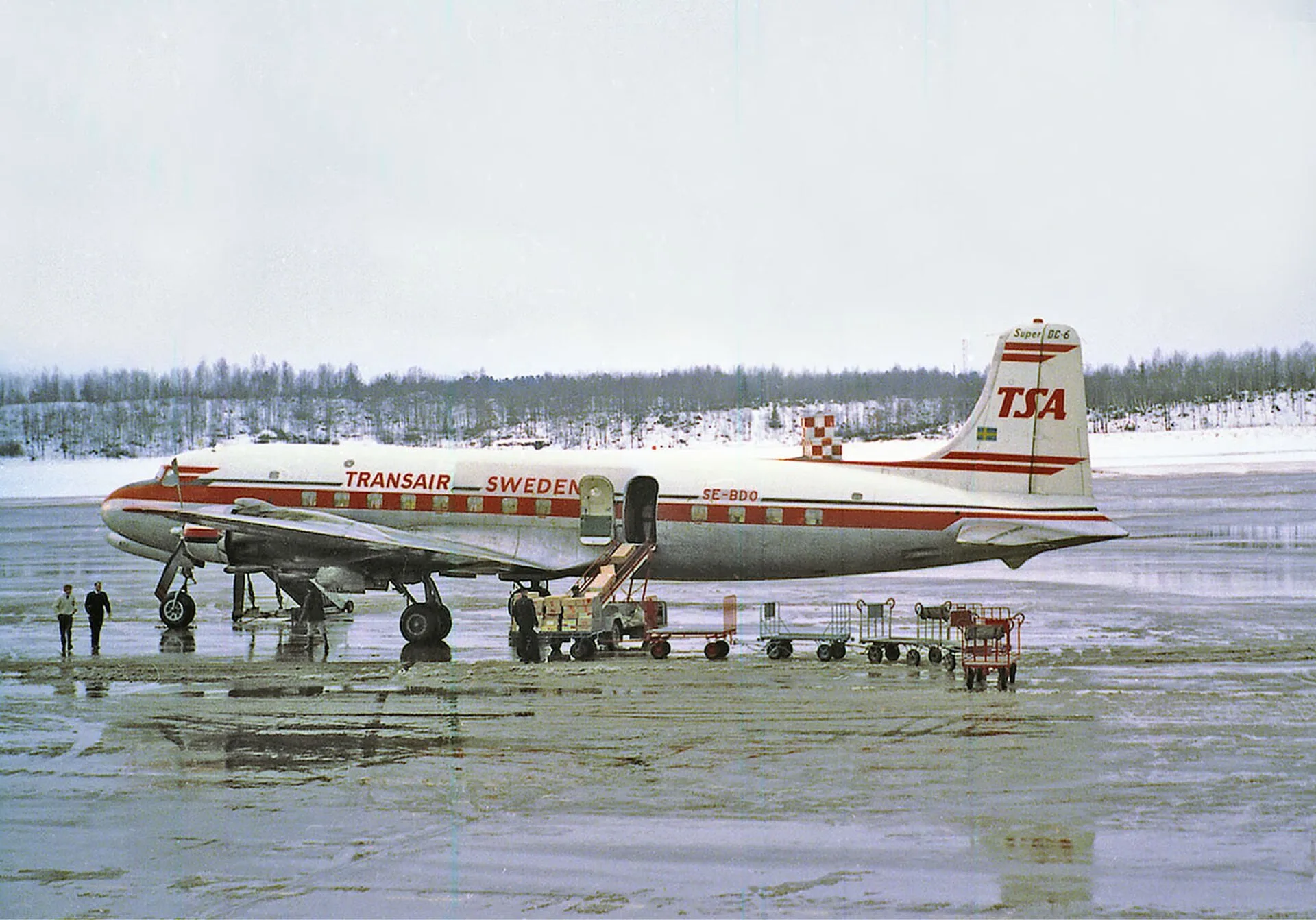
In September 1961 United Nations peacekeepers in the Congo had clashed with the forces of Katanga, the mineral-rich province whose leader, Moïse Tshombe, had declared it independent with the backing of Belgian mining interests and white mercenaries. Dag Hammarskjöld, the Swedish Secretary-General since 1953, decided to meet Tshombe in person to arrange a ceasefire. The meeting was set for Ndola, a mining town just over the border in Northern Rhodesia, then part of a British-ruled federation and now Zambia.
What happened
Hammarskjöld left Ndjili airport in Léopoldville at 5:51 in the evening on September 17 aboard the Albertina, a chartered Douglas DC-6 registered SE-BDY and flown by a Swedish crew from the charter firm Transair. Because Katanga had at least one Fouga Magister jet in service and had already harassed UN aircraft, the crew kept radio silence for most of the trip, filed a false destination and took a long detour east over Lake Tanganyika. Shortly after ten minutes past midnight the pilot told Ndola tower that he could see the runway lights and was descending. The tower asked him to report at 6,000 feet. He acknowledged, and nothing more was heard.
Ndola switched off its landing lights, assuming the plane had gone elsewhere. A flash in the sky was reported to the airport manager at about half past three in the morning, yet no air search started until about ten, and it went in the wrong directions. The wreck was not officially located until about three in the afternoon of September 18, roughly nine miles west of the airfield in open forest. The aircraft had clipped the treetops with its landing gear down and flaps set for landing, cartwheeled and burned. Fifteen of the sixteen people aboard were dead. Hammarskjöld’s body lay outside the fire, almost unmarked. The one survivor, the American security officer Sergeant Harold Julien, had lain burned in the sun for hours; before he died six days later he told a police inspector that the plane had blown up and that there had been many small explosions.
The investigation
Three inquiries followed in quick order. A Rhodesian board of civil aviation investigators found the approach normal except that the plane was about 1,700 feet too low, and could not exclude a deliberate act. A Rhodesian commission under Chief Justice Sir John Clayden went further and blamed the pilots for letting the aircraft descend into the trees. A United Nations commission, reporting in April 1962, saw no proof of sabotage, attack or mechanical failure but declined to exclude any of them. A Swedish review by the diplomat Bengt Rösiö in 1993 again settled on an altitude error by the crew.
The question was reopened by the historian Susan Williams, whose 2011 book Who Killed Hammarskjöld? gathered testimony from African charcoal burners and farmers near the crash site who said they had seen a second, smaller aircraft and a flash of fire before the DC-6 came down. In response a private trust set up the Hammarskjöld Commission, four senior jurists chaired by the British judge Sir Stephen Sedley, which reported on September 9, 2013. It accepted that the crash could be explained as controlled flight into terrain, but found persuasive evidence that the plane had been attacked or threatened as it circled to land. It singled out a former US Navy intelligence officer, Charles Southall, who recalled hearing a recording at a listening post in Cyprus that night in which a pilot announced he was making a run on the Transair DC-6. The commission concluded that the US National Security Agency had very probably recorded the local radio traffic and urged the UN to obtain it.
The explanations
The pilot-error case rests on the physical evidence: a calm, clear night, an orthodox approach pattern, engines running at impact and correctly set altimeters, all consistent with a crew that misjudged its height over unfamiliar ground. The attack case rests on witness accounts, on Julien’s words, on the presence of Katangan aircraft and foreign mercenaries in the region, and on the conspicuous gaps in the archives. A third theory, sabotage by a bomb, depends on documents headed South African Institute for Maritime Research that turned up at South Africa’s Truth and Reconciliation Commission in 1998 and describe an “Operation Celeste” to remove Hammarskjöld. Their authenticity has never been established, and the 2013 commission judged the claim impossible to verify.
Where it stands
The UN General Assembly took up the commission’s recommendation. A panel of experts led by Mohamed Chande Othman, a former chief justice of Tanzania, reported in 2015, and Othman has continued as the UN’s Eminent Person since. In 2017 he found it plausible that an external attack or threat caused the crash, and almost certain that no one aboard was killed after landing. His later reports, the most recent transmitted by Secretary-General António Guterres in October 2024, kept that assessment while leaving sabotage and unintentional human error open, and said that specific information almost certainly remains undisclosed in the archives of member states. Othman named South Africa, the United Kingdom and the United States as states likely to hold such material. His inquiry was still open in 2026. The cause of the crash is unproven, and the records that might settle it have not been released.