
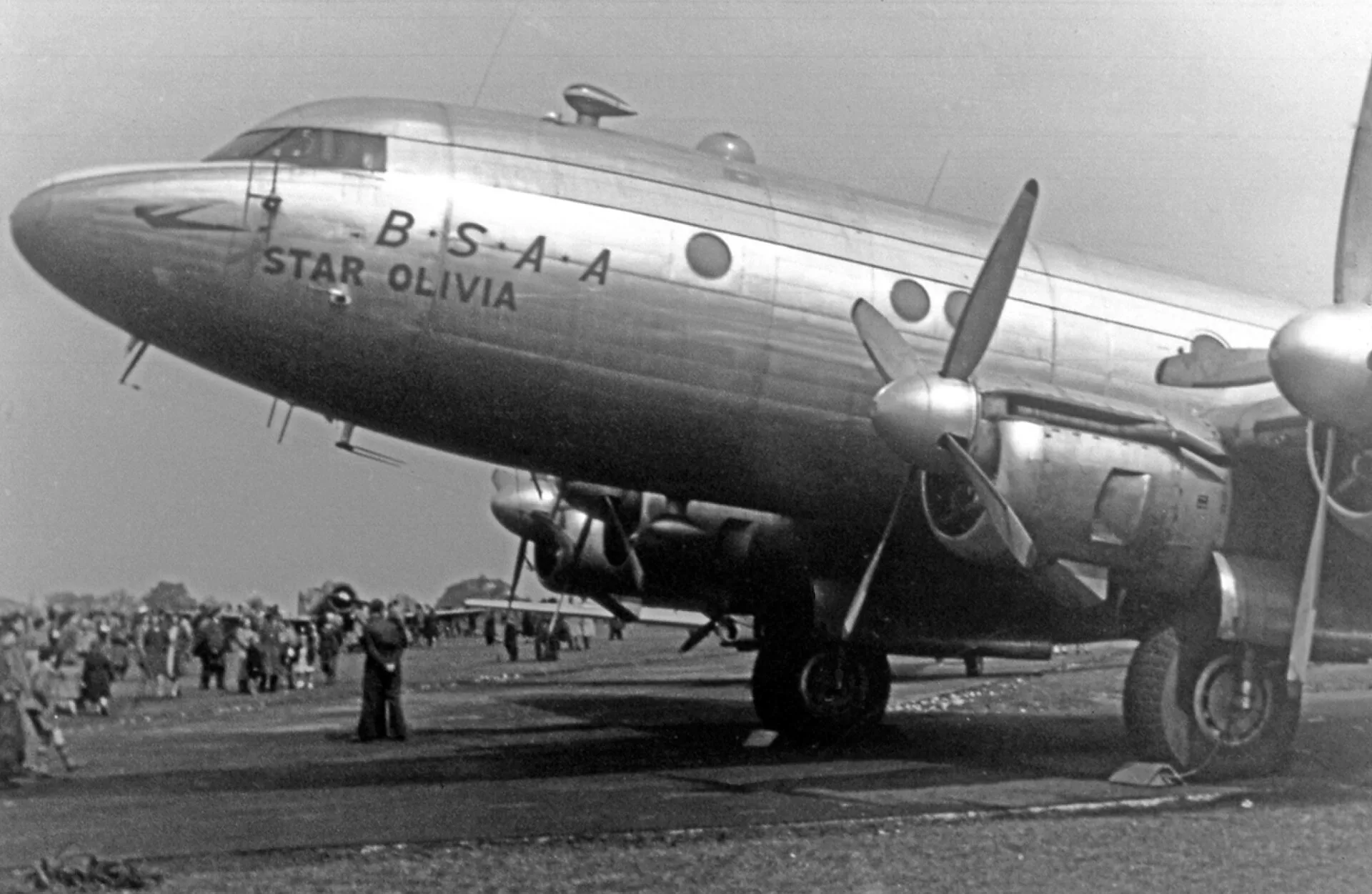
British South American Airways was a postwar state airline run largely by former wartime pilots, flying long, thinly served routes from London to the Caribbean and South America. Its fleet came from the Avro company: converted Lancaster bombers called Lancastrians, Yorks, and the Tudor, an airliner evolved from the same wartime bomber family. The Tudor IV was an enlarged version flown by the airline, and BSAA named its aircraft after stars. One Lancastrian, Star Dust, had already vanished over the Andes in 1947. Within the next eighteen months two Tudor IVs disappeared over the Atlantic near Bermuda.
What happened
Star Tiger, registered G-AHNP, was flying the London to Havana service. After a delay at Lisbon and a night’s stop in the Azores because of bad weather, it left Santa Maria at 3:34 p.m. on January 29, 1948 for the longest leg, nearly two thousand nautical miles of open sea to Bermuda. Aboard were six crew and twenty-five passengers, among them Air Marshal Sir Arthur Coningham, a senior Royal Air Force commander of the Normandy campaign. The captain, Brian McMillan, flew the whole leg at about two thousand feet, low enough to escape the worst of the headwinds. An airline Lancastrian an hour ahead on the same route passed back weather reports. At 3:15 a.m. on January 30 Star Tiger asked Bermuda for a radio bearing, received it and acknowledged. It was then roughly 340 nautical miles from the island. Bermuda never heard from it again, and no station picked up a distress call.
Almost a year later, on January 17, 1949, Star Ariel, G-AGRE, was pressed into service at Bermuda to carry the passengers of another Tudor that had developed engine trouble. It took off for Kingston, Jamaica, at 8:41 a.m. with seven crew and thirteen passengers, in good weather. Its captain, John McPhee, climbed to about eighteen thousand feet, sent a routine position report about an hour into the flight and said he was changing over to the Kingston radio frequency. Nothing more was received.
The investigation
Both disappearances set off large searches. For Star Tiger the US Air Force at Bermuda flew for five days in worsening weather; for Star Ariel American aircraft and a Navy task force combed tens of thousands of square miles. Neither search found wreckage, bodies or oil. BSAA’s Tudor IVs were taken out of passenger service after each loss.
The Star Tiger loss went to a public Court of Investigation under the judge Lord Macmillan, whose report appeared in September 1948. It found the crew experienced, criticized careless flight planning and lax procedures at Bermuda, and noted that the aircraft had had a failed heater and a faulty compass on earlier stages. It could suggest only possibilities, none of which it rated as even probable, although it considered that headwinds stronger than forecast would have eaten into the fuel. Its conclusion was that no more baffling problem had ever been presented for investigation and that what happened would never be known. The 1949 report on Star Ariel found no defect, no weather hazard and no evidence of sabotage, although it could not rule sabotage out entirely, and gave the cause as unknown.
The explanations
The sabotage theory came from Don Bennett, BSAA’s chief executive until he was dismissed in 1948 after objecting to the public inquiry. He later claimed both aircraft had been sabotaged and that the government had shut down inquiries; no evidence for either claim has been produced. In 2009 former BSAA pilots and the retired air accident investigator Eric Newton told the BBC that Star Tiger‘s low cruising height burned fuel fast and left almost no margin for any emergency, so that a sudden problem could have put it into the sea in seconds, and that the Tudor’s fuel-burning cabin heater, mounted under the cockpit floor near hydraulic lines with no fire warning, could have started a fire that destroyed Star Ariel before the crew could call for help.
Where it stands
Without wreckage, neither loss can be explained with certainty. Writers on the Bermuda Triangle later added both aircraft to their lists, but the inquiries found no sign of anything beyond weather, fuel and machinery, and the Tudor’s record and design give ordinary explanations that fit. The cases are unsolved, not inexplicable.