
The idea that the Earth is hollow, lit by an inner sun and reachable through great openings at the poles, has a surprisingly respectable origin. It began as a serious scientific hypothesis from one of the leading astronomers of the seventeenth century, passed through an American army officer’s crusade and a long line of popular books, and survives today in online claims that satellite photographs show a hole at the North Pole and that governments hide what lies inside. The physical evidence about the planet’s interior, gathered over three centuries, rules it out.
Halley’s shells
Edmond Halley, later famous for the comet that bears his name, was trying to solve a practical puzzle. Compass needles do not point to true north, and the amount of that deviation, the magnetic variation, was known to drift over the years. Sailors needed to understand it to navigate. In papers read to the Royal Society in late 1691 and early 1692 and printed in its Philosophical Transactions in 1692, Halley proposed that the Earth was built like a set of nested balls: an outer shell, two inner shells and a central core, separated by empty space, each carrying its own magnetic poles and turning at a slightly different rate. The slow slippage of the inner poles against the outer ones would move the compass.
Halley went further than the magnetism required. He suggested the gaps between the shells might hold air that glowed with its own light, that escaping luminous gas could explain the northern lights, and that the inner surfaces might well be inhabited, since a wise Creator would not waste so much room. He later had himself painted holding a diagram of the shells. The hypothesis was a reasonable guess for its time; there was then no way to test what lay beneath the crust.
Symmes and the polar holes
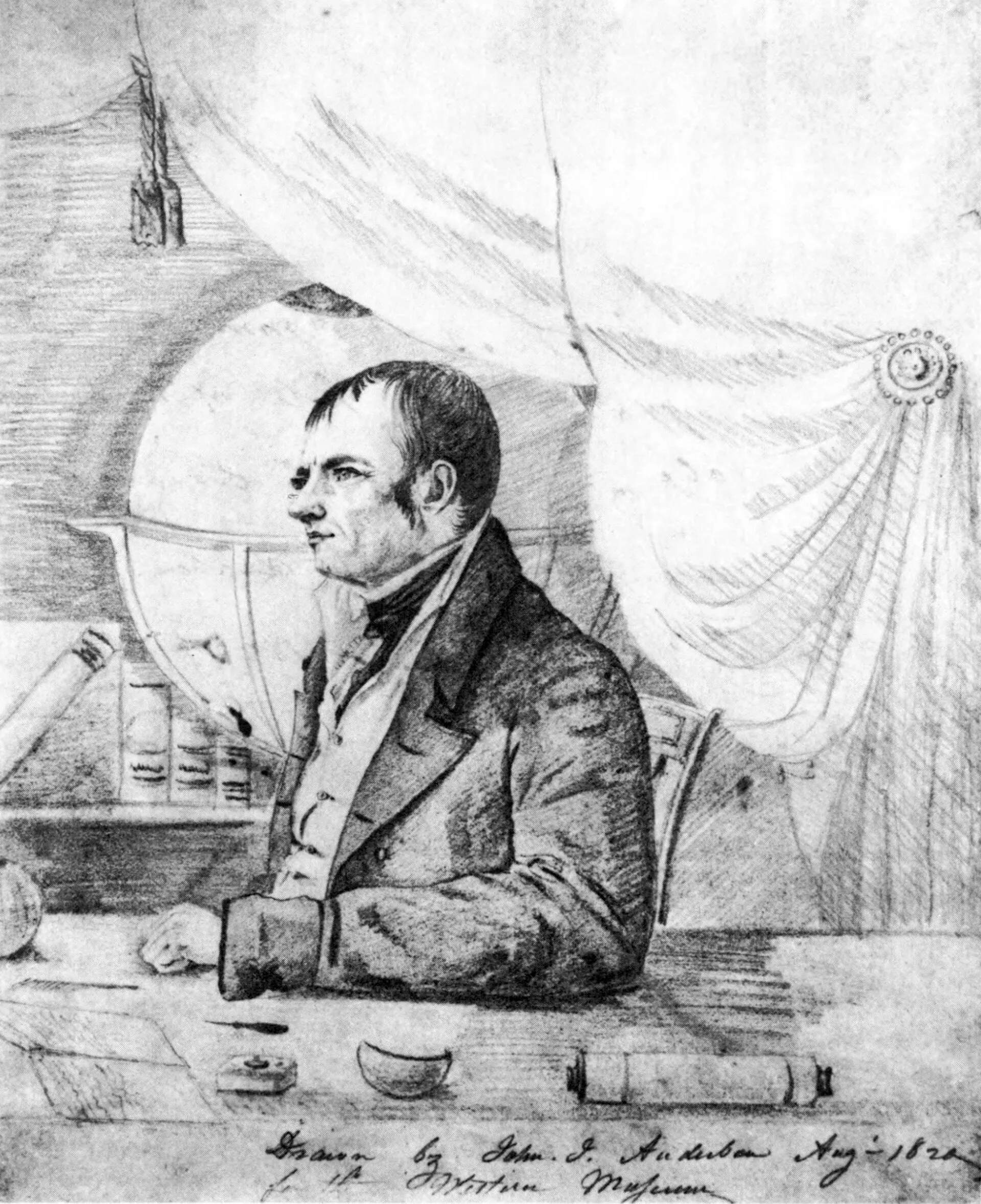
The version with openings at the poles is American. On April 10, 1818, John Cleves Symmes Jr., a former army captain living in the Ohio country, mailed hundreds of copies of a one-page circular from St. Louis addressed to all the world. It declared the Earth hollow and habitable, made of concentric spheres open at the poles, and asked for a hundred companions to set out from Siberia by reindeer sled and find a warm, rich land beyond the ice. Symmes attached a certificate vouching for his sanity. He lectured widely, was widely mocked, and petitioned Congress for an expedition without success. His follower Jeremiah Reynolds campaigned for polar exploration, agitation that helped lead to the United States Exploring Expedition of 1838–42. Symmes died in 1829, and the town of Hamilton, Ohio, honors him and his theory with a memorial crowned by a stone globe.
Later writers kept the idea going. William Reed’s Phantom of the Poles in 1906 dropped the inner shells but kept the hollow globe, and Marshall Gardner’s 1913 book, A Journey to the Earth’s Interior, added a small sun burning at the center, which he demonstrated with a patented working model. In 1964 a book titled The Hollow Earth, by an author writing as Raymond Bernard, tied the inner world to flying saucers and lost civilizations.
The polar photographs
In the late 1960s, hollow-earth publications began reprinting satellite images of the Arctic that seemed to show a dark circle at the pole, and those images still circulate as proof. The pictures were mosaics, built from many separate frames taken as the satellite passed overhead and stitched together. Around the pole itself was either a gap in coverage or a region in the darkness of polar winter, so the assembled picture showed a black disk where there was no data or no sunlight. Since then the North Pole has been reached by dogsled, ship, airship, airplane and submarine, and is crossed constantly by satellites. There is no hole.
What the inside is made of
The decisive evidence is physical. Measurements of the Earth’s density, starting with the Schiehallion experiment of 1774 and Henry Cavendish’s torsion-balance work in 1798, showed that the planet as a whole is about twice as dense as the rocks at its surface. A hollow Earth would be lighter than its own crust; the real one must be packed with heavy material at depth.
Seismology filled in the picture in the twentieth century. Earthquakes send waves through the whole planet, and seismometers around the world record when and how they arrive. Shear waves cannot cross liquid, and they disappear from a broad band on the far side of the globe from each earthquake, revealing a molten outer core. In 1936 the Danish seismologist Inge Lehmann proposed that faint compressional waves turning up inside the shadow zone had been bent by a solid inner core, an interpretation later instruments confirmed. The timing of these waves matches a planet layered from crust to mantle to outer and inner core, with no empty spaces of any size.
Where it stands
Halley’s shells were a legitimate hypothesis that later science disproved, and he never returned to the idea. The polar-opening version has never had evidence behind it, and the photographs offered for it are misread mosaics. The hollow Earth now lives on as a theme of adventure fiction, from Jules Verne onward, and as a conspiracy theory with no physical support.