
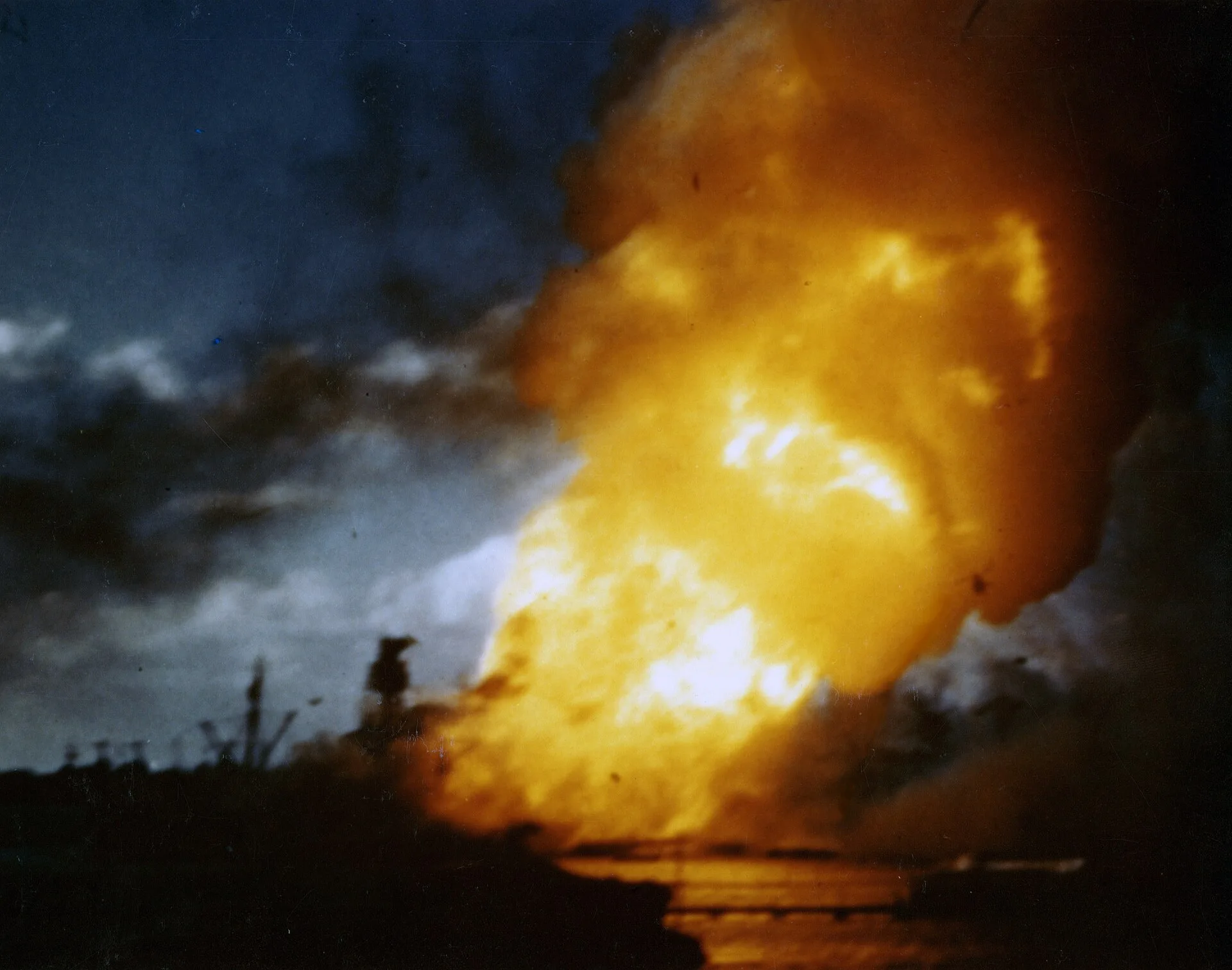
Just before eight on the morning of Sunday, December 7, 1941, Japanese carrier aircraft struck the U.S. Pacific Fleet at Pearl Harbor on Oahu. In under two hours they sank or damaged 21 ships, wrecked most of the aircraft on the island’s airfields and killed more than 2,400 Americans. The next day Congress declared war. Almost as quickly, a darker explanation took hold among the president’s critics: that Franklin D. Roosevelt, eager to bring a reluctant country into the war against Germany, knew the blow was coming and let it land. Ten official inquiries and generations of historians have examined that charge.
The case against Roosevelt
The theory rests on several real facts. The United States had been reading Japan’s top diplomatic cipher, which American codebreakers called Purple, and circulated the decrypts under the label Magic. Through 1941 Washington tightened economic pressure on Tokyo, freezing Japanese assets and cutting off oil in the summer. On November 27 the Navy sent its Pacific commanders a message that opened by calling itself a war warning. And in October 1940 an intelligence officer, Lieutenant Commander Arthur McCollum, had written a memo listing eight measures that might provoke Japan, remarking that it would suit the United States well if Japan could be drawn into openly starting the fighting.
Revisionist writers built their cases on these points. The historian Charles Beard argued in 1948 that Roosevelt’s diplomacy had maneuvered Japan into firing first. Rear Admiral Robert Theobald, who had served under the Pacific Fleet commander, published The Final Secret of Pearl Harbor in 1954. John Toland’s Infamy in 1982 cited a Dutch naval attaché’s diary as evidence that U.S. naval intelligence was tracking carriers northwest of Hawaii. Robert Stinnett’s Day of Deceit, in 2000, went furthest, claiming that the Japanese strike force had broken radio silence, that American stations had plotted its course across the Pacific and that the McCollum memo was the blueprint for administration policy. Believers also point out that the fleet’s three aircraft carriers were away from Pearl Harbor that morning.
The investigations
The first inquiry, led by Supreme Court Justice Owen Roberts within weeks of the attack, blamed the Hawaiian commanders, Admiral Husband Kimmel and Lieutenant General Walter Short, for failing to prepare. Army and Navy boards in 1944 shifted much of the blame to Washington, singling out Secretary of State Cordell Hull and Army Chief of Staff George Marshall. After the war a joint congressional committee heard testimony from November 1945 to May 1946, gathering more than 5,000 pages of transcripts and many thousands more of exhibits, including the Magic decrypts. Its majority report concluded that the ultimate responsibility lay with Japan, that U.S. policy had given no justifiable provocation, and that commanders in Hawaii and the Army and Navy intelligence and planning staffs in Washington had made errors of judgment rather than committed dereliction of duty. It specifically rejected the idea that Roosevelt and his advisers had tricked or coerced Japan into attacking. Two Republican senators, Owen Brewster and Homer Ferguson, dissented, arguing that the record was incomplete and that Washington shared more of the blame. A 1995 Defense Department review again found failures on both ends but declined to clear Kimmel and Short.
What historians concluded
Most historians reject foreknowledge. Purple carried diplomatic traffic, and nothing in it named Pearl Harbor as a target. The Japanese navy’s own operational code, JN-25, was only partly broken and could not be read in time; Washington’s small team of naval codebreakers was swamped by diplomatic messages. The carrier force sailed under orders of strict radio silence while home stations sent decoy traffic to make it seem the fleet was still in Japanese waters. The cryptologic historian David Kahn, reviewing Stinnett’s book, checked the intelligence summaries Stinnett cited and found that none placed the Hawaii strike force on the air. The carriers’ absence, meanwhile, reflected their role at the time as scouts and aircraft ferries; battleships were still regarded as the fleet’s main striking power.
The view that has held up best is Roberta Wohlstetter’s, in her 1962 study Pearl Harbor: Warning and Decision. She argued that Washington did not lack signals but was drowning in them: true indicators were mixed with false ones, with Southeast Asia and the Philippines the expected targets, and divided Army and Navy commands each assumed the other was on watch. Gordon Prange, whose decades of research were completed by his collaborators as At Dawn We Slept and Pearl Harbor: The Verdict of History, came to a similar conclusion of shared, ordinary failure.
Where it stands
Washington expected war with Japan within days and pursued policies it knew Japan would find intolerable; that much is documented. What no inquiry or archive has produced is evidence that Roosevelt or his commanders knew Pearl Harbor was the target and chose to leave it exposed. The surprise was a failure of analysis, coordination and imagination. In 2000 Congress passed a nonbinding resolution saying Kimmel and Short had been denied vital intelligence and asking that they be restored to their highest ranks, a step no president has taken.