
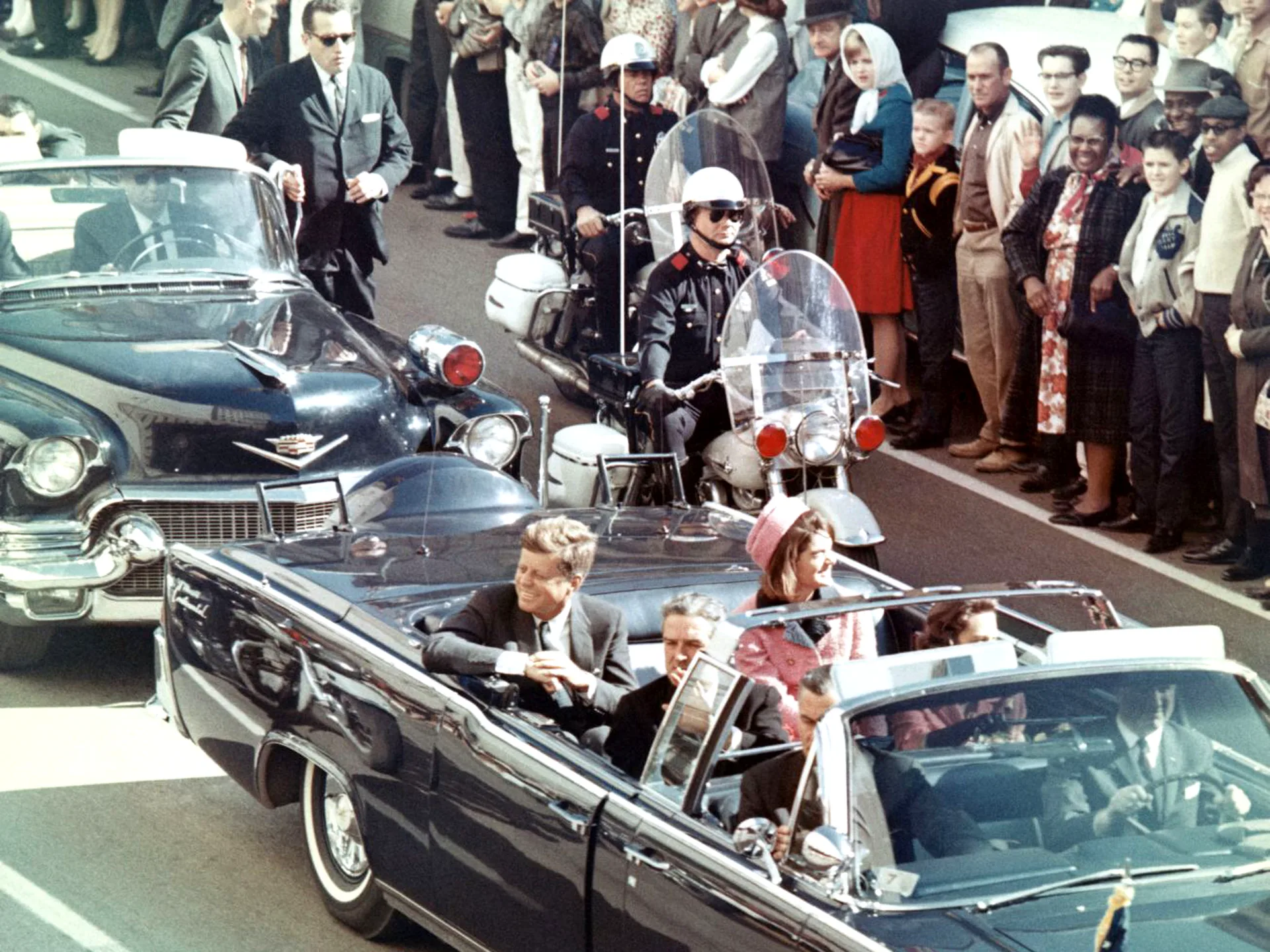
At 12:30 p.m. on Friday November 22, 1963 the presidential motorcade turned off Houston Street into Elm Street in Dealey Plaza, Dallas, and shots were fired. President John F. Kennedy was dead within the hour; Governor John Connally, in the seat ahead of him, was badly wounded. A 24-year-old warehouse employee, Lee Harvey Oswald, was arrested that afternoon and shot dead two days later in the basement of police headquarters by a nightclub owner, Jack Ruby. Two official inquiries, a presidential commission and a congressional committee, reached different conclusions about whether Oswald acted alone, and sixty years on most Americans still think he did not.
What happened
The Warren Commission, appointed by President Johnson on November 29, 1963, reported in September 1964. It found that three shots had been fired from the sixth-floor corner window of the Texas School Book Depository, that Oswald fired them with a mail-order rifle he owned, and that it had found no evidence of a conspiracy, foreign or domestic. To account for the wounds with three shots, one of which missed, the commission’s staff concluded that a single bullet had passed through Kennedy’s neck and then through Connally’s chest, wrist and thigh, and was the nearly intact bullet found on a stretcher at Parkland Hospital. Critics named it the magic bullet.
Doubt grew through the 1960s and 1970s. Dozens of witnesses in the plaza had looked toward the grassy knoll west of the depository rather than the building when the shots were fired, and some said they heard shots from there. The Zapruder film appeared to many viewers to show the president’s head driven backward, which they took to mean a shot from the front. The autopsy at Bethesda, conducted in haste by pathologists without forensic experience, left disputes about the location of the wounds that the photographs and X-rays never fully settled.
The investigation
The House Select Committee on Assassinations re-examined everything between 1976 and 1979. Its panels of pathologists, photographic analysts and ballistics experts largely upheld the Warren Commission: Oswald fired three shots from behind, two of which struck the president, and the single-bullet explanation was consistent with the medical evidence. Then, late in its work, the committee received an acoustic analysis of a Dallas police dictabelt recording made through a motorcycle officer’s stuck microphone. Experts told the committee that impulses on the tape matched gunfire in the plaza and that there was a 95 per cent probability of a fourth shot from the grassy knoll. On that basis the committee’s final report concluded that Kennedy was “probably assassinated as a result of a conspiracy”, while stating it could not identify a second gunman or the conspiracy’s extent and that the Soviet and Cuban governments, organized crime as a group, the CIA, FBI and Secret Service were not involved.
The acoustic finding did not survive long. At the request of the Justice Department, the National Research Council convened a Committee on Ballistic Acoustics under the physicist Norman Ramsey. Its 1982 report found that the probability calculations had been done wrongly and that the impulses taken for gunshots had been recorded about a minute after the shooting, by which time the motorcade had been ordered to the hospital. The key was faint crosstalk from the second police channel, first noticed by a musician named Steve Barber, which fixed the timing. The committee concluded that the acoustic evidence gave no basis for a second gunman. The finding on which the committee’s conspiracy verdict rested has not been accepted since.
The explanations
The theories fall into two groups. The first is forensic: that the single bullet is impossible, that the autopsy was altered or the body tampered with, that the knoll was occupied. Each was examined by both inquiries, and the official reading has held. The second is political: that the Mafia, the CIA, anti-Castro Cubans, Lyndon Johnson or some combination arranged the killing and that the government then covered it up. Both inquiries looked for this and found that individual mobsters or exiles could not be excluded, but that no evidence pointed to any organization. What the House committee did establish was that the FBI and CIA had withheld information from the Warren Commission, which is the documented basis for the widespread belief in a cover-up.
After Oliver Stone’s 1991 film “JFK” Congress passed a law ordering every assassination record into a single collection at the National Archives. Releases in 2017 and 2018 under President Trump and in 2021, 2022 and 2023 under President Biden left a few thousand documents partly redacted. On March 17, 2025 Trump ordered the rest opened, and over the following days the Archives posted more than 80,000 pages, followed by a further release in January 2026. The files have added detail about CIA operations and sources; none of them has produced a second gunman.
Where it stands
Gallup has asked Americans about the assassination since the week it happened. Belief in a conspiracy ran between 74 and 81 per cent from the mid-1970s to 2003 and stood at 65 per cent in November 2023, with the federal government, the Mafia and the CIA the suspects most often named. The record supports a lone gunman in the depository and documents agencies that hid what they knew. Whether anyone stood behind Oswald remains unproven, and likely to stay so.