
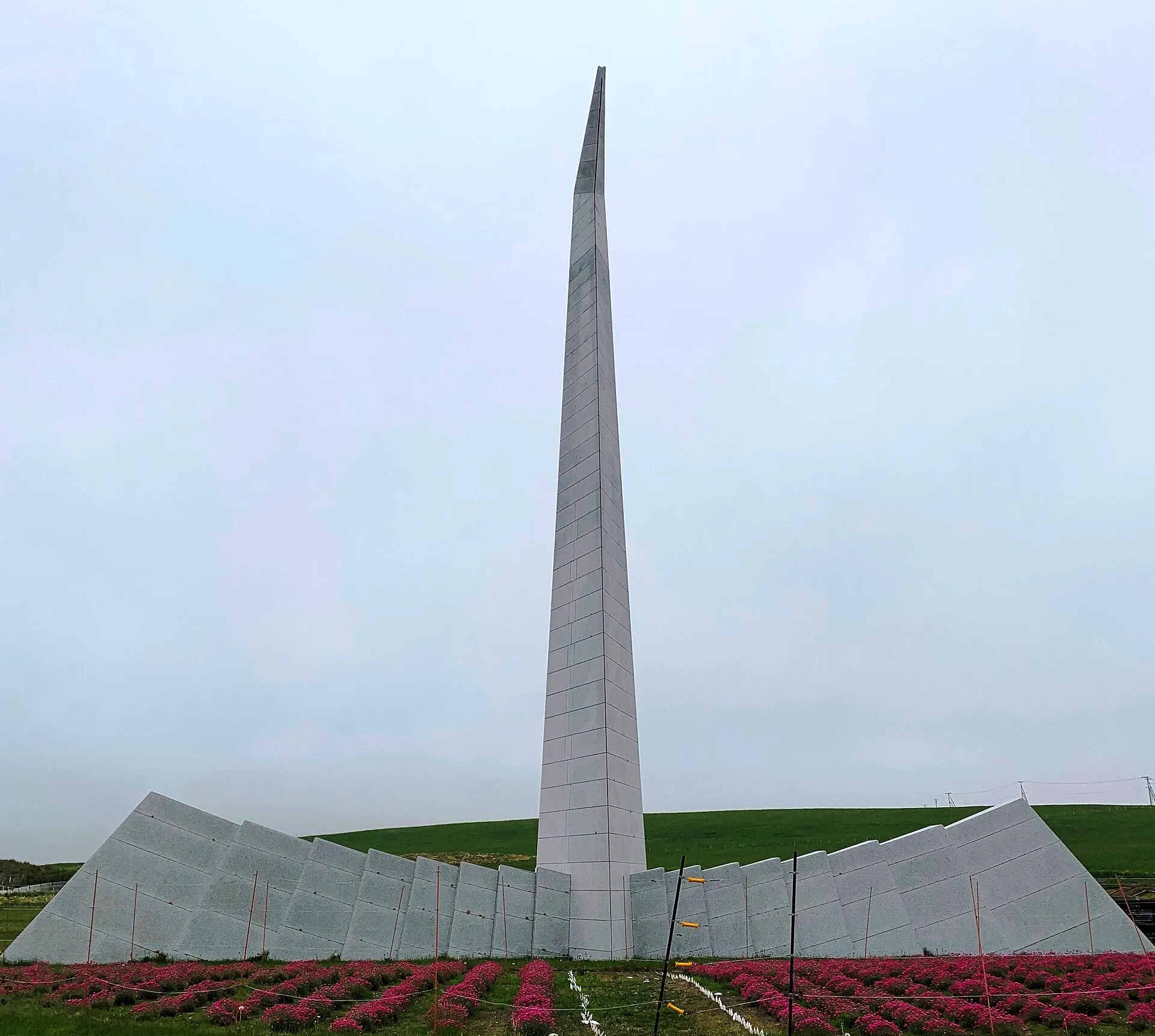
In the small hours of September 1, 1983, Tokyo time, a Soviet Su-15 interceptor fired two air-to-air missiles at a Korean Air Lines Boeing 747 that had wandered hundreds of miles off its route and across some of the most heavily guarded territory in the Soviet Far East. The airliner, flying as KAL 007 from New York to Seoul by way of Anchorage, crashed into the Sea of Japan off Moneron, a small island west of Sakhalin. All 269 people on board died, among them Larry McDonald, a Georgia congressman who also led the John Birch Society.
What happened
The jet left Anchorage about 4 a.m. local time on August 31 with three Korean flight crew on the flight deck. From almost the first leg it drifted north of the planned track, and the gap kept widening. Instead of following its chain of oceanic waypoints along the edge of Soviet airspace, it held a steady magnetic heading toward Kamchatka. Soviet MiG-23s sent up over the peninsula never caught it. The airliner crossed the Sea of Okhotsk and reached Sakhalin, where a ground controller vectored Major Gennadi Osipovich’s Su-15 onto it. Osipovich later said he saw the blinking navigation lights and fired cannon bursts that, without tracer rounds, nobody aboard could have seen. When the 747 began a routine climb cleared by Tokyo, the Soviet side read it as evasion. The missiles were fired at about 3:26 a.m. The airliner stayed in the air for roughly twelve minutes, its crew struggling with a damaged aircraft, before it spiralled into the water.
Moscow at first denied any knowledge, then said the plane had been a spy flight. Washington released intercepted Soviet radio traffic, and President Reagan called the attack a crime against humanity. Peter Grier’s 2013 history for Air & Space Forces Magazine notes that US analysts soon saw a messier picture: the Soviet air defense command had apparently taken the 747 for an RC-135 reconnaissance jet, one of which had been operating off Kamchatka that night.
The investigation
The International Civil Aviation Organization (ICAO) reported in December 1983 without the most important evidence. The Soviet Union told investigators that no flight recorders had been found. ICAO concluded the intrusion was accidental and offered two possible navigation errors, the leading one being an autopilot left in heading mode.
That Soviet statement was false. After the Soviet collapse, President Boris Yeltsin released Politburo papers showing that Soviet divers had located the wreck and recovered both recorders in October 1983, while Soviet ships kept up the appearance of a search and shadowed the American vessels hunting for the same debris. In October 1992 Yeltsin gave transcripts to a delegation of victims’ families in the Kremlin. On a visit to Seoul in November he opened an orange case before President Roh Tae-woo and presented the black boxes as a gesture of apology, according to The Moscow Times. The containers alone did not settle anything; the tapes themselves reached ICAO in January 1993, together with recordings of Soviet ground-to-air traffic, and were transcribed by the French accident bureau in Paris.
ICAO’s 1993 report kept the accident finding and made it specific. The crew had set the autopilot to a heading of 245 degrees after takeoff and never noticed that the inertial navigation system was not steering the aircraft, either because it was never selected or because the jet was already outside the 7.5-mile window in which it could capture the planned track. The report also found that Soviet forces had not used the internationally agreed procedures for identifying and warning an intruder. In a 1993 column for the Christian Science Monitor, the space engineer James Oberg argued that the new evidence placed responsibility on the Soviet chain of command rather than on the pilots.
The theories
Doubts were bred by secrecy on both sides. Soviet leaders and some Western writers argued that a veteran crew could not have strayed so far by chance and that the flight was gathering intelligence for the United States; the American historian Alexander Dallin wrote in 1985 that the intrusion looked hard to explain as an accident but that he had found no direct evidence it was deliberate. Others suggested that McDonald, a fierce anti-communist, was the intended target. Because few remains were ever found and Soviet orders sent rescue vessels toward Moneron, a persistent minority has claimed that the airliner ditched intact and that passengers were taken into Soviet custody. None of these ideas fits the recorder data, which shows an unremarkable cockpit, no awareness of the deviation, and an aircraft breaking up under attack.
Where it stands
The cause of the deviation is settled as human error on the flight deck, and the shootdown as a Soviet decision taken in haste and in error. The cover-up was real, but it hid Soviet blunders and the recovered recorders, not a spy mission. The disaster helped push the United States to open the GPS satellite signal to civilian use, and in 1984 ICAO amended the Chicago Convention to commit states to refrain from using weapons against civil aircraft in flight.