
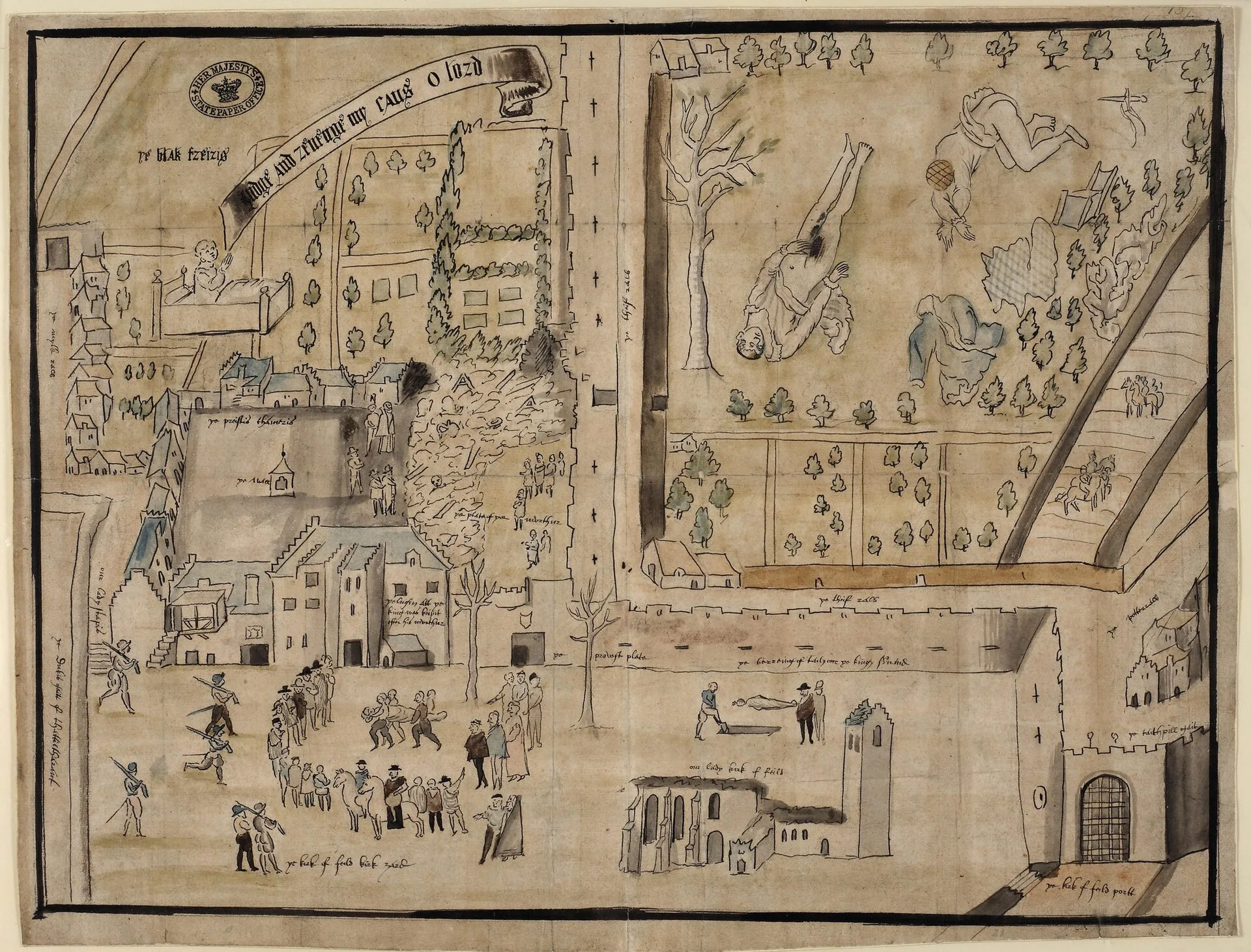
At about two o’clock on the morning of February 10, 1567, an explosion leveled a house at Kirk o’ Field, on the southern edge of Edinburgh. The man lodging there was Henry Stuart, Lord Darnley, the king consort of Scotland and husband of Mary, Queen of Scots. He was found dead in a garden nearby, beside his servant, neither of them marked by the blast. Within days the capital was full of placards naming the queen and the Earl of Bothwell as the killers. Within months Mary had married Bothwell, lost her throne and fled. Exactly who planned the murder, and what the queen knew, has been argued for more than four hundred years.
What happened
Darnley had married his cousin Mary in July 1565 and quickly made himself unpopular, including with her. He was arrogant and drank heavily, and when she refused him an equal share of royal power he turned on her Italian secretary, David Rizzio, joining the nobles who stabbed Rizzio to death in front of the pregnant queen at Holyroodhouse in March 1566. He then abandoned his fellow conspirators. Their son, the future James VI, was born that June, but the marriage did not recover. Late in 1566 Darnley went to his family in Glasgow and fell seriously ill, probably with syphilis, although some accounts say smallpox. Mary visited him and persuaded him to come back to Edinburgh, where he was installed in a house in the old church precinct of Kirk o’ Field to recover.
On the evening of February 9 the queen divided her time between a servant’s wedding festivities at Holyrood and a visit to Darnley’s bedside. A few hours after she left the house was blown apart by gunpowder. According to the British Library’s reconstruction from surviving depositions, Darnley and his valet, William Taylor, seem to have realized the house was surrounded and let themselves down from an upper window with a rope and a chair, then tried to escape through a door in the town wall, only to run into armed men. Witnesses heard Darnley begging for his life. Both men were almost certainly smothered, and the gunpowder was then set off. A bird’s-eye drawing of the scene made that February survives among the English state papers at The National Archives in Kew.
The investigation
Mary ordered an inquiry and offered a large reward, but the anonymous accusations kept coming; one placard showed her as a mermaid, a common slur for a prostitute, with Bothwell as a hare caught in her net. Darnley’s father, the Earl of Lennox, pressed for a trial. Bothwell was tried in April 1567 and acquitted in proceedings widely seen as rigged, and in May he married the queen. Scotland’s nobles rose against them. After the confrontation at Carberry Hill in June, Bothwell fled abroad, Mary was imprisoned and forced to abdicate in favor of her infant son, and several of Bothwell’s servants and followers were later executed for the murder.
The Casket Letters
In 1568 Mary escaped to England and asked her cousin Elizabeth I for help. Elizabeth instead held her and set up conferences at York and Westminster to examine the charges against her. There her half-brother, the Earl of Moray, now regent of Scotland, produced the contents of a silver casket said to have been seized from a servant of Bothwell’s: love letters, sonnets and marriage contracts supposedly in Mary’s hand, some appearing to show her complicit in a plot against her husband. The documents were unsigned and undated, and they came from her enemies. English commissioners compared the handwriting and accepted them, but Mary refused to recognize the tribunal, and Elizabeth concluded that nothing had been proved either way. The originals later disappeared, leaving only copies and translations.
The explanations
Bothwell’s leading role has the strongest support, since the confessions of his men at their trials point to him, and any rival theory has to explain them away. Beyond that the theories divide. Mary’s accusers held that she and Bothwell were lovers who plotted together. Her defenders have long argued that the lords who hated Darnley, including some who had signed a bond against him in late 1566, carried out the killing and then forged or doctored the letters to destroy the queen as well; one long-standing version puts Moray and the Earl of Morton behind Bothwell. Many modern scholars take a middle view: the biographer John Guy has argued that the letters mixed genuine writing by Mary with false material and that about half their content is untrue, which leaves the question of her guilt open.
Where it stands
The site of the house now lies under the quadrangle of the University of Edinburgh’s Old College, where archaeologists confirmed the church’s location in 2010. Darnley was certainly murdered, almost certainly with Bothwell’s direction. Whether the queen consented, turned a blind eye or knew nothing depends on documents that no longer exist in their original form.