
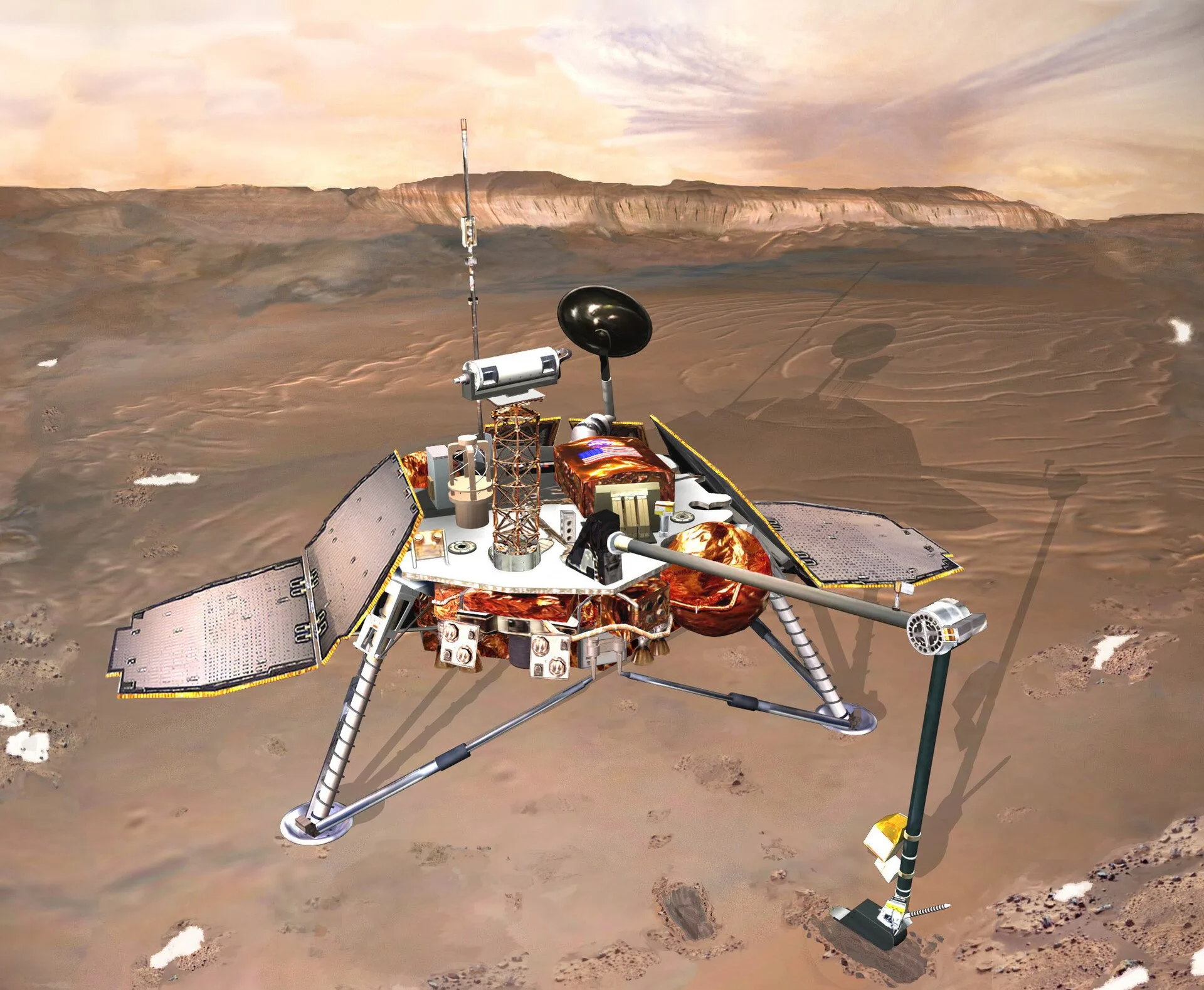
Mars Polar Lander left Cape Canaveral on January 3, 1999 with two small Deep Space 2 penetrator probes bolted to its cruise stage. It was the second half of NASA’s 1998 Mars Surveyor pair, built by Lockheed Martin under the agency’s faster-better-cheaper program, and its partner, Mars Climate Orbiter, had already been lost in September 1999 when a metric-to-imperial mix-up flew it into the atmosphere. The lander was aimed at a strip of layered terrain near 76 degrees south, on the edge of the southern polar cap, where it was to dig for water ice for 90 days.
What happened
Arrival was set for December 3, 1999. As planned, the spacecraft stopped transmitting while it turned for atmospheric entry, and the probes separated to strike the surface about 60 kilometers away. Touchdown was expected at 12:14 p.m. Pacific time, with a 45-minute data session due to begin 24 minutes later. Nothing came. Over the following weeks JPL tried every listening strategy it had, and the two probes were never heard from at all. In mid-January 2000 the project stopped formal recovery attempts.
There was one twist. Engineers at Stanford University, whose 150-foot dish in the foothills had been tested as a receiver for the lander’s UHF radio, found a faint tone in recordings made on December 18 and January 4, close to the lander’s 401.5-megahertz frequency and about as strong as a cell phone. JPL asked the lander to call Stanford again, and on February 4 the Jodrell Bank and Westerbork radio telescopes joined the hunt. Nothing repeated. On February 16, 2000 NASA announced that the tone was too pure to have crossed interplanetary space and had almost certainly come from a component in the dish itself.
The investigation
Because the lander carried no telemetry during entry, descent and landing, a decision taken to save money, the investigators had to reason from the design. The JPL Special Review Board chaired by John Casani reported on March 22, 2000, and a separate Mars Program Independent Assessment Team under former Lockheed Martin executive Thomas Young briefed NASA headquarters the same month. Both reached the same probable cause. Each of the three landing legs carried a magnetic sensor meant to tell the flight software when the footpad touched the ground. Tests on the ground showed that the jolt of the legs springing open at about 1,500 meters could trip those sensors for a few milliseconds. The software was supposed to ignore any reading until the radar put the craft within 40 meters of the surface, but a flaw let the spurious value stay latched in memory. When the lander reached 40 meters the software saw a touchdown already recorded and shut the descent engines off, dropping the spacecraft at roughly 22 meters per second onto ground it was never built to survive.
The Casani board was careful about its language. The lack of data meant other failure modes could not be positively excluded, it wrote, but there was little doubt about the probable cause. It found no probable cause for the loss of the Deep Space 2 probes, listing four plausible ways they could have died, and noted that a system-level qualification test for the probes had been deleted to save cost and schedule. The Young panel went further on the institutional side, blaming inadequate funding and inadequate margins across the whole program.
The explanations
The alternative stories began while the lander was still being hailed. Late-night radio and a cluster of websites built on the earlier Face on Mars literature argued that two spacecraft lost at Mars in three months was too neat for accident, and proposed that the lander had been destroyed by something on the surface, had been shot down to keep its cameras away from structures, or had landed and returned pictures that NASA was suppressing. The Stanford tone was folded into the narrative as a signal the agency chose not to pursue.
Each element has a mundane counterpart in the record. Climate Orbiter’s loss was fully explained by a units error. The lander’s failure mode was identified by two independent panels, reproduced in ground testing, and corrected in the design of Phoenix, which landed safely in the northern polar region in 2008. The Stanford signal was chased by three observatories before it was given up. And the absence of wreckage is less strange than it sounds: at the 1.5-meter resolution of the Mars Orbiter Camera the lander would have been one or two pixels wide, and the region is buried under seasonal carbon dioxide frost for much of the year.
Where it stands
In May 2005 Malin Space Science Systems announced that a review of its January 2000 images had turned up a bright feature resembling a parachute and a dark spot with a pale center that could be the lander. A sharper image taken that September, once the frost had cleared, showed nothing at the spot, and the team withdrew the identification in October. The HiRISE camera on Mars Reconnaissance Orbiter began its own search in 2009 at 25 centimeters per pixel and has reported no find. Mars Polar Lander is still lost. That it was lost to a flaw in a few lines of landing software, rather than to anything living on Mars, is as settled as any finding about a spacecraft nobody has seen since.