
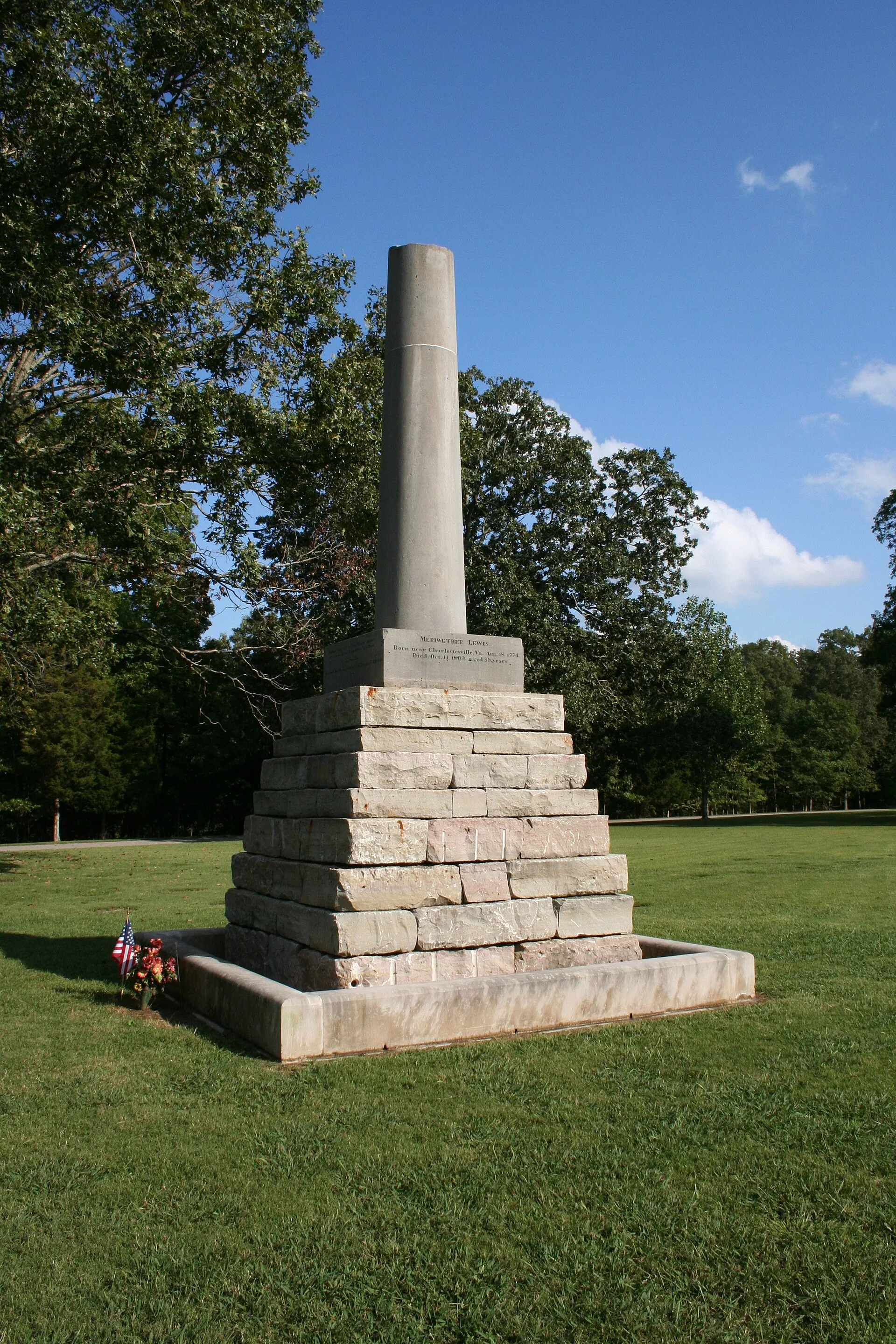
Three years after he and William Clark came back from the Pacific, Meriwether Lewis was dead at 35, shot twice in a log inn on the Natchez Trace in Tennessee. Thomas Jefferson, who had sent him west and knew him as well as anyone, concluded that he had killed himself. Many of his relatives, a Tennessee commission and a line of later writers have suspected murder. The body that could settle some of the argument lies under a federal monument, and the government has declined to dig it up.
What happened
By 1809 Lewis was governor of Upper Louisiana, based in St. Louis, and in trouble. The War Department had refused to honor drafts he had drawn for territorial business, leaving him personally liable, and he had made little progress on publishing the expedition journals. In September he set out for Washington to clear his accounts, carrying his papers. He meant to go by river to New Orleans and then by sea, but at Fort Pickering, the post at the Chickasaw Bluffs near present-day Memphis, he changed his plans. According to a letter written by the fort’s commander, Lewis had tried to kill himself on the way downriver, and he was briefly kept there under watch. When he left, he went overland with James Neelly, the federal agent to the Chickasaws, and his own servant, John Pernier.
Past the Tennessee River two horses strayed. Neelly stayed to find them and Lewis rode on, and on the evening of October 10 he stopped at Grinder’s Stand, a roadside inn about seventy miles from Nashville. Robert Grinder was away. His wife, Priscilla, gave Lewis a meal and a room and, by her account, was frightened enough by his pacing and muttering to spend the night in another building. In the small hours she heard shots. At daybreak Lewis was found with a wound to the head and another to the body. He died that morning, October 11, 1809, and was buried near the inn.
The investigation
No one saw the shooting, and almost everything known about the night comes from Mrs. Grinder through other people. Neelly passed on her story in a letter to Jefferson a week later. The ornithologist Alexander Wilson, a friend of Lewis, interviewed her a few months later and wrote down a fuller version, with Lewis begging the servants to finish him. A third account, published decades later, added strange riders, a third shot, and Pernier wearing Lewis’s clothes the next morning. The differences between the versions are the foundation of most murder theories.
Jefferson’s verdict came in a short memoir he wrote in 1813 for the published history of the expedition. He described Lewis as prone since youth to spells of melancholy, which he called hypochondriac affections, said they had returned once Lewis settled into a desk job in St. Louis, and stated plainly that Lewis had done the deed himself. Clark accepted the same conclusion. In 1848, though, a commission appointed by Tennessee to mark the grave opened it, and its report said death at the hands of an assassin now seemed more likely. The state then raised a broken limestone column over the site, a common emblem of a life cut short.
The explanations
Those who favor suicide point to the debts, the reported attempts on the river, Jefferson’s and Clark’s confidence, and the historians’ view, given its best-known form by Stephen Ambrose, that Lewis was drinking heavily and possibly using opium. Some have added malaria or syphilis as reasons for his state of mind. Those who favor murder note that two shots from single-shot pistols is an awkward way to kill oneself, that Mrs. Grinder’s stories shifted, and that the Trace was notorious for robbers; suspicion has fallen on Robert Grinder, on Pernier and even on Neelly. Local tradition speaks of an inquest and even a trial, but no records have been found.
Where it stands
In 1996 a coroner’s jury in Lewis County, Tennessee, convened by the district attorney general, heard forensic experts and recommended exhumation. The effort was led by James Starrs, who taught law and forensic science at George Washington University, and backed by many of Lewis’s collateral descendants. The National Park Service, which manages the grave as part of the Natchez Trace Parkway, refused in 1998, and Ambrose and the documentary writer Dayton Duncan wrote to President Clinton supporting the refusal. The Interior Department agreed to an exhumation in 2008 and withdrew that approval in 2010. The body remains untested, and the question of suicide or murder remains open.