
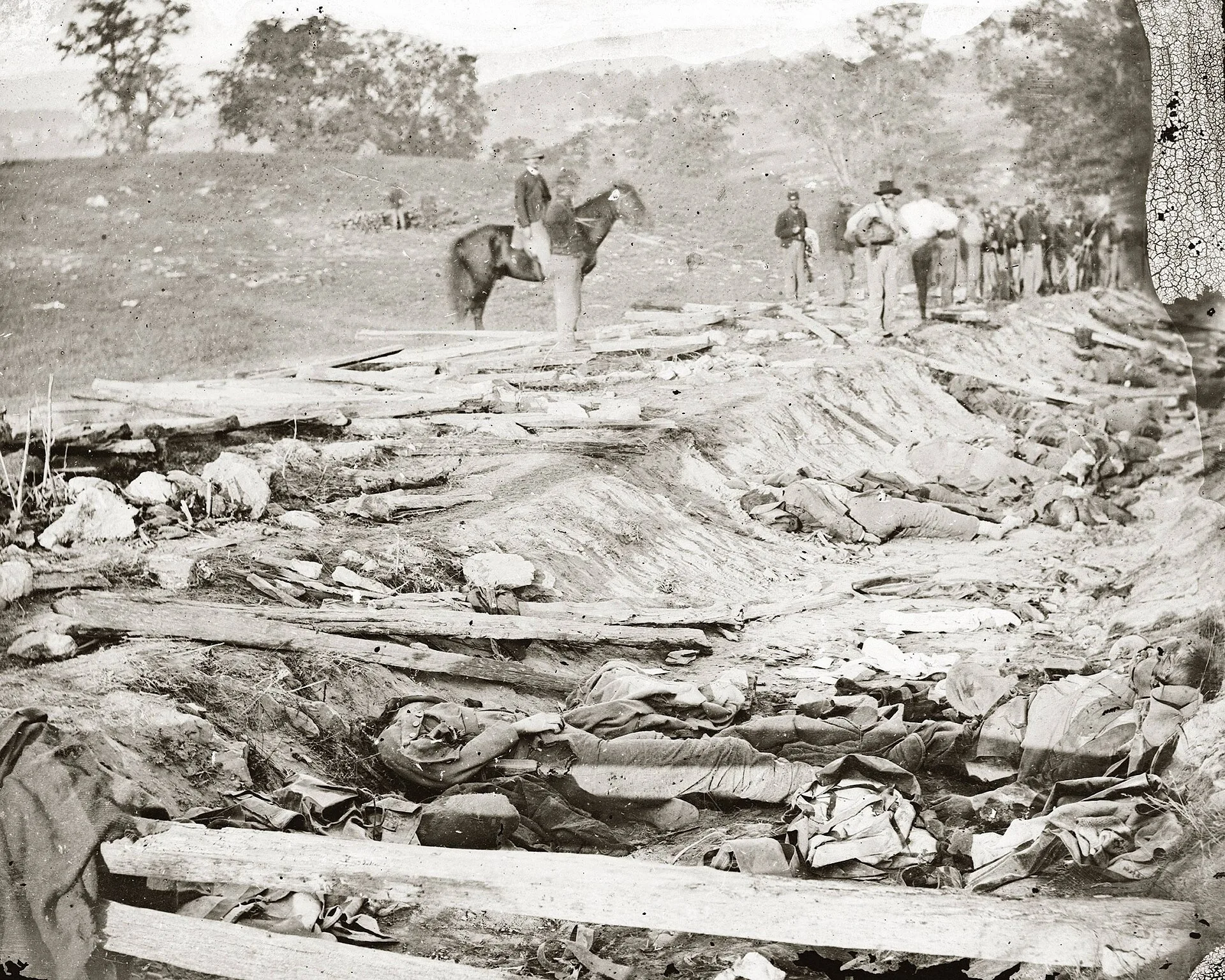
On September 17, 1862, the Union Army of the Potomac and the Confederate Army of Northern Virginia fought along Antietam Creek outside the village of Sharpsburg, Maryland. By nightfall roughly 23,000 men had been killed, wounded or captured, the heaviest toll of any single day in American military history. The farmland where it happened is now Antietam National Battlefield, run by the National Park Service, and it carries a body of ghost lore to match its history.
What happened in 1862
The battle came in three stages, moving from north to south across the field. The morning fighting in and around a cornfield and the West Woods was the deadliest. Toward midday the fighting shifted to a farm lane worn down below the level of the surrounding fields by years of wagon traffic. About 2,200 Confederates lay behind fence rails piled along it and held off attacks by close to 10,000 Union soldiers for more than three hours, until Union troops reached a position from which they could fire down the length of the lane. The park’s casualty table puts the losses there at about 5,400. Survivors described the road as paved with bodies, and it has been called Bloody Lane ever since.
In the afternoon, at the southern end of the field, Union troops under Major General Ambrose Burnside spent hours trying to force a three-arched stone bridge then called the Rohrbach Bridge, held by a few hundred Confederate riflemen, most of them Georgians, on the bluff above. It fell in the early afternoon and has borne Burnside’s name since. The dead from that sector were buried hastily nearby, many without markers, before later reburial.
The ghost stories
The stories cluster at the places where the dying was worst. At Bloody Lane visitors have reported the smell of gunpowder, the crack of musketry on empty afternoons, and men in Confederate gray walking the lane who were taken for reenactors until they disappeared. The best known tale involves a group of schoolboys from Baltimore who are said to have heard singing from the fields near the observation tower, a chant that sounded to them like the “fa-la-la” of “Deck the Halls.” Storytellers connect it to the Irish Brigade, which attacked near that spot and whose Gaelic battle cry, by this reading, resembled the carol.
At Burnside Bridge the reports are of small blue lights moving near the creek at night and the sound of a drum beating cadence before fading away. Further accounts attach to the Pry House, which served as a Union headquarters and hospital, and to the Piper farmhouse, with footsteps on the stairs and the figure of a woman said to be the wife of a general who died there, and to St. Paul Episcopal Church in Sharpsburg, used as a Confederate hospital, where screams and lights in the tower have been described. A history column on the Federal Highway Administration’s website collected many of these, and they fill regional ghost books and tour scripts.
The explanations
None of the accounts come with names, dates or recordings that would let them be checked. Most are third-hand: an unnamed visitor, a group of students, people on a night walk. The Irish Brigade story depends on modern listeners mapping a half-heard sound onto a famous incident they already knew from the park’s own interpretation.
A battlefield is also a place where expectation runs high. Visitors arrive knowing the death toll, walk a sunken road that looks almost exactly as it did in 1862, and move through quiet farmland at dusk. Sounds carry across open fields from roads, farms and the town; lights move on distant cars and porches. Those conditions produce the experiences people report without anything left over.
Where it stands
The National Park Service’s material on Antietam deals with the battle, its casualties and its landscape, not with the supernatural. Its published rules also cut off most nighttime ghost hunting: under the park compendium, all areas other than the visitor facilities are closed from 30 minutes after sunset until 30 minutes before sunrise, except for permitted camping, special-use permits and volunteer events. Ghost tours operate in Sharpsburg, and the stories keep circulating. The history behind them is fully documented; the ghosts remain a legend.