
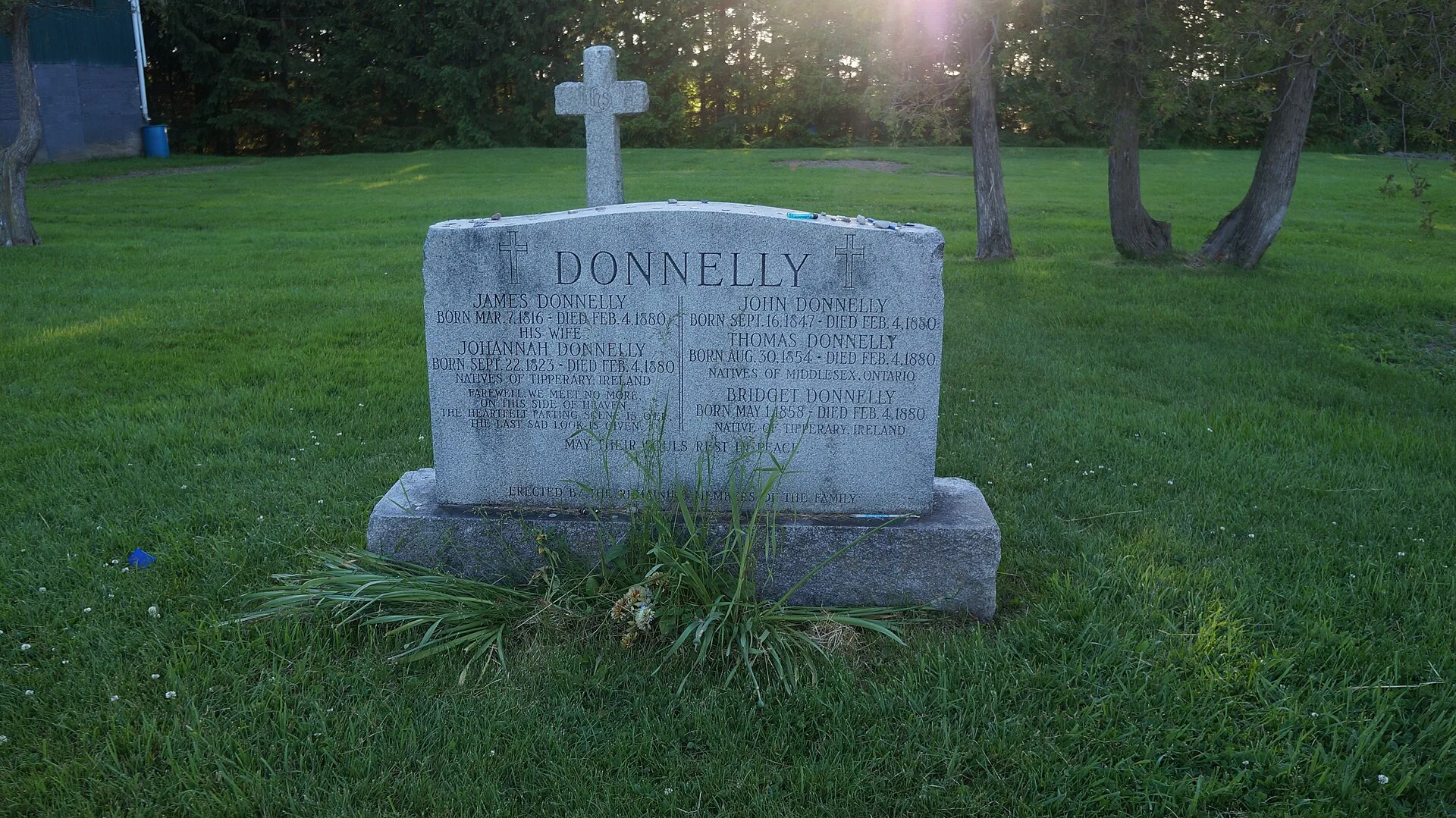
Before dawn on February 4, 1880, a crowd of men from the farming township of Biddulph, north of London, Ontario, beat and burned to death four members of the Donnelly family in their farmhouse and shot a fifth at his brother’s door a few miles away. A boy hiding under a bed saw some of it. More than a dozen men were arrested and one of them was tried twice, but nobody was convicted. For generations the subject was avoided in a district where many families had ties to the accused, and the road where it happened has collected stories of its own.
What happened
James and Johannah Donnelly came from County Tipperary in the 1840s and settled on the Roman Line, a concession road through Biddulph lined with Irish Catholic farms. Their claim to the land was disputed from the start; in 1856 they lost half of their hundred acres in court, and the next year James killed a neighbor, Patrick Farrell, with a handspike during a drunken quarrel at a logging bee. He served seven years in Kingston Penitentiary. The seven Donnelly sons grew up hard and quarrelsome. Their stagecoach line fought a fierce rivalry with a competing line in the 1870s, with coaches wrecked and stables set alight on both sides, and the family was blamed for most of the district’s crimes, though seldom convicted of them.
The historian and playwright James Reaney, writing in the Dictionary of Canadian Biography, traced the Roman Line’s feuds, arson and secret societies back to Tipperary and argued that the Donnellys were as much targets as troublemakers. Their troubles deepened after they voted against the local Catholic Conservative candidate in 1878. In 1879 a new parish priest, Father John Connolly, denounced them and organized a peace society whose members pledged to have their homes searched for stolen goods; the Donnellys refused, and a harder core of members formed a vigilance committee. In January 1880 the elderly couple were charged with burning a neighbor’s barn. Their hearing was due to resume on February 4.
The night before, the committee met at a schoolhouse, drank, and walked to the Donnelly farm with Constable James Carroll at their head. Carroll handcuffed Tom Donnelly in bed on the pretense of an arrest. The men then clubbed James, Johannah, Tom and their niece Bridget to death and set the house on fire. A hired boy, Johnny O’Connor, had been asked to stay the night; he hid under a bed, saw several faces, and escaped the flames. The mob moved on to Will Donnelly’s house at Whalen’s Corners, called out his name, and shot down his brother John when he opened the door.
The trials
An inquest found murder by persons unknown, but local officials arrested more than a dozen men, Carroll among them. Before the case came to court, the O’Connor family’s house in Lucan was burned. Carroll was tried alone for Johannah’s murder in London in October 1880; the jury could not agree. The Crown attorney, Charles Hutchinson, privately called a second attempt a waste of time and money in a county so hostile to the family. It went ahead anyway in January 1881, and after about a week the jury found Carroll not guilty, days before the first anniversary of the killings. No one else was ever convicted. Reaney concluded that local prejudice against the Donnellys probably carried the jury past strong evidence.
The legends
For decades many in Biddulph preferred not to talk about the massacre. Thomas P. Kelley’s sensational book The Black Donnellys (1954) made the family famous and brought so many sightseers to St. Patrick’s Cemetery that it was closed to visitors; descendants replaced the original tombstone, which said the five had been murdered, with a plainer marker. Ghost stories grew alongside the tourism. A 1980 London Free Press feature, preserved by the University of Victoria’s Canadian Mysteries project, reported the local belief that the Roman Line is cursed and that horses traveling it on the night of February 3 do so at risk of death; a Lucan-area farmer described a boarded mare that bolted in terror every night and a presence he would only call “something” that banged cupboard doors. He added that the living were the bigger problem: souvenir hunters prying boards off his barn, and drunks knocking at midnight to ask where the Donnellys had lived.
Where it stands
The massacre itself is well documented in court papers, newspapers and the testimony of the boy who survived it. Who struck which blow was never established by a court, and no one was punished. The curse belongs to folklore. The Lucan Area Heritage and Donnelly Museum now tells the story in the town.