
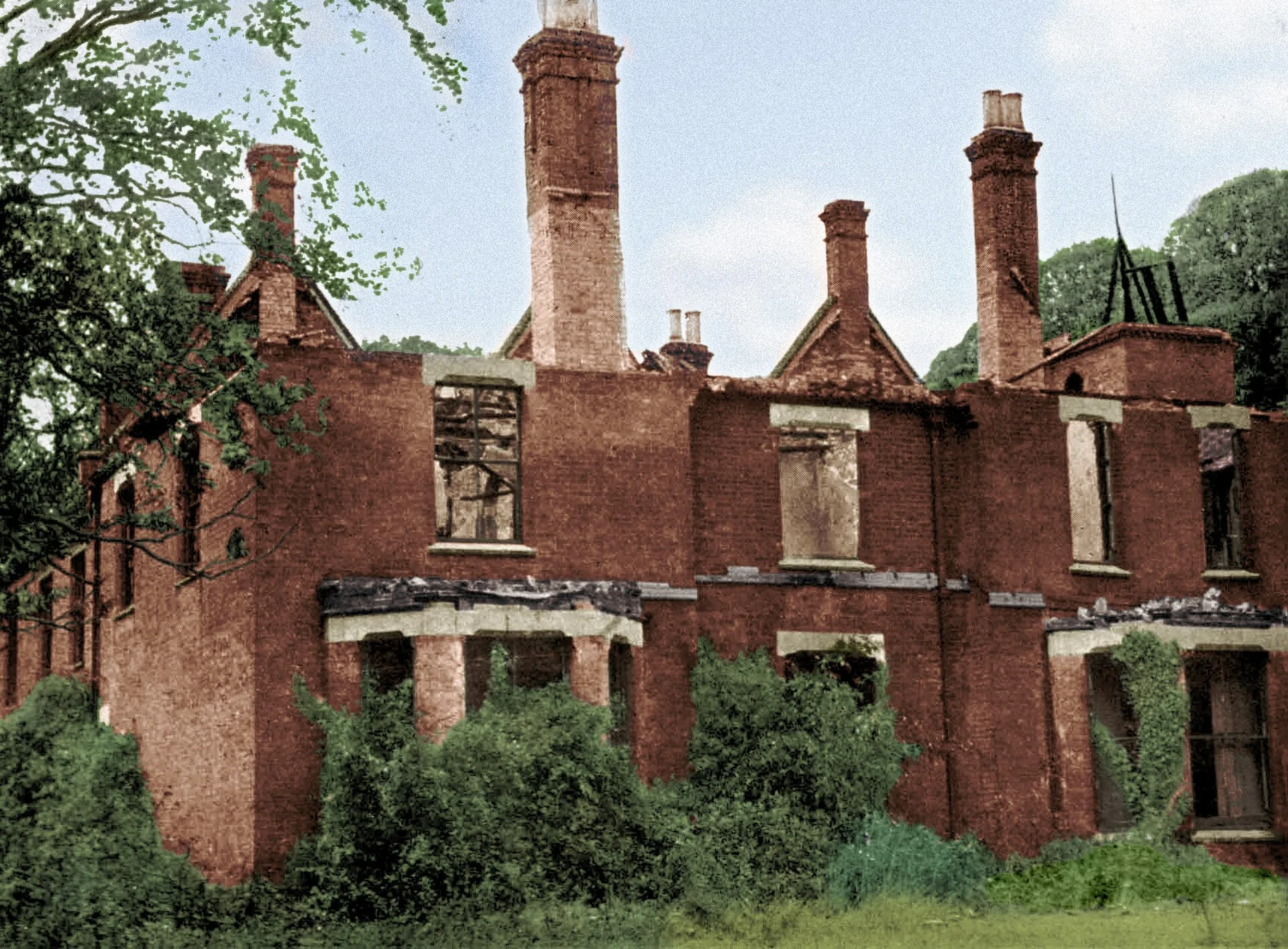
Borley is a scattering of houses in the farmland of north Essex, close to the River Stour and the Suffolk border, a few miles from Sudbury. In 1863 its rector, the Rev. Henry Dawson Ellis Bull, put up a large red-brick rectory across the lane from the church. Between its gutting by fire in 1939 and its final demolition five years later, one investigator turned it into the best-known haunted house in Britain, and a decade after his death three of his former colleagues set out to show how much of that reputation he had made up.
What happened
Stories about the house were told in the Bull family long before anyone wrote them down. The best known is a nun seen walking in the garden; four of the Bull daughters said they saw her on a July afternoon in 1900. Local lore added a phantom coach and a doomed romance between a monk and a novice, though no monastery or nunnery is known to have stood on the site.
The haunting became national news in June 1929. Harry Bull, the builder’s son and successor, had died in 1927, and the new rector, the Rev. Guy Eric Smith, and his wife Mabel had been in the house about a year. Unsettled by local talk, they wrote to the Daily Mirror, which sent a reporter along with Harry Price, a psychical researcher, amateur conjuror and lover of headlines. On his first visit stones and other objects flew, a mirror frame rapped out answers at a séance, and the Mirror ran the story. The Smiths moved out within months.
The busiest period followed. From October 1930 the rectory was home to the Rev. Lionel Foyster, a cousin of the Bulls, his much younger wife Marianne and their adopted daughter. Over five years they reported bells, thrown bottles and stones, doors locking themselves, small fires, Marianne being tipped out of bed, and penciled scrawls on the walls that seemed to appeal to her by name. Lionel kept a running diary of the events. Price eventually counted some 2,000 incidents, but he also came to suspect that Marianne was producing at least some of them.
After the Foysters left in 1935 the house stood empty, and in May 1937 Price took a year’s lease. He advertised in The Times for helpers and enrolled 48 volunteer observers, who kept watch in shifts. Planchette sessions run by the family of one observer, the engineer Sidney Glanville, produced messages from a supposed French nun named Marie Lairre, who claimed to have been murdered and buried on the site, and from another voice that promised the house would burn. A new owner, Captain William Gregson, moved in late in 1938. On the night of February 27, 1939 an oil lamp went over and fire gutted the building; his insurers later disputed the claim.
The investigation
Price published The Most Haunted House in England in 1940 and The End of Borley Rectory in 1946. In 1943 he dug in the cellars and found fragments of a woman’s skull and jaw, which he treated as the nun’s remains; they were later buried in the churchyard at nearby Liston. The two men who did the digging reportedly thought the jawbone came from a pig. In April 1944, as demolition went on, Price returned with the Life magazine reporter Cynthia Ledsham and the photographer David Scherman. One of Scherman’s frames caught a brick in midair, and Price offered it as the first photograph of a poltergeist missile.
Price died in 1948. The Society for Psychical Research then asked three members, Eric Dingwall, Kathleen (Mollie) Goldney and Trevor Hall, to review the whole file. Their report, The Haunting of Borley Rectory, filled most of a volume of the Society’s Proceedings and was also issued as a book in 1956. They went through the testimony phase by phase and found suggestion, rumor, embellishment and, in places, deliberate fraud. They printed a statement from Ledsham that the brick had been tossed by a workman behind a wall whom all three visitors had seen. A Daily Mail reporter, Charles Sutton, had already accused Price of throwing pebbles himself during the 1929 visit.
The explanations
The authors argued that ordinary causes covered almost everything: rats and wind in a large, run-down house, a nearby railway, hoaxing villagers, misremembered dates, and a few people with motives to keep the story going. Marianne Foyster, interviewed decades later, said her husband had faked some of the incidents and that Price knew the diary was not reliable, while insisting that some events had no explanation she could give. Mabel Smith, too, wrote to the Daily Mail in 1949 to condemn Price’s book.
Not everyone accepted the verdict on Price. In 1969 the SPR published a long reply by Robert Hastings, who reexamined the same evidence and concluded that many of the charges of personal fraud were not proved. The Society’s own encyclopedia still treats the case as unreliable evidence for anything paranormal.
Where it stands
Nothing of the rectory survives; bungalows now stand in part of its grounds. Ghost hunters transferred their attention to Borley church, which has had to install security cameras against trespassers. As a story, Borley is real and well documented. As evidence of a haunting, it collapses under the weight of the people who told it.