
Cock Lane is a short street running down from Smithfield market in the City of London, not far from St Paul’s. In the winter of 1762 it was jammed day and night with people trying to get into one house, the home of Richard Parsons, parish clerk of St Sepulchre’s church, to hear a ghost.
What happened
The story began two years earlier. William Kent, a moneylender from Norfolk, had lost his wife Elizabeth in childbirth, and her sister Fanny Lynes had come to keep house for him. Church law barred a man from marrying his dead wife’s sister, so the two lived together as an unmarried couple and made wills in each other’s favor. In London they took lodgings with Parsons in Cock Lane, and Kent lent his landlord money. While Kent was away at a wedding, Fanny and Parsons’ young daughter, Elizabeth, heard unexplained knocking and scratching. The couple soon moved out after a quarrel over the unpaid loan, Kent went to law to recover it, and soon afterward Fanny died of smallpox and was buried in the vault of St John’s church in Clerkenwell.
By the end of 1761 the knocking in Cock Lane was back, centered on Elizabeth, then about twelve, who also suffered fits. Parsons and a Methodist preacher, John Moore, decided that the noises were Fanny’s spirit and set up a code of one knock for yes and two for no. Through it the ghost declared that she had not died of smallpox but of poison given to her by Kent. Through January 1762 sittings were held at Cock Lane and in other houses, and Parsons charged for admission. Visitors included Horace Walpole and the king’s brother, Prince Edward. Charles Mackay’s later account of one session records the ghost getting a simple fact wrong in front of Fanny’s former servant, who was present and contradicted it.
The investigation
With Kent’s name now openly linked to murder, the Lord Mayor, Sir Samuel Fludyer, arranged a proper test. On the night of February 1, 1762 the girl was taken to the house of the Rev. Stephen Aldrich of Clerkenwell, searched, and put to bed under the watch of a group of women, while a committee of gentlemen waited nearby. Its members included Lord Dartmouth, the cleric John Douglas, who had a name for exposing frauds, and Samuel Johnson. While Elizabeth’s hands were held, nothing knocked. She said she could feel the spirit on her back like a mouse, but it would neither speak nor show itself. The ghost had promised to rap on Fanny’s coffin in the St John’s vault, so at about one in the morning part of the company went down to it. There was no sound. Johnson’s account of the night, published that month in the Gentleman’s Magazine, concluded that the child had some way of making or counterfeiting the noises.
Believers claimed Kent had moved the coffin, so he went down again with the undertaker, the sexton and others, had it opened and published the result. In a later test the girl was seen hiding a small piece of board in her clothing. A pamphlet clearing Kent, probably written by Oliver Goldsmith, appeared at the end of February.
The explanations
There was no ghost. Kent prosecuted Parsons, his wife, their servant Mary Frazer, John Moore and a tradesman who had backed them for conspiring to accuse him of murder. The case was heard at the Guildhall before Lord Mansfield, and on July 10, 1762 all five were found guilty. Parsons got two years in prison and three spells in the pillory; his wife got a year and Frazer six months. Moore and the tradesman were urged to compensate Kent. The crowds at the pillory, unusually, treated Parsons kindly and collected money for him.
How the noises were made was never fully established. Mackay thought Parsons’ wife did the knocking and the girl the scratching. The motive is clearer: a man in debt and being sued turned his lodger’s bereavement into an accusation of murder.
Where it stands
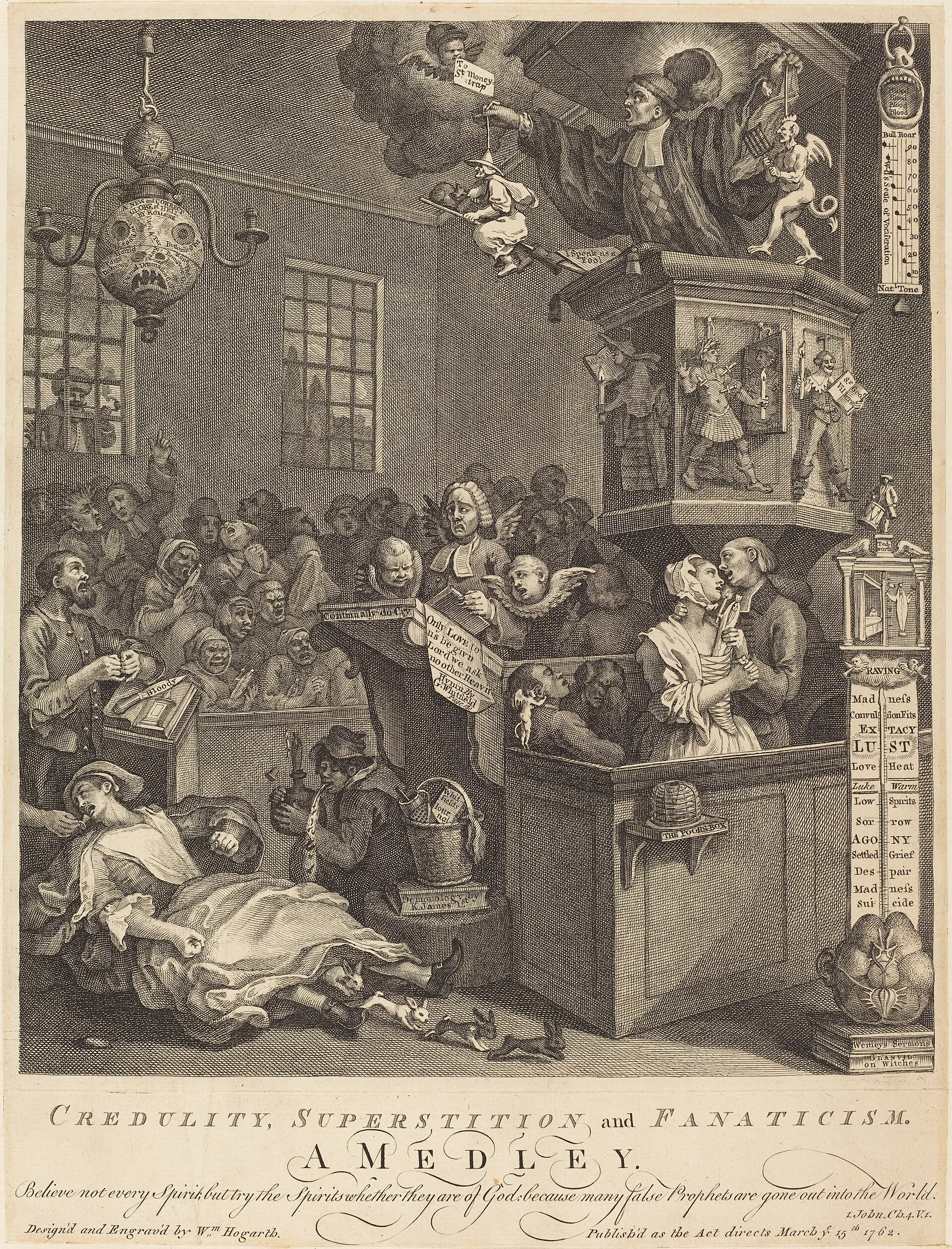
The affair became a byword for public credulity. The poet Charles Churchill mocked Johnson as the gullible Pomposo in his satire The Ghost, although Johnson had helped expose the fraud, and Hogarth worked the Cock Lane ghost into his prints. In the 1840s an artist sketching in the St John’s vault was shown a coffin said to be Fanny’s, found the body inside unusually well preserved and wondered about poison, a speculation that has never gone further. The verdict of 1762 still stands: the haunting was staged, and the only victim of foul play was Kent’s reputation.