
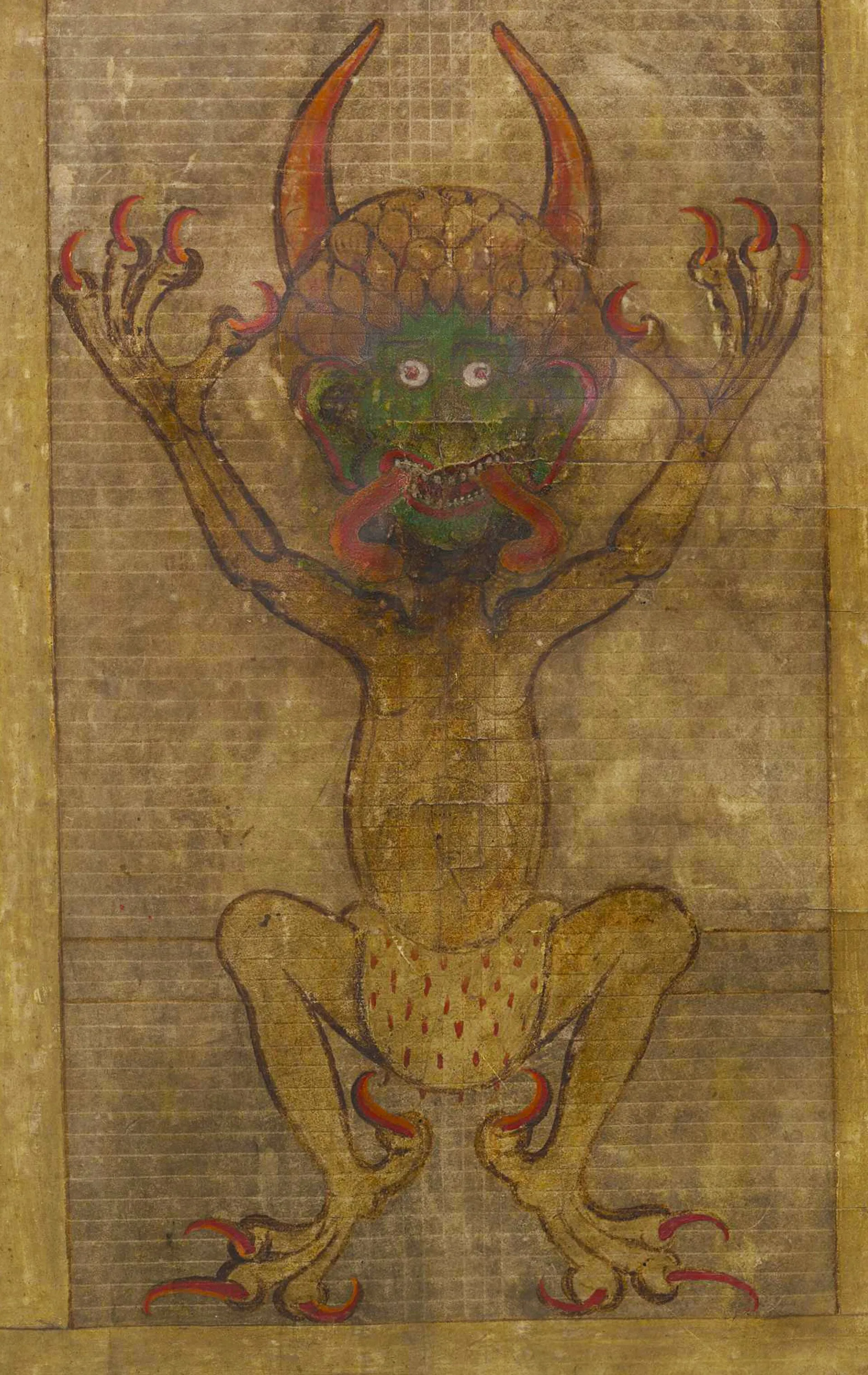
The Codex Gigas, Latin for “giant book,” is thought to be the largest medieval manuscript that survives. Its 310 parchment leaves are close to a meter tall, and with its wooden, metal-fitted binding it weighs about 75 kilograms, enough that two people are needed to move it. It is kept in the Treasury Room of the National Library of Sweden in Stockholm. Swedes have called it the Devil’s Bible for centuries, because of a single page and the story told about it.
What happened
The page is folio 290 recto. It holds a full-length figure of the Devil, alone, crouching with clawed hands raised, green-faced and horned, wearing a white ermine loincloth. It is faced across the opening by a painting of the Heavenly City, and the two are the only full-page pictures in the book. Most of the codex is not sinister at all. About half is the Latin Bible, Old and New Testaments, and the rest is a working library: the Etymologies of Isidore of Seville, a medieval encyclopedia, medical treatises, the chronicle of Bohemia written by Cosmas of Prague, a calendar with a list of the dead, and a handful of charms and conjurations against illness and evil.
The legend attached to it is old. A monk of Podlažice in Bohemia, condemned to be walled up alive for breaking his vows, promised to save himself by producing in a single night a book that would bring lasting glory to his monastery and contain all human learning. Near midnight he saw he could not finish, and he called on the Devil, who completed the work in exchange for his soul and had his own likeness added in thanks. In the fuller version the monk later begs the Virgin Mary for rescue and dies just before he can be released from the pact.
The investigation
The National Library of Sweden, which has owned the codex since the seventeenth century, has published a detailed history of it. The book was written in the Kingdom of Bohemia, in what is now the western Czech Republic. Its calendar includes St. Procopius, made a saint in 1204, and its necrology lists Bishop Andreas of Prague, who died in 1223, but not King Ottokar I, who died in 1230, which places the writing between those dates. A note on the first leaf names the small Benedictine house of Podlažice, near Chrudim, as the first known owner and says the monks pawned it to the Cistercians of Sedlec before it was bought back for the abbey of Břevnov in 1295, when it was already counted among the wonders of the world. The library doubts it was written at Podlažice at all, since the house was too small and too poor for a project on that scale.
Emperor Rudolf II took the book to his castle in Prague in 1594. In July 1648, in the last days of the Thirty Years’ War, Swedish troops seized Prague Castle and shipped its treasures north, and the codex reached Stockholm the following spring. When fire swept the royal palace on May 7, 1697, rescuers hurled it from a window to the ground below; some leaves were lost, and one account written decades later claims it landed on a bystander. It moved to the new National Library building on New Year’s Day 1878, and in 2007 it was lent to Prague and shown at the Czech National Library, its first return in more than 350 years.
The explanations
The single-scribe part of the legend holds up. The handwriting is uniform from beginning to end, and specialists who examined the ink and script for a 2008 National Geographic documentary concluded that one person wrote it. What they rejected was the timetable. Estimates of the labor involved run to many years of steady work, and scholars quoted in the Prague press put it at twenty years or more. The scribe’s name is unknown. A monk called Herman, recorded on November 10 in the book’s own necrology with the word inclusus, is the usual candidate, but the library notes that inclusus meant a recluse who chose an enclosed life, not a prisoner bricked into a wall.
The story itself has a known pedigree. The library identifies it as a version of the medieval tale of Theophilus, a cleric who bargains with the Devil, repents and is saved by the Virgin, the same pattern later used for Faust. The portrait of the Devil sits in a sequence about sin and penance, set against a vision of heaven, which is exactly where a medieval reader would expect him.
Where it stands
The Codex Gigas is a real, well-dated and fully digitized object, and its scale is genuinely astonishing for one copyist. The library itself calls the one-night legend baseless, but notes that it shows how strongly the size of the book impressed the people who saw it. Nothing in the record suggests supernatural help.