
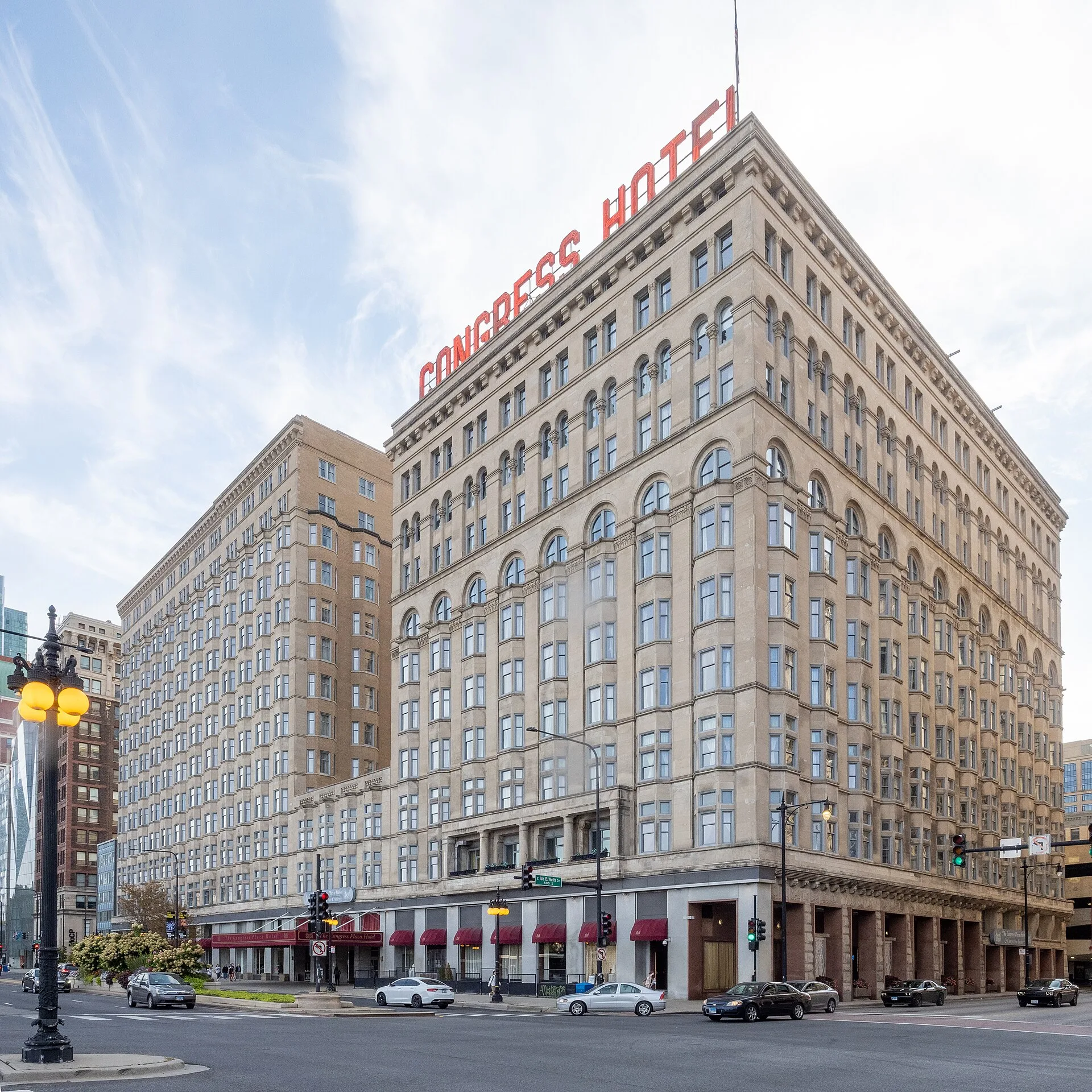
The Congress Plaza Hotel fills most of a block of South Michigan Avenue opposite Grant Park. It opened in 1893 as the Auditorium Annex, an overflow house for the Auditorium Building across Congress Street, timed for the crowds of the World’s Columbian Exposition. The developer R. H. Southgate hired Clinton J. Warren to design the north tower, and a marble-lined tunnel under the street, Peacock Alley, joined the two buildings. Holabird & Roche added a south tower in 1902 and 1907, bringing the complex to about a million square feet, and by 1908 it was simply the Congress Hotel. Today it has 871 rooms.
What happened
For its first half century the Congress was a political hotel. Grover Cleveland, William McKinley, Theodore Roosevelt, William Howard Taft, Woodrow Wilson, Warren Harding, Calvin Coolidge and Franklin Roosevelt all stayed or spoke there, and in June 1912 Roosevelt addressed a crowd in Grant Park from his balcony during the Republican convention that split his party. The building also collected the tragedies any large old hotel collects. In August 1939 Adele Langer, a Jewish refugee from occupied Czechoslovakia who feared deportation, jumped from a thirteenth-floor window with her two small sons. In the Second World War the federal government took the building over and ran Army Air Forces classes in it; guests returned in 1944.
The modern chapter began on June 15, 2003, when roughly 130 housekeepers, cooks and servers represented by the hotel workers’ union, UNITE HERE Local 1, went on strike against a proposed seven percent pay cut. The strike lasted almost ten years, ended on May 30, 2013 without concessions, and left the hotel running, by one estimate, at about twenty percent occupancy. It was in those lean years that ghost tours began walking the corridors, and the Congress acquired its present reputation.
The lore
The stories are many and do not agree with one another. The best known concerns Peg Leg Johnny, a one-legged man reported in the dining room, lobby and hallways who is blamed when lights and electronics switch themselves on and off. Nobody knows who he was; one version makes him a vagrant murdered in the back alley, another a circus performer named Charles Conway who escaped prison in 1925 and was never seen again, and a third a cheerful long-term resident with a wooden leg who died at breakfast in the 1940s. A fourth-floor room, given as 441 by some tellers and 411 by others, is said to hold a dark female figure who stands at the foot of the bed and kicks guests awake.
The Chicago Architecture Center records the legend that the elevator stops unexpectedly on the eighth floor, together with complaints of whispers and moving objects on the fourth and twelfth. Travel + Leisure, naming the Congress the most haunted place in Illinois, reported that Al Capone ran his operations from the hotel and that his ghost appears near his eighth-floor suite. Ghost-tour accounts add a sealed room, its doorway drywalled over with the furniture still inside, which some visitors are told was the inspiration for Stephen King’s story 1408, and a small boy in knee breeches who runs the south-tower halls. The tour guide Tony Szabelski, who has said that if anywhere in Chicago is haunted it is the Congress, identifies the boy with six-year-old Karl Langer.
The investigation
There has never been a formal investigation, only tours and television. In 2017 the Columbia Chronicle asked the hotel’s director of human resources, Mark Souder, about the stories; he said management does not acknowledge them. Chris Sanchez, who markets the annual Haunted Halloween Ball, called them rumors that happen to suit the theme of the party. The historian Adam Selzer, who led tours through the building during the strike years, told the paper that every old hotel eventually acquires a ghost, that one author seems to have taken a list of famous guests and imagined each of them haunting the place, and that a Chicago writer simply invented the claim about King’s 1408. Some of the stories, he said, are easily debunked, and people believe obvious jokes.
The explanations
The Capone suite is the weakest link. No record places him as a resident, the hotel’s own tour literature calls the rumor that he owned the Congress false, and the version in which he merely played cards there on Friday nights is as far as the evidence goes. The sealed room has an ordinary reading: hotels close rooms for plumbing and structural reasons, and the detail that furniture was left inside comes from window washers looking in from outside. The drift of the room number between 441 and 411, and of Peg Leg Johnny between three different men, is the signature of an oral tradition rather than a documented one.
What is solid is the ordinary history. A building that has housed guests continuously since 1893 has seen suicides, falls down elevator shafts and at least one murder, and a hotel that stood half empty for a decade had every commercial reason to welcome a haunted reputation.
Where it stands
The Congress Plaza Hotel appears on most lists of Chicago’s haunted places, was named the state’s most haunted site by Travel + Leisure and a top ten haunted hotel by USA Today in 2014, and throws a Halloween ball for a couple of thousand guests every year. Its ghosts belong to the ghost-tour era and have never been examined by anyone without a ticket to sell. The Congress is a historic hotel with a good story, which is a different thing from a haunted one.