
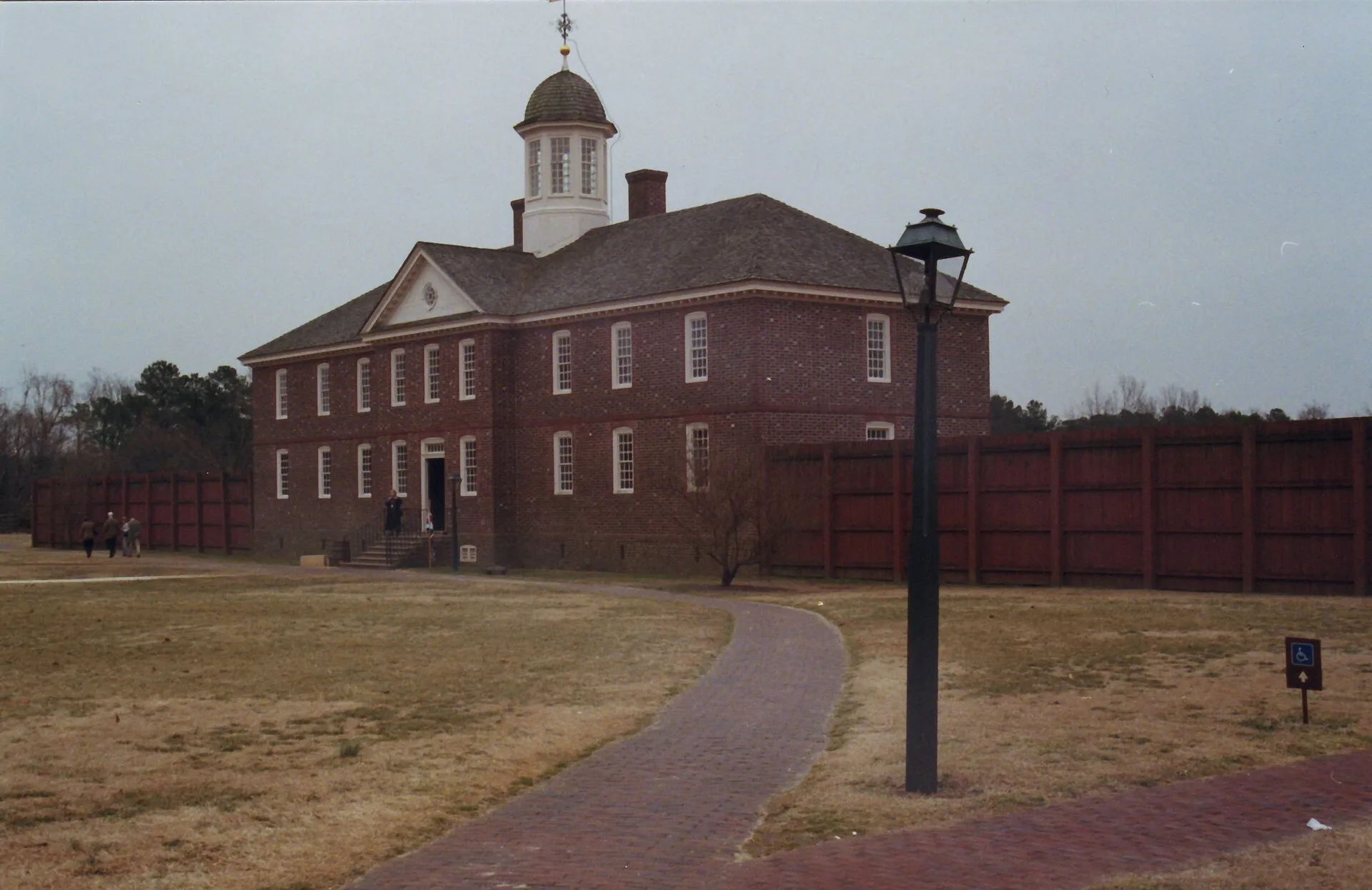
Williamsburg was the capital of colonial Virginia, and in 1766 its royal governor, Francis Fauquier, asked the House of Burgesses to build a hospital for people he described as deprived of their reason. Until then the only place the colony had for them was the jail. The Burgesses agreed in 1770, the building went up between 1770 and 1773 to a design by Robert Smith of Philadelphia, and the first patients were admitted on October 12, 1773. The Public Hospital for Persons of Insane and Disordered Minds was the first institution in British North America built solely for the mentally ill.
What happened
The hospital was a place of confinement before it was a place of cure. Behind the pedimented front and cupola were 24 cells with barred windows, each holding one patient on a straw bed, often in manacles. A keeper lived on the ground floor; there was no room for a physician. For its first sixty years the treatments were those of the age: bleeding, strong drugs, plunge baths, solitary confinement and restraint.
That changed in 1841, when John Minson Galt II, a member of the family that had kept the hospital for generations, became superintendent at the age of 22 with 125 patients in his care. Galt practiced what was then called moral management: respect and kindness, good food and sleep, work, games and company. A patients’ library opened in 1843, and by the 1850s roughly half of the 280 patients, those judged convalescent and well behaved, had the freedom of the town during the day. Galt helped found the Association of Medical Superintendents of American Institutions for the Insane, the forerunner of the American Psychiatric Association.
In May 1862 the Union army came up the Peninsula. Williamsburg fell after the battle of May 5, and troops took the hospital the next day. The white staff had fled, leaving 252 patients locked inside without food; an employee named Somersett Moore came back and handed the soldiers the keys. Galt was barred from the building. He died on 17 or May 18 of an overdose of laudanum. The state hospital’s own history says he had probably lived with depression for years and that the overdose may have been deliberate; the William & Mary library, which holds his diary, records a belief that anxiety over patients he could no longer reach contributed to his death.
The decades after the war were ones of crowding and custodial care. On June 7, 1885 the original 1773 building burned. The hospital, by then Eastern State Hospital, moved in stages between 1937 and the 1960s to a farm on the edge of town, where it still operates. Between 1983 and 1985 the Colonial Williamsburg Foundation rebuilt the 1773 building on its excavated foundations and opened it as an exhibit on the treatment of mental illness, with a 1773 cell beside an 1845 room from the Galt years.
The investigation
There has been no investigation of hauntings at the hospital, because there is nothing to investigate beyond the scripts of the evening ghost tours. Those scripts agree with one another and with nothing in the archive. A woman called Mary, admitted for hysteria, is said to scream from an invisible restraint chair in which she died. A man chained to a wall for twenty years rattles his irons. Seven patients who burned behind locked doors in the 1885 fire beat on doors that no longer exist. Galt himself is cast as a sinister figure in a blood-stained coat, an odd fate for the man who took the chains off.
A few hundred yards away stands the Governor’s Palace, which has a better claim to a dark history. It was a hospital for American wounded after Yorktown, it burned on December 22, 1781, and when the garden was excavated in 1929 before rebuilding it yielded 158 skeletons, 156 of them men, some with military buttons: the Revolution’s dead, buried where they died. The tours sell a hedge-maze ghost in two versions. In one a young woman, sometimes a William & Mary student of the early 1900s, is cut down in the maze with a scythe by an escaped asylum patient. In the other an escaped patient of the 1700s hides in the maze to kill the governor, is caught and hanged, and walks the paths at night. Neither appears in any record, and the Palace and its gardens are a 1930s reconstruction.
The explanations
The ghost stories borrow their power from real suffering. Patients were manacled in the first cells; the hospital was abandoned with its inmates locked in; a wealthy patient, Lucy Ludwell Paradise, was committed in her old age and died there, and tours still call her Mad Lucy. But the named ghosts, the fire deaths and the maze murderer have no source older than the companies that tell them, and the building visitors are invited to feel uneasy in is forty years old. The hospital’s history is more unsettling than its folklore, and it is all documented.
Where it stands
The reconstructed hospital is open as a museum and doubles as the entrance to the DeWitt Wallace Decorative Arts Gallery. Eastern State Hospital continues at its present site, more than 250 years after Fauquier’s speech. The ghost tours run every night of the year. The asylum is history; the hauntings are a legend built on it.