
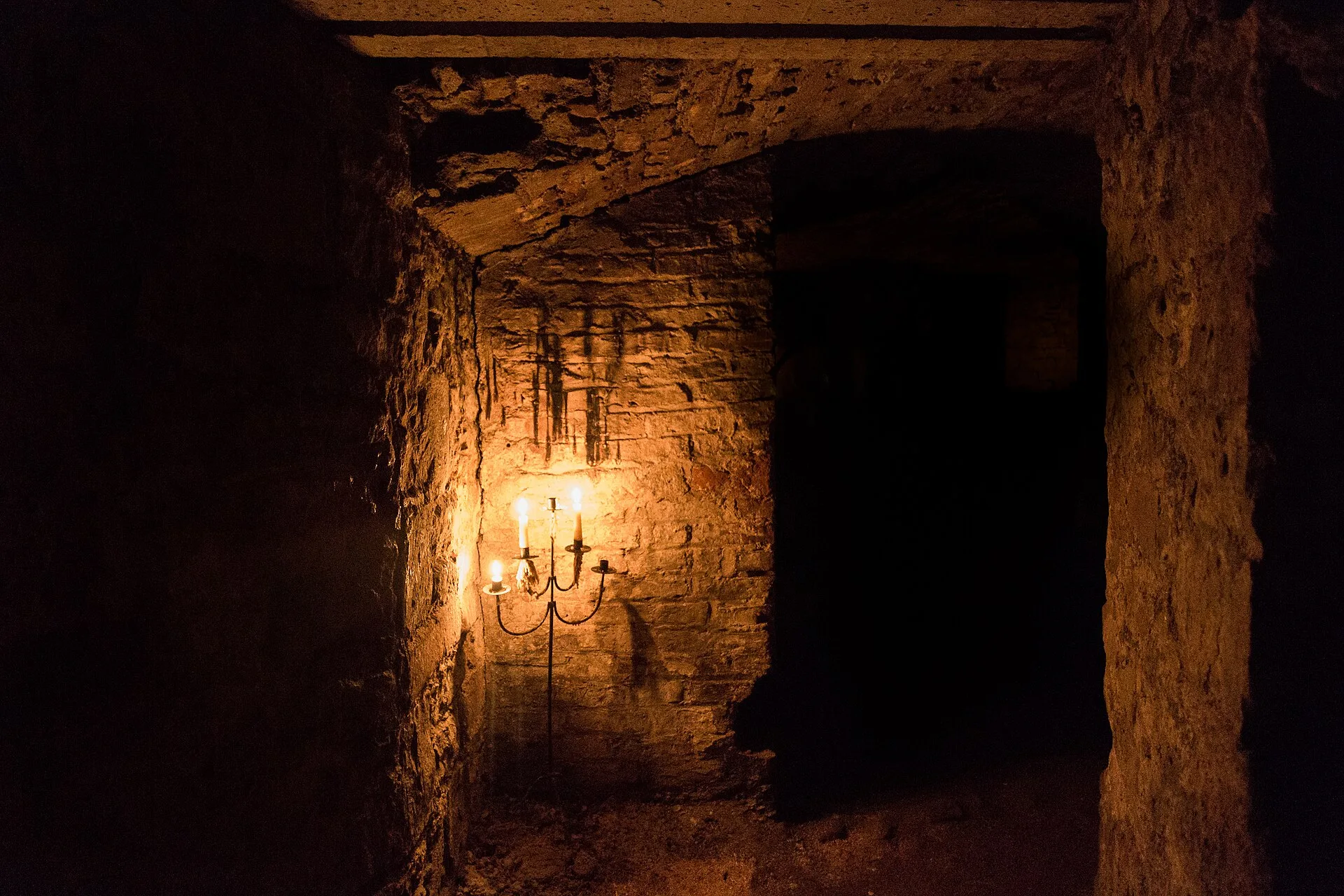
Edinburgh’s Old Town sits on a ridge, and the South Bridge was built to carry traffic off the ridge across the Cowgate ravine to the growing suburbs beyond. Proposed in 1775, begun with a foundation stone on August 1, 1785 and opened to carts in July 1788, it is a thousand feet long and thirty-one feet high at its tallest, a viaduct of nineteen round arches probably designed by Alexander Laing and Robert Kay after Robert Adam’s grander scheme was rejected as too expensive. Tenements were built hard against it on both sides almost at once, so that only the single arch over the Cowgate has ever been visible. The other eighteen vanished inside the buildings, and the spaces within them, about 120 chambers from the size of a cupboard to forty square meters, are the Edinburgh Vaults.
What happened
The vaults were meant as cellars for the shops above, and for a few decades they worked: storerooms for wine and cloth, cobblers’ and tradesmen’s workshops, taverns. The flaw was that the bridge deck was never sealed. Water came through the stone, the air went bad, and from as early as 1795 the better tenants began to leave; by the 1820s the businesses had gone. What moved in was everyone else. The vaults became a refuge for the destitute, including Irish immigrants and Highlanders displaced by the Clearances, and a cover for illicit trades. On July 1, 1815 the Edinburgh Evening Courant reported a secret distillery found under one arch that had been running for eighteen months. Conditions were dark, wet and unsanitary, disease was constant, and the tradition that the body snatchers Burke and Hare stored their victims there has no evidence behind it beyond the fact that the vaults were the kind of place where such a thing could be imagined. Sometime between 1835 and 1875 the chambers were filled with rubble and forgotten.
They were found again by accident. In the 1980s Norrie Rowan, a former Scotland rugby international, came across a passage into the arches while renovating the Tron Tavern, and an excavation in 1985 turned up the middens of the people who had lived there: toys, medicine bottles, plates, clay pipes. In 1989 Rowan used the tunnels to get the Romanian rugby player Cristian Raducanu away from the Securitate agents minding his team, weeks before the revolution. Through the 1990s Rowan and his son Norman cleared hundreds of tons of rubble by hand, finding thousands of oyster shells as they went. The chambers south of the Cowgate are now event venues, The Caves and The Rowantree, and the Fringe fills them with shows every August. The chambers to the north, entered from Blair Street and Niddry Street, became ghost tours.
The ghosts
The tour ghosts have names. Mr Boots is a tall figure in heavy boots and a tattered coat who is heard pacing the stone and is said to drive visitors out of one chamber; the Watcher stands at the back of tour groups and appears in the corner of photographs; a small boy called Jack takes hands in the dark; and a vault that housed a modern Wiccan group’s temple, its stone circle still on the floor, is kept for the end of the tour. Visitors report cold, nausea, pushes and scratches, and photographs taken in the vaults with figures, faces or lights in them circulate online every year.
The investigation
Television has been down several times. Most Haunted broadcast from the vaults in 2003 and returned for a live Halloween special in 2006; Ghost Adventures filmed there and reported encounters. The one piece of evidence worth the name came in 2009, when the actor Joe Swash spent a night alone in the vaults for a BBC Three program that aired in January 2010. The cameras recorded about twenty minutes of indistinct voices that Swash did not hear at the time. The BBC’s sound engineers first suggested that the noise had drifted in from the nightclubs that share the arches, and although no source was ever identified, nobody has shown that it was anything else.
The explanations
Everything the tours offer as evidence has a mundane twin. The vaults are cold, wet and unlit, with uneven floors and the acoustics of a stone pipe; they sit under a busy street and beside late-night venues, so that footsteps and voices come through the masonry. A tour group holding phones in a black room produces long exposures, dust in the flash and other people’s shoulders, which is what most of the figures in the photographs turn out to be once the next picture in the sequence is seen. The names themselves are young: Mr Boots and the Watcher are not in any account before the tours began in the 1990s, and the historian Jan-Andrew Henderson’s 1999 book on the underground city treats the ghosts as something the vaults acquired after reopening rather than something they brought with them.
Where it stands
The Edinburgh Vaults are a real place with a real history of misery, which is why they are so effective. The people who died in them in the nineteenth century left bottles and pipes, not apparitions; the apparitions arrived with the lighting rigs. As a built relic of the Georgian city they are remarkable, as a haunted site they are a stage, and the tours are honest enough to be both.