
What happened
The British began a fort on Mud Island, below the mouth of the Schuylkill, in 1771 under the engineer John Montresor, lost interest, and left the Pennsylvania Committee of Safety to finish it in 1776. When the British army took Philadelphia in September 1777 it could not be supplied until the Royal Navy got up the Delaware, and the river was blocked by sunken obstructions covered by the guns of Fort Mifflin on the Pennsylvania side and Fort Mercer in New Jersey. Montresor was sent to take back the fort he had designed. The garrison, around 400 Continentals under Lieutenant Colonel Samuel Smith and then, after Smith was wounded, Major Simeon Thayer, sat on a mudflat with ten serviceable guns. From November 10, 1777 British batteries on the mainland and, from the 15th, warships in the channel, poured in what is generally counted the heaviest bombardment of the war, with a French engineer, Fleury, directing repairs each night. On the night of November 15 Thayer evacuated the survivors to Fort Mercer; forty men stayed to burn the barracks and left with the flag still flying. Roughly 250 of the defenders had been killed or wounded. The fort never fought again, but the weeks it cost the British helped Washington get his army to Valley Forge.
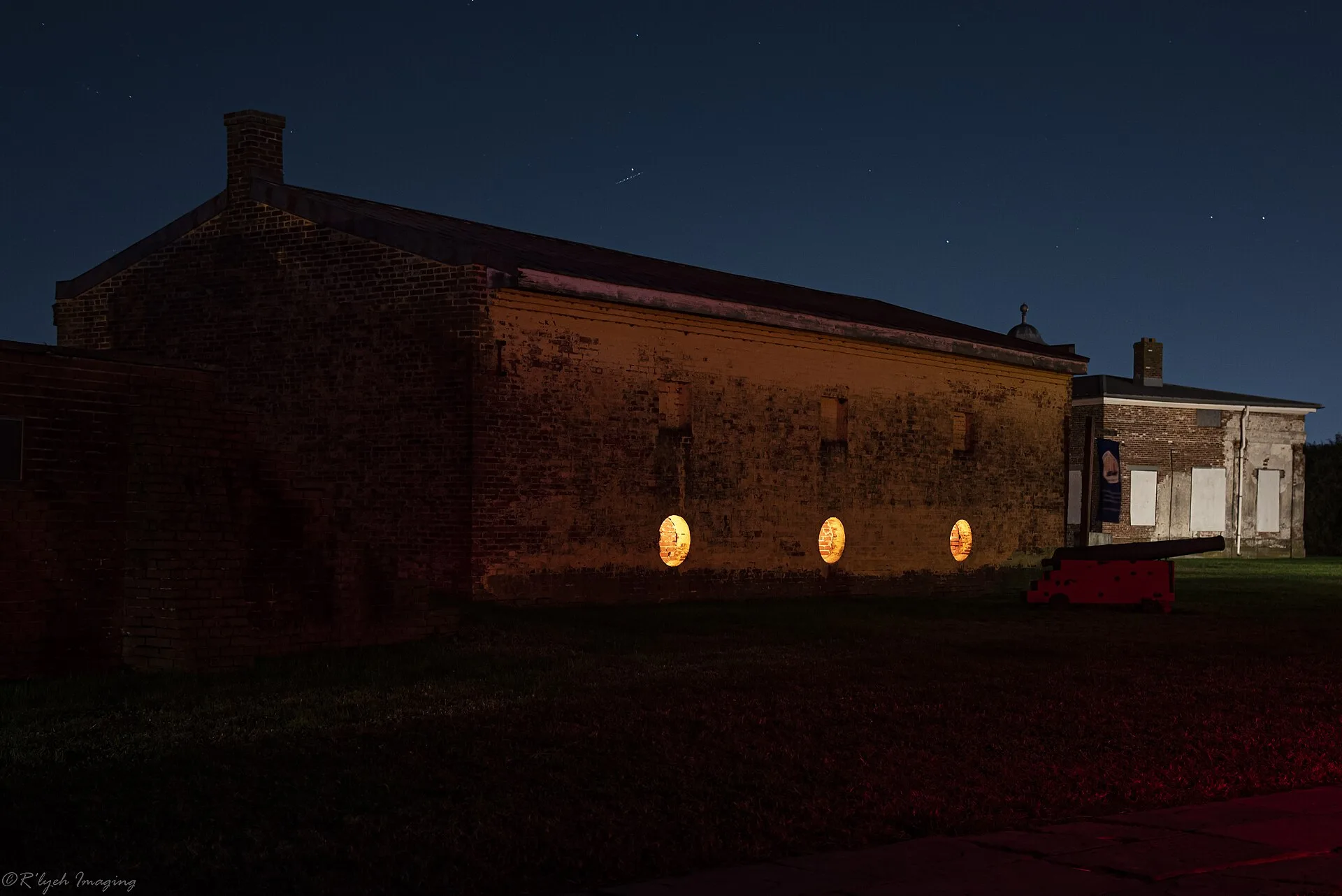
The ruin was rebuilt from 1793 under the first federal fortification program, with Pierre L’Enfant supervising in 1794 and the French engineer Louis de Tousard after him, and named in 1795 for Thomas Mifflin, Pennsylvania’s first governor. The brick walls, casemates, officers’ quarters, barracks, hospital and magazines that visitors see date from then to the 1840s. By the Civil War it was obsolete as a fort and useful as a prison. Repairs in 1863 fitted it to hold Confederate prisoners from Gettysburg, up to 216 at a time, along with Union deserters and civilians, including 44 men from Columbia County held without charge for months over the so-called Fishing Creek Confederacy. The casemates were damp and crowded and disease was common. Private William H. Howe of the 116th Pennsylvania, who had gone home sick and shot one of the officers sent to bring him back, was convicted of desertion and murder, led a mass escape attempt from the casemates in February 1864, and was hanged in the fort on August 26, 1864, the only wartime execution there and one attended by ticket-holding spectators.
The fort stored munitions in both world wars and held anti-aircraft guns in the second, when Battery H of the 76th Coast Artillery, the first Black coast artillery unit, was posted there. The Army decommissioned it in 1954 and the property passed to the City of Philadelphia in 1962; it became a National Historic Landmark in 1970 and the Army Corps of Engineers still uses a corner of it. Volunteers began tours in 1969, and since 1986 a non-profit, Fort Mifflin on the Delaware, has run the site.
The investigation
The ghost stories grew with the tours. The best known is the Screaming Woman, said to wail from the officers’ quarters so loudly that neighbors have called the police. She is identified as Elizabeth Pratt, but the accounts disagree about who that was: an officer’s wife who disowned a daughter for courting an enlisted man and hanged herself from the balcony when the girl died of typhoid; a mother who died of typhoid herself; or a woman who simply screamed on hearing of her child’s death. Howe is said to walk Casemate 5 and to have left his signature in Casemate 11, a sealed chamber rediscovered in 2006. A faceless man, a lamplighter in the barracks and a tour guide in the powder magazine round out the roster. The cable series Ghost Hunters filmed at the fort, Weird NJ sent a crew to spend a night in Casemate 5 in 2023, and the fort sells overnight Sleep with the Ghosts investigations that regularly sell out.
The explanations
No version of the Pratt story cites a muster roll, a burial, a newspaper or a letter, and the versions cannot all be true. The fort sits at the end of the runways of Philadelphia International Airport, beside the river and a tidal marsh, and a brick enclosure full of empty vaulted rooms is a fine amplifier for aircraft, wind, waterfowl and the river. The recorded bangs and thuds in the Weird NJ account came from a group alone at night in an old masonry fort, which is the condition under which such sounds are always recorded. A local paranormal researcher has offered the alternative that the screams belong to a modern murder victim dumped in the nearby swamp, which says something about how the stories are made.
Where it stands
The documented history of Fort Mifflin needs no ghosts to be remarkable, and the non-profit that keeps the roofs on the buildings is open that the paranormal programs help pay for the restoration. The siege, the prison and Howe’s hanging are facts; Elizabeth Pratt is a story told in the dark.