
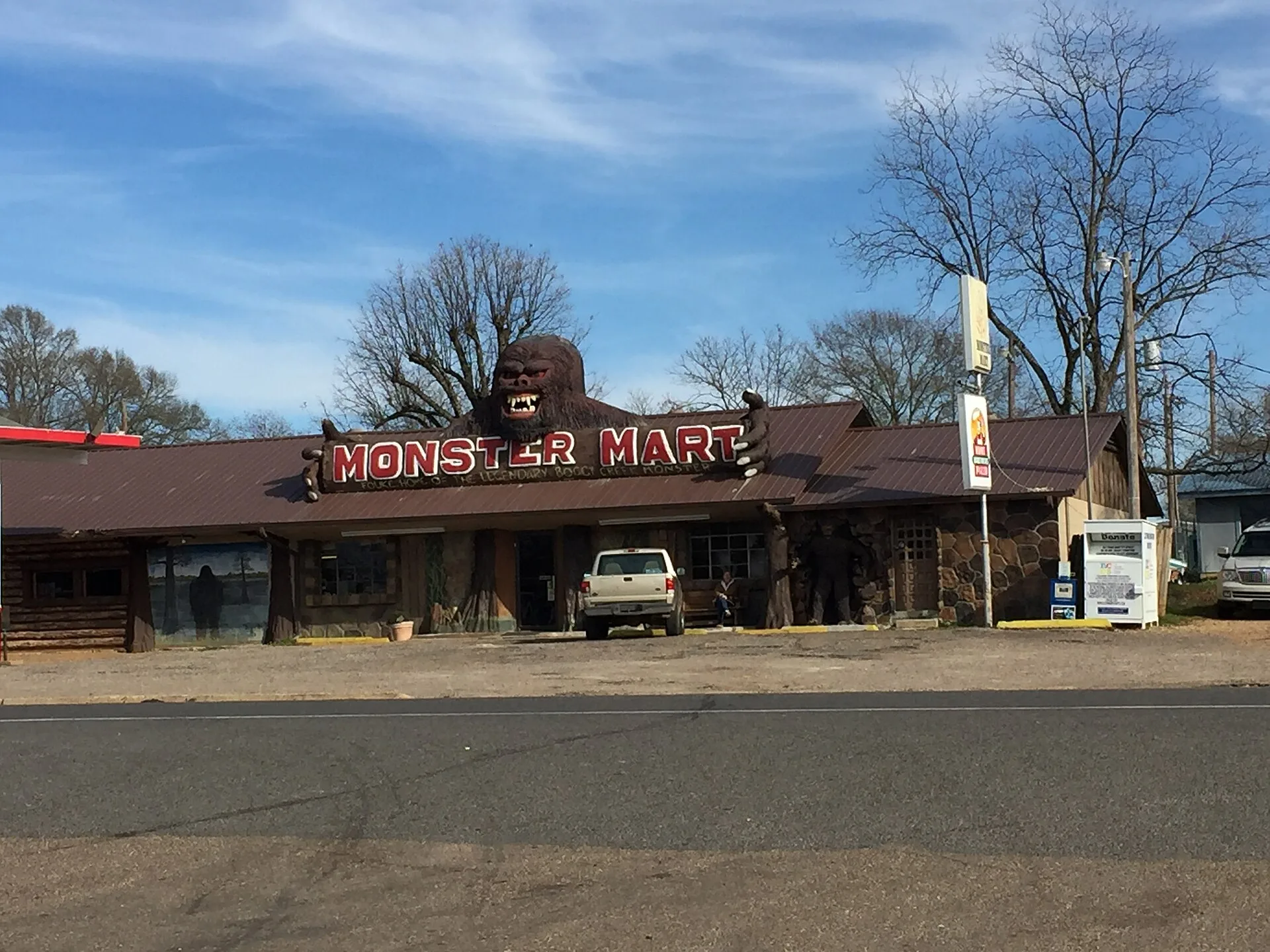
Fouke is a small town in Miller County, in the far southwestern corner of Arkansas, a short drive south of Texarkana. The land around it is low, wooded and wet, cut by creeks and sloughs, among them Boggy Creek. In the spring of 1971 the town acquired the monster that still defines it.
What happened
Bobby and Elizabeth Ford had recently moved into a rented house outside town. At the beginning of May 1971, by their account, Elizabeth was asleep on a couch when she woke to see a hairy arm with claws reaching through a window screen, and a pair of red eyes. Bobby, his brother Don and a companion took guns outside and fired at a large dark shape near the house; they believed they hit it but found no blood. Bobby told the town constable that the creature then caught him around the shoulder on the porch. He described it as about seven feet tall and three feet across the chest, breathing heavily and moving very fast. He broke free, ran through the front door and was treated at a hospital for minor scratches and shock. The Fords said the creature had been seen around the house for several days, and officers who came out found odd tracks and scratch marks on the porch, along with damage to a window and the siding.
The coverage
Jim Powell, who reported for both the Texarkana Gazette and the Texarkana Daily News, drove out with Dave Hall of the local radio station KTFS and found the family packing to leave. Powell’s first story was followed the next day by another that used the name Fouke Monster for the first time, and the Associated Press and United Press International carried it across the country. Monster hunters, reporters and the curious followed. Later residents told of earlier encounters, and a local family, the Crabtrees, supplied many of the most vivid stories, but Brian Dunning of Skeptoid notes that the historian Lyle Blackburn, searching Arkansas newspapers, found no printed mention of a hairy creature near Fouke before Powell’s report.
The tracks
The best-known physical evidence was a set of footprints found in a soybean field owned by Scott Keith, who ran a filling station in town. They showed three toes. A state game warden could not confirm them, and about a month after the Ford incident Frank Schambach, an archaeologist at Southern State College in Magnolia, was quoted in the Gazette giving a ninety-nine percent chance the tracks were a hoax: every known primate has five toes, the region had no history of apes, and apes are active by day while the Fouke creature was reported at night. In 1986 the former sheriff and the mayor both said they believed the tracks were man-made. Dunning points out that the first casts were long, narrow and three-toed, later ones looked more like an ape’s, and later still some resembled an ostrich’s, a progression that fits hoaxers learning anatomy better than a single animal.
The film
The filmmaker Charles B. Pierce made the story into The Legend of Boggy Creek, a docudrama shot in and around Fouke with local residents, including some of the people involved, playing themselves. Released in 1972, it reportedly cost about $160,000 and grossed some $20 million, becoming one of the year’s top earners and a cult favorite that spawned sequels and imitators. The film fixed the creature in popular memory and is still screened in town.
Where it stands
Sightings have been reported sporadically since, including dozens in the late 1990s, but nothing has been caught, photographed clearly or recovered. Fouke has embraced its fame: a convenience and souvenir shop is called the Monster Mart, and since 2013 the town has held a Fouke Monster Festival, which in 2022 marked the film’s fiftieth anniversary with talks and bus tours of sighting locations. The Fords’ frightening night is part of the record; the monster it produced is a legend.