
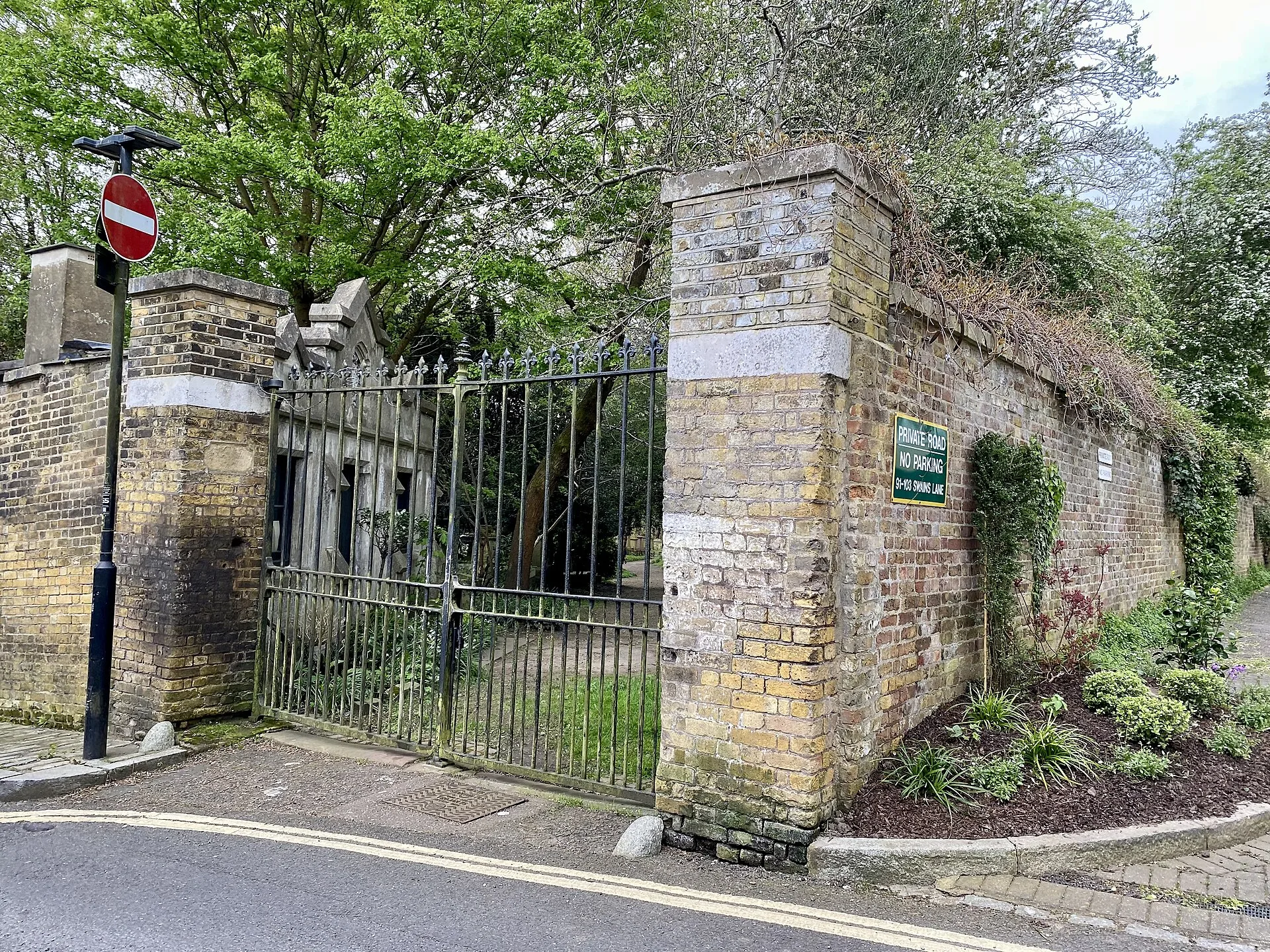
Highgate Cemetery climbs the slope of Swain’s Lane in north London. Opened in 1839 as one of the city’s grand private burial grounds, it had by the late 1960s become a jungle of ivy, broken monuments and forced vaults, used by courting couples, vandals and the curious. Hammer had shot scenes for its Dracula films among the tombs. In early 1970 that setting produced a modern legend, and the legend produced a feud that outlived one of its two leading men.
What happened
The story started with letters to the local weekly, the Hampstead and Highgate Express. In February 1970 the paper printed a note from David Farrant, a young man with an interest in the occult, describing a gray figure he had seen near the cemetery’s north gate and asking whether anyone else had seen something similar. Readers wrote in with their own stories: a tall figure in a hat who melted through a wall, a spectral cyclist, disembodied voices, and an account from 1967 of two schoolgirls who believed they had watched the dead rising. Farrant later mentioned finding dead foxes.
A second man then took over the narrative. Seán Manchester, who led a group he called the British Occult Society and later styled himself a bishop, told the paper the figure was no ordinary ghost. In his account a nobleman from eastern Europe, a practitioner of black magic, had been brought to England in a coffin and buried on the site, and Satanists meddling in the cemetery had roused him. The Ham and High ran it under a headline asking whether a vampire walked in Highgate.
The story left the letters page on Friday March 13, 1970. Both men appeared in a Thames Television report, talking about staking whatever they found, and within hours a crowd of around a hundred people arrived at the gates. Many climbed the walls and roamed the graves in the dark while some forty police officers tried to clear them out.
The investigation
There was never an investigation of a vampire; the investigations were of people. In August 1970 the century-old remains of a woman were found desecrated near the vault where she had been laid. Soon afterward Farrant was arrested in the churchyard of St Michael’s next to the cemetery, carrying a stake and a crucifix. At Clerkenwell in September he was acquitted, the court deciding a churchyard was not an enclosed area under the law he was charged with breaking. In 1974 he was jailed for damaging memorials and interfering with remains in the cemetery, charges he always denied; he did admit sending voodoo effigies to two police officers.
The vampire hunt itself ended, as far as Manchester was concerned, in 1973, when he said he had found the creature’s body in a house in nearby Crouch End and driven a stake through it. Nobody else witnessed this. The same year the two rivals publicized a magical duel on Parliament Hill that never took place.
The explanations
The folklorist Bill Ellis studied the affair in a 1993 article in the journal Folklore, placing it within the rumors about Satanic cults then circulating on both sides of the Atlantic. The ingredients of the legend are easy to see: ordinary ghost stories about a spooky place, a newspaper happy to print colorful letters, two rivals each claiming to be the expert, and a television broadcast that turned talk into a crowd. The vampire itself, with its foreign aristocrat and coffin, borrows heavily from Bram Stoker and the Hammer films. The real damage in the cemetery, including the disturbed remains, came from living intruders, whoever they were.
Much of what is now told about Highgate rests on the competing books the two men wrote. Manchester’s The Highgate Vampire appeared in 1985 and Farrant answered with Beyond the Highgate Vampire in 1991. Farrant maintained that the vampire was the media’s word and that he had only ever reported a ghost. Each spent decades disputing the other’s account in print and later online, until Farrant’s death in April 2019.
Where it stands
The cemetery was rescued in 1975 by a volunteer group, the Friends of Highgate Cemetery, whose not-for-profit trust now owns and runs it, cares for the graves that were vandalized and has declined to comment on the episode. Nothing about the events of 1970 required anything supernatural. What remains is a well-documented media panic and a durable piece of London folklore.