
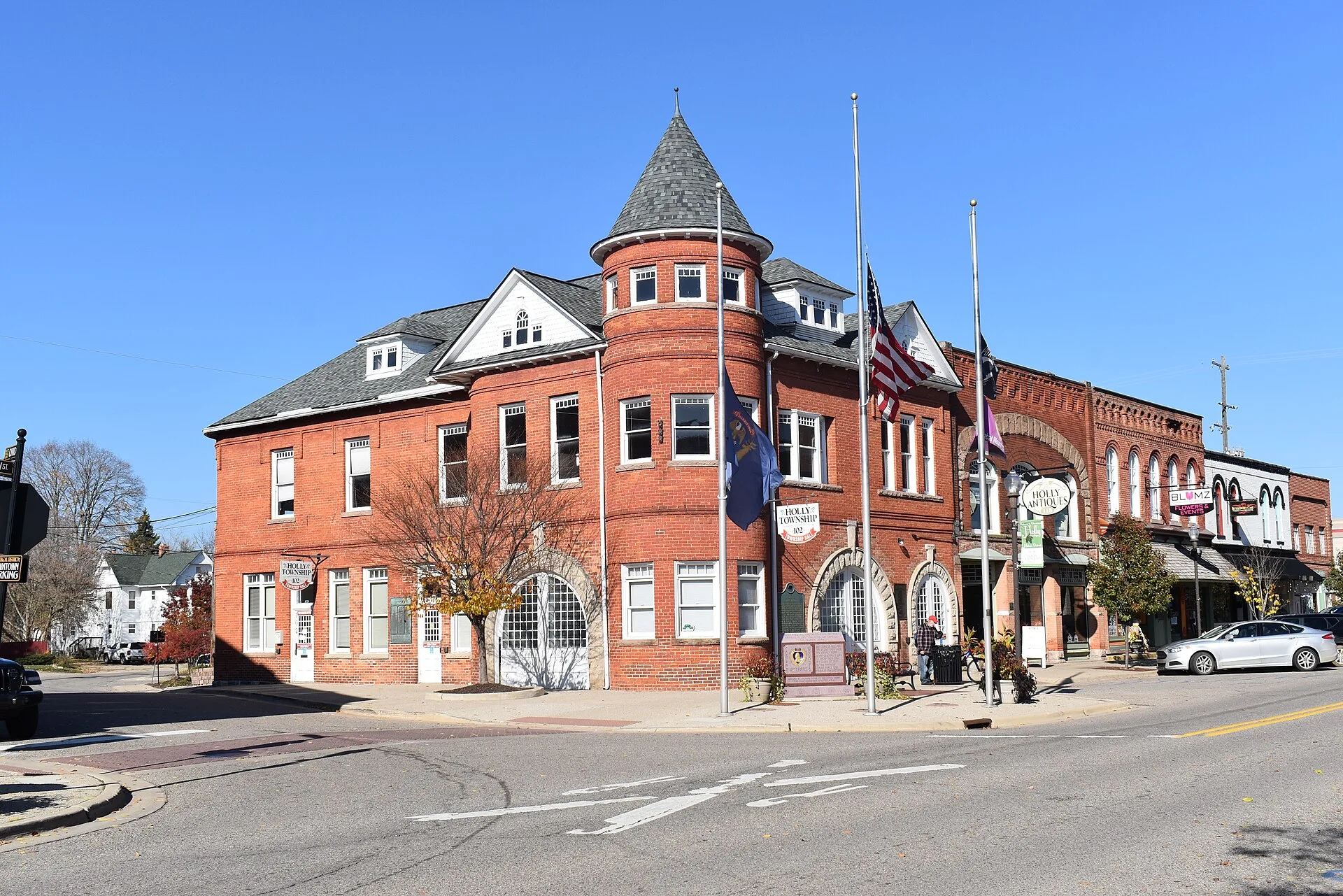
Holly is a village in Oakland County, Michigan, about fifty miles northwest of Detroit, that owes its existence to a railroad junction. The Holly Hotel sits on Battle Alley, a short street named for the brawls that spilled out of its saloons in the railroad years. The building has burned three times, been restored twice, and since the 1980s has advertised its ghosts as hard as its dining room.
What happened
The Detroit and Milwaukee line reached Holly in 1863, and the Flint and Holly line joined it the following year. At the peak more than twenty-five trains a day stopped, and a hotel trade grew up around the depot. John Henry Hirst ran the Exchange Hotel until it burned in April 1892, and that year he put up its replacement, a two-and-a-half-story red brick Queen Anne building with a three-story octagonal corner tower, hot-water heating and a dining room with pretensions. The hotel’s own history dates the building to 1891; the Clio entry, drawing on the Pontiac Gazette and Detroit Free Press of June 1892, puts its completion in 1892. Hirst called it the Hirst House.
Hirst’s wife Lydia died in 1903 and he sold up in August 1906. The building changed hands twice in a week, lost its roof to a fire in July 1907 and was renamed the Holly Inn. On August 29, 1908, the temperance campaigner Carry Nation came through Holly, smashed whiskey bottles in the bar with her hatchet and beat the drinkers with her umbrella; the owner had her arrested. Joseph P. Allen bought the hotel in 1912, and on January 19, 1913, a fire, blamed on a match dropped down a clothes chute, destroyed the upper floors. Allen rebuilt in a plainer style and reopened it as the Allendorf; under a later owner it became the Hotel Norton. As passenger trains thinned out, the hotel declined into a bar and restaurant.
On January 19, 1978, sixty-five years to the day after the 1913 fire, faulty wiring started another blaze that gutted the interior, with damage put at $550,000. Dr. Leslie Sher bought the shell and rebuilt the roof and tower to the 1892 drawings, and the restaurant reopened in 1979 as the Historic Holly Hotel under George Kutlenios. It was listed on the National Register of Historic Places on February 8, 1980. A comedy club opened in the basement in 1983, and George H. W. Bush ate there during a 1992 campaign whistle-stop. On June 21, 2022, a fire that began nearby destroyed a stretch of Battle Alley; seventeen fire departments responded, five firefighters were hospitalized, and the hotel was badly damaged again. The owners announced that they would rebuild.
The investigation
The ghosts came with the 1979 reopening and the dining trade. In 1989 Norman Gauthier, a self-described professor of parapsychology who made a career of declaring buildings haunted, visited and pronounced the hotel “loaded with spirits.” A regional group, the Ghost Hunters of Southern Michigan, has run overnight investigations there every year since, and the hotel holds a séance and ghost dinner each October. None of these produced a published report; the hotel’s own website is the only account of what was found.
The explanations
The hotel names four regulars. John Hirst, who died in the 1920s, is said to appear in a frock coat and top hat at the top of the stairs or in the former barbershop in the basement, announced by cigar smoke and a deep laugh. Nora Kane, described as a hostess from the early years, is credited with the scent of flowery perfume in the bar’s turret, with piano music and singing late at night, and with turning up in the background of wedding photographs, usually cut off at the knee. A red-haired girl of nine to thirteen is blamed for moving a meat cleaver and the hanging utensils in the kitchen, for footsteps on the back stairs and giggling, and the hotel says she was the only spirit to answer at a séance in the early 1990s; nobody knows who she was. Leona, the Hirsts’ rat terrier, is heard barking and felt brushing against legs, mostly by the morning cooks. In February 1996 Mrs. Kutlenios reported a solid-looking Native American man without feet in one dining room; he was never seen again.
The documented history of the hotel, assembled from newspapers, the census and the National Register nomination, has no Nora Kane in it. The coincidence of the two fire dates is real and is the hotel’s best story, but it does not need a ghost. Cigar smoke, perfume and piano music are ordinary in a hundred-year-old bar and restaurant with a working piano, and a figure in a wedding photograph is more easily a guest than an apparition. The hauntings have been told the same way by the same owners for forty years, and they bring in customers every October.
Where it stands
The fires of 1907, 1913, 1978 and 2022, Carry Nation’s visit and the National Register listing are all on record. The ghosts rest on the hotel’s own word and on a 1989 visit by a man whose business was finding spirits. Until the building reopens, the stories are on pause; there is no reason to think they will not resume with the restaurant.