
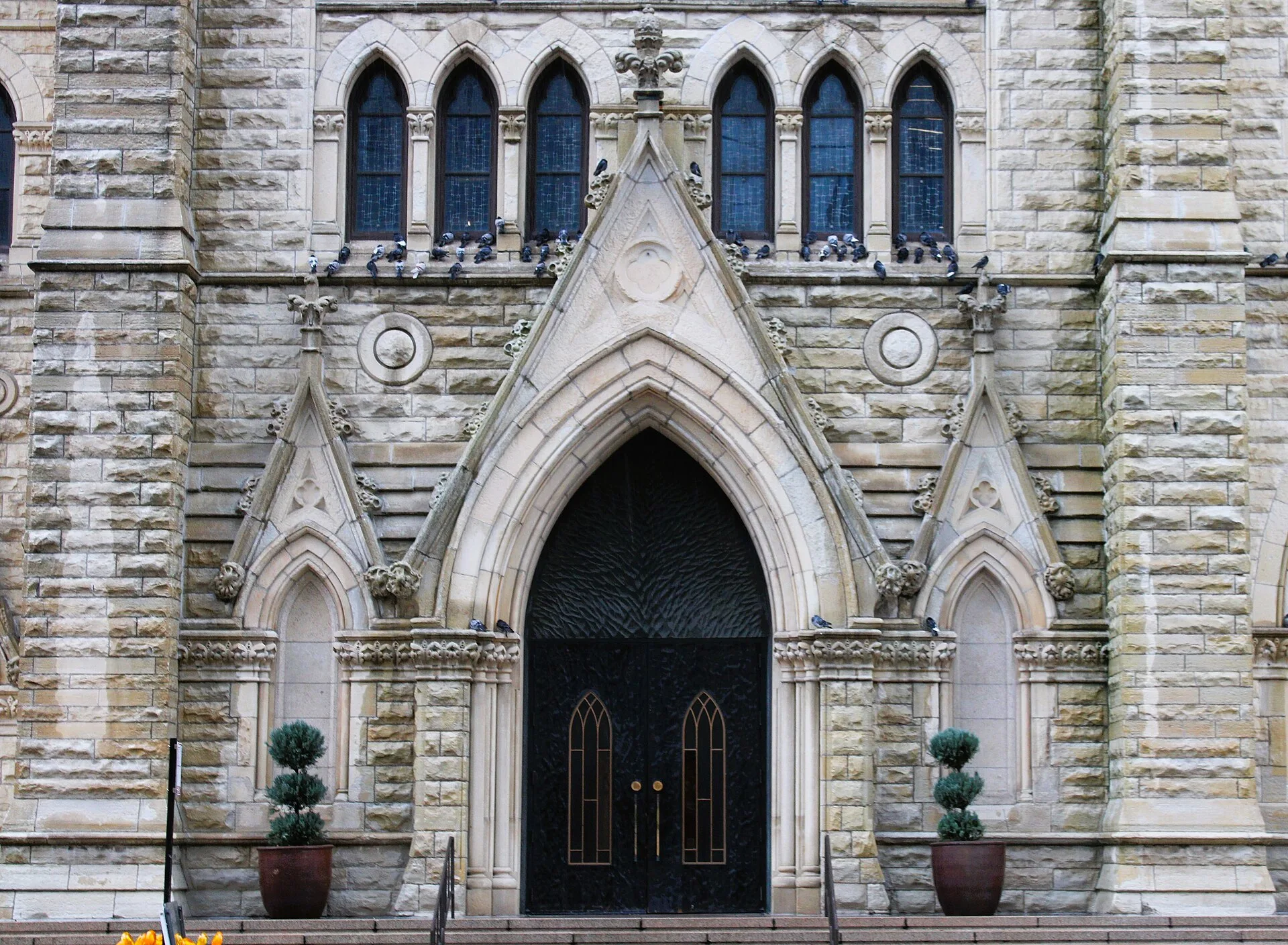
Holy Name Cathedral, the seat of the Archdiocese of Chicago, stands at 735 North State Street. Its cornerstone was laid in 1874, the church was dedicated the following year, and the stone at the southeast corner of the front steps still carries that date. During Prohibition the view from its doors was of a flower shop at 738 North State, Schofield’s, which from 1922 belonged in part to the bootlegger Dean O’Banion and served as the headquarters of the North Side gang. Two of the gang’s leaders died within sight of the cathedral in as many years.
What happened
O’Banion had been an altar boy and chorister at Holy Name and was married there. On November 10, 1924, after a liquor deal with Johnny Torrio’s South Side organization collapsed, three men walked into Schofield’s, one shook his hand, and the others shot him among the chrysanthemums. The cathedral refused him a funeral; he was buried at Mount Carmel. His friend Earl Wojciechowski, who went by Hymie Weiss, took over the gang and the office above the shop and spent the next two years trying to kill Torrio and then Al Capone. Torrio was shot and retired. On September 20, 1926 a convoy of Weiss’s cars poured more than a thousand rounds into Capone’s Hawthorne Hotel in Cicero and missed him.
Capone’s reply came three weeks later. Gunmen rented a second-floor room at 740 North State, next to the flower shop, and a second post in a building on Superior Street, and waited for days. At about four in the afternoon of October 11, 1926 Weiss returned from the courthouse, where a jury was being picked for the trial of an ally, with his bodyguard Patrick Murray, the lawyer William W. O’Brien, O’Brien’s investigator Benjamin Jacobs and his driver Sam Peller. They parked beside the cathedral on Superior and crossed State toward the shop. A submachine gun and a shotgun opened up from the windows. Weiss, 28, took ten bullets and fell in the street; Murray died in front of the cathedral; O’Brien was hit four times and crawled into a stairwell; Jacobs and Peller were wounded. Father Bernard Sheil came down the steps and conditionally anointed the dying. The rounds that missed struck the cathedral’s cornerstone and shattered its inscription, a verse from Philippians about every knee bowing at the name of Jesus.
The investigation
Police attributed the machine gun to Jack McGurn and the shotgun to Sam Hunt, whose golf bag was found in the second post, and credited Frank Nitti with organizing it. A witness, Charles McKibben, insisted the wounded Peller and Jacobs had shot Weiss themselves, which the physical evidence did not support. Nobody was ever charged. The cathedral refused Weiss a funeral as it had O’Banion, and he too went to Mount Carmel, leaving an estate reported at 1.3 million dollars. In 1929 the Chicago Tribune’s James O’Donnell Bennett walked readers past the damaged stone, and visitors have been looking for the holes ever since.
The legend
Ghost tours tell two stories about the stone. The first is that the bullet holes cannot be patched: the mortar refuses to dry and runs out, or sets and pops free soon afterward, as though the building insists on keeping the record. The second is that a well-dressed man in a 1920s suit and fedora is seen near the steps in the early evening, sometimes with the sound of gunfire, and vanishes when approached; tour guides offer him as Weiss, and the guide Tony Szabelski has reported his equipment answering yes and no to questions about him. A tour participant’s photograph of orbs of light near the cornerstone has been published by the investigator Ursula Bielski.
The explanations
The cathedral’s own history settles most of it. During a later renovation the front steps were extended across the facade, covering the cornerstone and its wrecked inscription except for the date, so the holes were not so much repaired as built over. Of the marks still visible, Chicago magazine established that the cleanest round hole, the one most often photographed, was drilled to hold a bracket for a placard of service times, while the real damage consists of filled and faded pocks from .45-caliber rounds in the rough limestone. Repairs to stone of that kind are ordinary masonry, and the archdiocese has never reported one failing. The man in the suit has no named witness and no date; State Street on an October evening is full of men in coats.
Where it stands
The marks beside the 1874 date are genuine, the men who caused them are known, and the archdiocese’s refusal to bury either gangster from its cathedral is part of the city’s story. Everything added since, from unpatchable mortar to a ghost in a fedora, is tour-stop embroidery on a crime that needs none.