
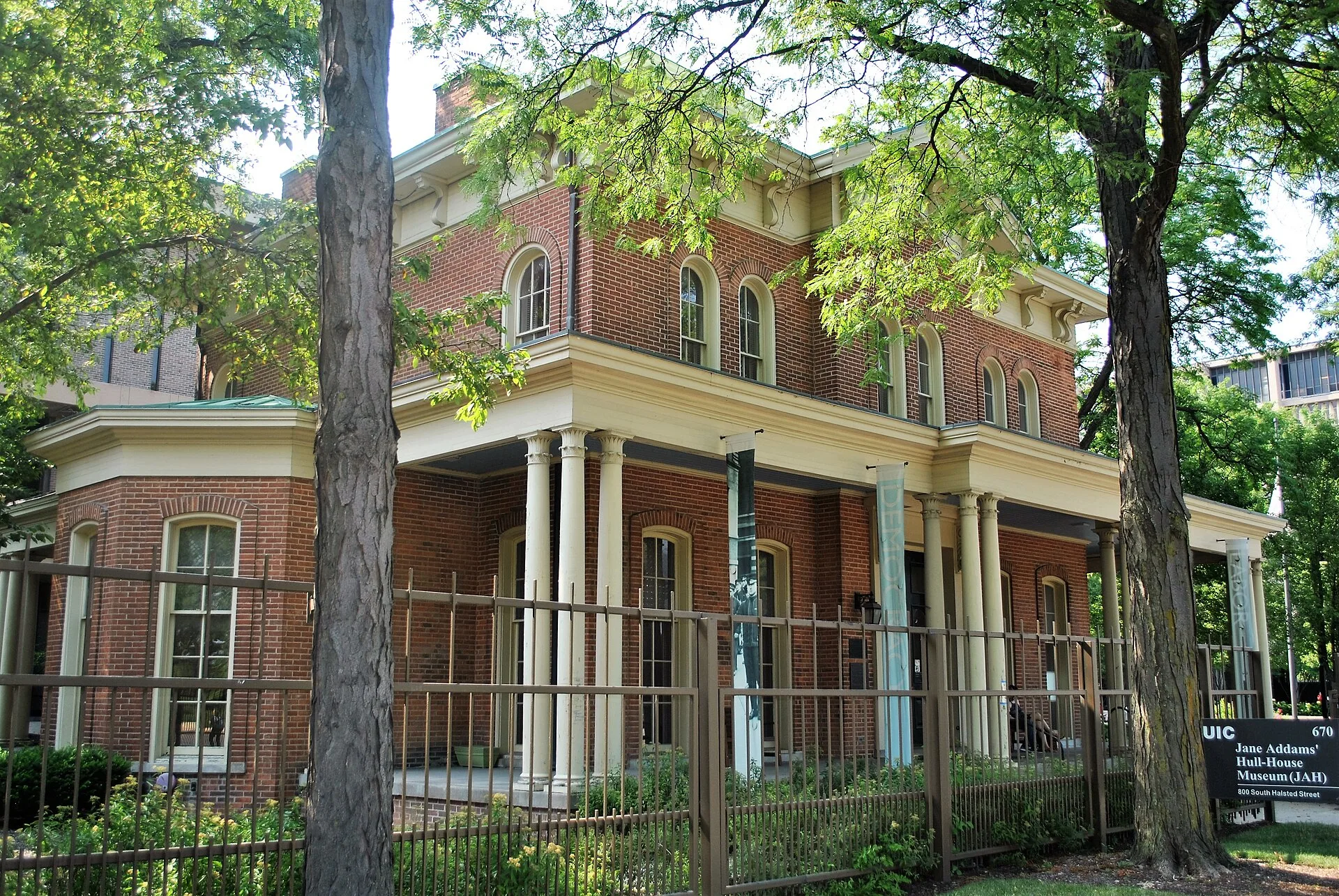
Hull House at 800 South Halsted Street, Chicago, is the mansion where Jane Addams and Ellen Gates Starr opened their settlement house in 1889, the first and most famous in America. On the city’s ghost tours it is also a haunted house with a lady in white on the stairs and a baby with horns in the attic. Addams wrote about both herself, and what she wrote is the best evidence in the case.
What happened
Charles J. Hull, a real estate dealer, built the brick Italianate house in 1856, when Halsted Street was on the edge of the city and fashionable. His wife died in the house in 1860, and he moved out in 1868. The Great Fire of 1871 passed it by, but the district filled with immigrants, the house was let out as rooms, and the neighborhood became the crowded, poor Nineteenth Ward. On September 18, 1889, Addams, Starr and their housekeeper Mary Keyser moved into the second floor, and the following spring Hull’s cousin and heir, Helen Culver, gave them a free leasehold of the whole house. By 1907 the settlement had grown to thirteen buildings around it.
Addams recorded the house’s first ghost in her 1910 memoir Twenty Years at Hull-House. When she arrived, she wrote, the house had a half-serious reputation for a haunted attic, respected enough by the second-floor tenants that they kept a large pitcher of water on the attic stairs, which she took to be a survival of the belief that a ghost cannot cross running water, while admitting her eagerness for folklore might be coloring the reading. Later accounts from the settlement add that the ghost was Mrs. Hull, that Addams slept in the room where she had died and saw something there more than once, and that she moved to another room without closing the first; guests who slept in it reported a restless night and sometimes a woman in white. Addams never described the figure herself.
The Devil Baby
The second story broke in the autumn of 1913. Three Italian women pushed into Hull House one morning demanding to see the Devil Baby, and would not believe the residents who said there was none. Over the next six weeks thousands of people came, from the ward, the city and the suburbs, at all hours, and the settlement’s ordinary work ground to a halt. The story they had heard was that a child had been born in the neighborhood with horns, a tail, cloven hoofs and the power of speech, and that the women of Hull House had taken it in and locked it in the attic. In the Italian version a pious girl had married an atheist who tore a holy picture from the bedroom wall, and the devil had entered the child she was carrying; the baby was born talking, cursed its father, and escaped from the priest’s arms at its baptism. In the Jewish version a father of six daughters said he would rather have a devil than a seventh girl, and got one. The newspapers picked the story up only in its fifth week, by which time it had traveled entirely by word of mouth.
Addams wrote it up twice, in a short note for the American Journal of Sociology in July 1914 and at length in the Atlantic Monthly for October 1916, and again in her book The Long Road of Woman’s Memory the same year. She denied the baby flatly and was more interested in why the old women of the ward wanted it so badly. They came, she found, because the story vindicated them: it punished a husband who scorned his wife’s religion, it warned daughters away from dance halls and strange men, and it let women who had spent their lives absorbing hardship speak of it openly. The Devil Baby, she argued, was a fairy tale of the kind women had always used to tame men, surfacing among people who got their news from each other rather than from print.
The investigation
The settlement’s own records are the investigation. No child was ever produced, no mother identified, and no one who came to see the baby had seen it; everyone had heard from someone else. Addams treated the rumor as data about her neighbors, and the Jane Addams Papers at Ramapo College and the Hull-House Museum, which now occupies the mansion, present it the same way, as stories about the ward rather than evidence of anything in the attic.
The explanations
Most of the settlement was demolished in 1963 for the University of Illinois campus; the mansion and the dining hall, moved about 200 yards, were kept and opened as a museum, and the house was made a National Historic Landmark in 1965. The commercial ghost tours that stop outside it carry the lady in white, the water pitcher and the Devil Baby in the attic. What the record supports is thinner: tenants with a superstition, a settlement founder who found their superstition interesting, and a rumor she showed to be false while it was still running.
Where it stands
The Devil Baby never existed; Addams said so in 1913 and spent three years explaining why people needed it. The woman in white rests on house tradition and on Addams’s own willingness to record a tale she half-believed. Hull House is as well documented as any building in Chicago; its hauntings are documented too, as folklore collected by the woman who lived there.